


No More Hissy Fits: The
“Cat Burrito”
Drying Hack
You Need to Know
by Misty Gieczys
Photos provided by Misty Gieczys
An illustration of a black and white dog with pointed ears and a happy expression, wrapped tightly in a light brown, tortilla-like blanket. The top of its head, including the ears, is visible, and it is wearing a collar with green and red accents.
In a busy grooming salon, efficiency and animal welfare are paramount. The drying phase of cat grooming, however, often triggers stress in feline clients. Cats instinctively seek secure, enclosed spaces when feeling vulnerable—a natural behavior that traditional drying methods don’t always accommodate. This can lead to prolonged appointments, a diminished experience for the cat, and potential safety risks for both animal and groomer.

But what if a drying technique could align with this innate feline desire for comfort and security? The “cat burrito” method, utilizing a strategic three-towel system, does precisely that. It offers a practical solution to significantly reduce drying time and feline distress by creating a calming, cocoon-like environment, transforming a challenging step into a more controlled and positive experience for your feline clients.

The success of the cat burrito technique begins with the proper setup of your drying station. You will need three towels, which should be clean, dry, absorbent and appropriately sized for the cat you are about to groom.

An illustration of a black and white dog with pointed ears and a happy expression, wrapped tightly in a light brown, tortilla-like blanket. The top of its head, including the ears, is visible, and it is wearing a collar with green and red accents.
In a busy grooming salon, efficiency and animal welfare are paramount. The drying phase of cat grooming, however, often triggers stress in feline clients. Cats instinctively seek secure, enclosed spaces when feeling vulnerable—a natural behavior that traditional drying methods don’t always accommodate. This can lead to prolonged appointments, a diminished experience for the cat, and potential safety risks for both animal and groomer.

But what if a drying technique could align with this innate feline desire for comfort and security? The “cat burrito” method, utilizing a strategic three-towel system, does precisely that. It offers a practical solution to significantly reduce drying time and feline distress by creating a calming, cocoon-like environment, transforming a challenging step into a more controlled and positive experience for your feline clients.

The success of the cat burrito technique begins with the proper setup of your drying station. You will need three towels, which should be clean, dry, absorbent and appropriately sized for the cat you are about to groom.

A white towel is laid flat on a dark-colored, rectangular surface. The surface appears to be a grooming table.
Fig. 1) Lay your first towel (white) out flat, orienting it lengthways along your grooming table. Ensure it covers a significant portion of the table’s length, providing a comfortable and secure base for the subsequent layers and, most importantly, for the cat.
A gray towel is laid horizontally across the middle of a white towel on a dark surface. The white towel is on a bright blue surface.
Fig. 2) With your foundation towel in place, you’ll now lay out the second towel (gray) flat across the approximate center of the first towel, running perpendicular to it. The two towels should now form a clear plus-sign shape (+).
A brown towel is laid flat on top of a gray towel, which is on a light-colored surface. The brown towel is slightly off-center and has small specks of white visible on it.
Fig. 3) Take your third towel (brown) and lay it directly on top of the existing two, aligning it lengthways, parallel with towel number one and the orientation of your grooming table. The third towel will complete the layered structure designed to maximize moisture absorption and create a snug enclosure for the cat.
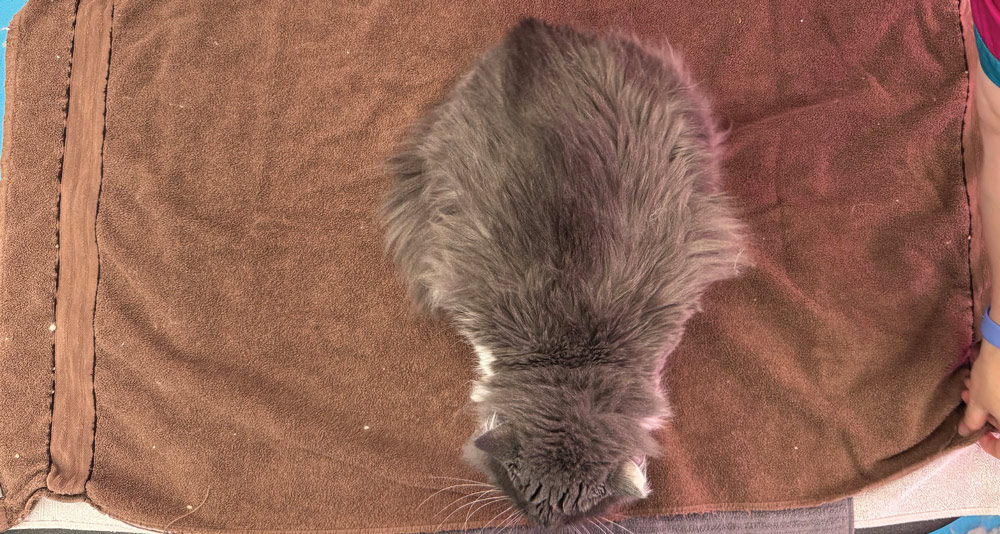
A fluffy, gray and white cat is positioned in the center of a brown towel. The cat is facing away from the camera.
Fig. 4) With your towel layers perfectly arranged, gently but securely place the freshly bathed, damp cat in the center with its head is facing away from you. This orientation can help in maintaining control and may reduce stress for the cat as you begin the wrapping process. Ensure the cat is settled before you proceed to enclose it in the burrito.
A person's hand rests on a gray towel. A brown towel is being folded over from the right side, covering a cat that is not visible in this frame.
Fig. 5) With your left hand maintaining gentle but firm contact on the cat’s shoulders for stability, take the right side of towel number three and smoothly draw this portion over the cat’s body.
A person's hand is shown, tucking a brown towel around an object on a gray towel. The brown towel is being folded to create a tight wrap.
Fig. 6) Immediately following the previous step, take the left side of towel number three and lay it firmly over the first flap, completely yet comfortably enveloping the cat’s body.

Once the cat’s body is securely wrapped, remove your stabilizing from underneath the towel and place it back onto the cat’s shoulder area, resting firmly on top of towel number three to hold the initial burrito closed.
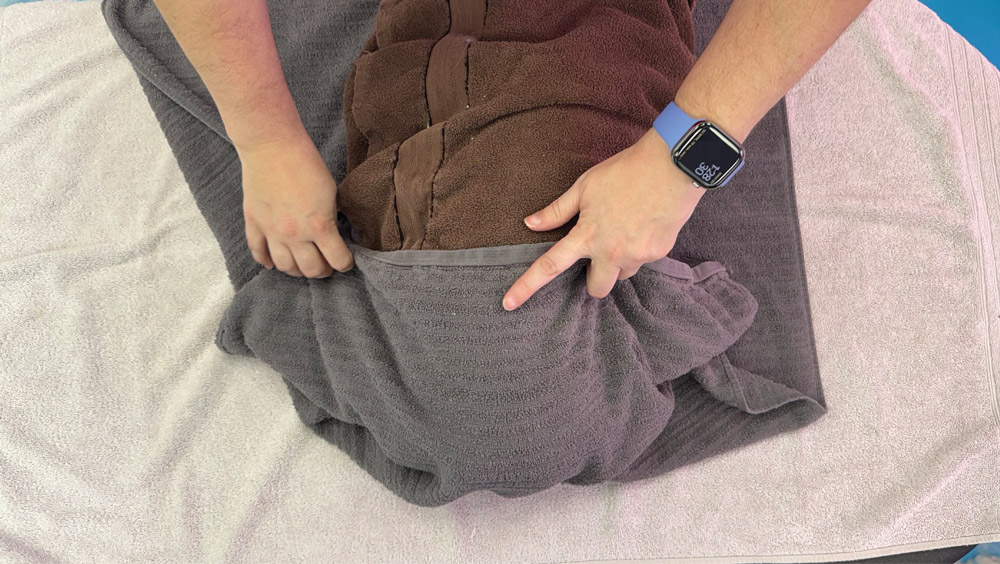
A person's hands are shown, with one hand holding and folding a gray towel over a brown towel. The person is wearing a blue smart watch on their left wrist.
Fig. 7) Now take the end of towel number two that is nearest to the cat’s head and gently draw it up and over the cat’s head, providing a loose, comforting hood.
A person's hands are shown, with one hand resting on a gray towel wrapped around an unseen subject. The person's other hand is out of frame, but the arm is visible, showing a blue smart watch on the wrist.
Fig. 8) Take the remaining portion of towel number two and gently draw this end up and over the cat’s hindquarters and tail. This step fully encapsulates the cat, preventing them from escaping forward or backward.
A person's hands are shown, with one hand pressing down on a white towel. The other hand is holding a dark gray towel that is being folded over the white towel. A small brown stain is visible on the white towel.
Fig. 9) Keeping your left hand firmly on top of the already wrapped cat, use your right hand to draw the right side of towel number one up and snugly over the existing towel layers, similar to how you began wrapping with towel number three.
A person's two hands are shown resting on a white, tightly wrapped towel. The towel covers an object that is not visible, and the background is a dark, solid surface.
Fig. 10) With one hand still placed on top of the cat, use your other hand to bring the left side of towel number one up and firmly over the cat, overlapping the portion brought over in the previous step. The cat should now be snugly and securely encased in all three towels.
A person's arms are shown holding a tightly wrapped, white towel. The person is wearing a blue smart watch on their left wrist.
Fig. 11) Carefully lift the entire burrito, ensuring the cat’s head is kept in a comfortable, upright position. Apply gentle, even pressure by squeezing systematically down the length of the cat’s body.

This entire hands-on absorption process should only take a few minutes. It is critical to remember that the cat is never left unattended while wrapped and must not be placed in an enclosure during this active drying stage.

Gently place the cat back onto the grooming table, and while the cat is still fully enclosed to benefit from the sound muffling, begin to introduce the dryer. Turn your dryer on at a safe distance, allowing the cat to acclimate to the noise.
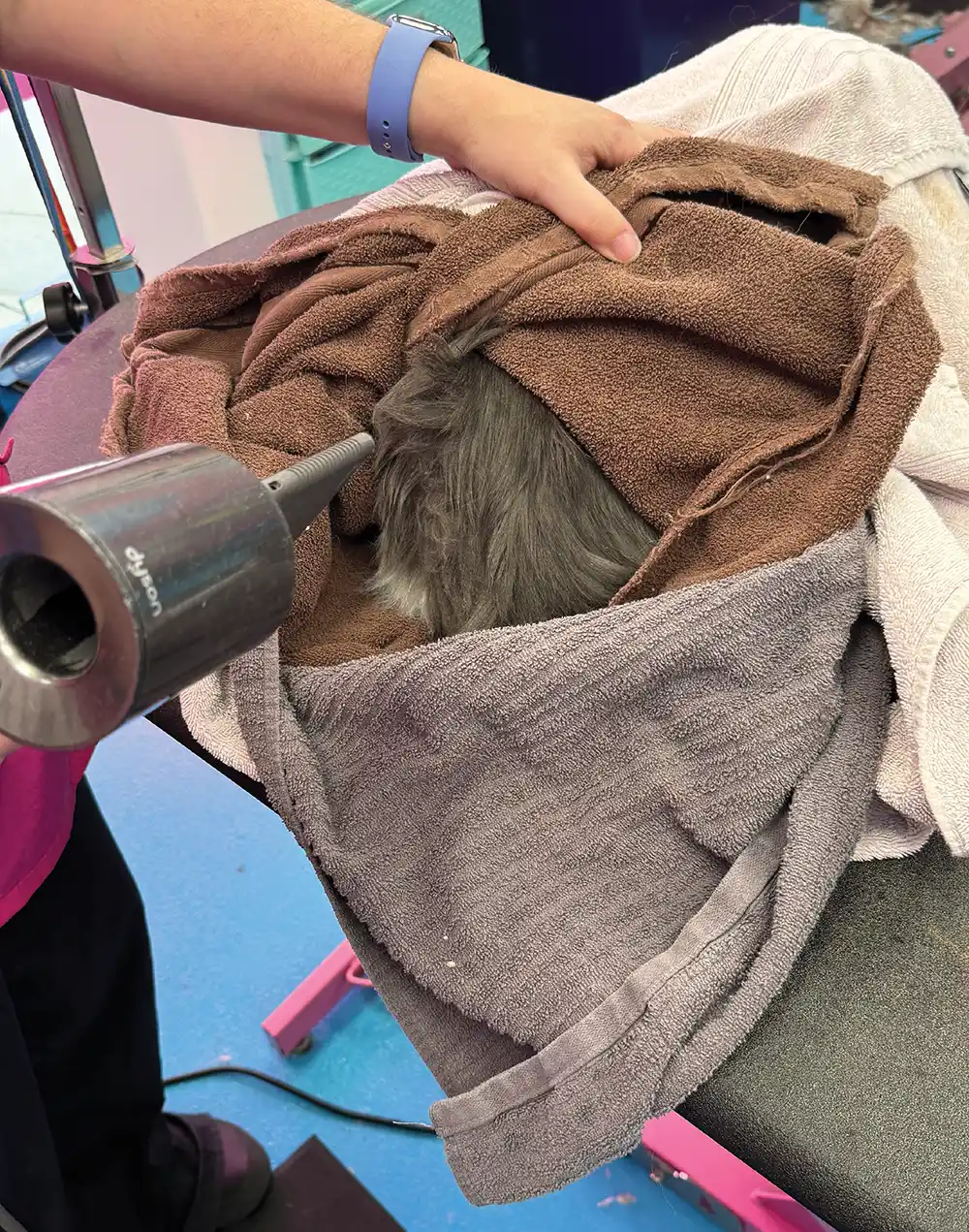
A person's hands are shown holding and adjusting brown and gray towels that are wrapped around a gray cat. The person is using a gray handheld hair dryer to dry the cat's fur. The person's left hand has a blue smart watch on the wrist.
Fig. 12) Once the cat appears relatively calm with the sound, you can then carefully begin to peel away the towel layers at the rear of the cat, creating an opening for drying.

For particularly noise-sensitive or “spicy” cats, consider placing a Happy Hoodie on the cat before creating the burrito for additional sound reduction. However, the dryer should still be introduced in the same manner.

Proceed to dry the cat primarily through this rear opening in the burrito. When the cat indicates it’s ready to emerge, remove the two outermost towels, leaving the cat resting on the last towel.

Be aware that cats may urinate during the drying process, especially when the rear is being dried; the remaining towel serves as a crucial barrier to absorb this, preventing the need for a re-bath.

Adopting this three-layer burrito method can make a real difference in your grooming routine, leading to smoother sessions and calmer cats, so you can say goodbye to hissy fits and hello to fur-tastic finishes!