

 n the animal industry, we strive to do what is best for the pets in our care. But could we unknowingly be doing or not doing something that could cause harm?
The obvious first thing we think about is if the pet is safe in the salon (on the table, in the tub, etc.). Through tragedies over the years, our techniques and our attentiveness to pet care have been heightened. We have gotten away from restraints that were not quick-release. We have exchanged neck restraints for ones that go under the legs. We also monitor them more closely when they are in the tub or on the table, rather than walking away, as was more common in the past.
But what about some of the safety issues that are not as obvious? What is your policy for vaccinations? Do you require the Bordetella vaccine? How about the dog flu vaccine? I hear many groomers say it is not their job to ensure pets are vaccinated; that is a veterinarian’s job. And while that is true, as a salon owner, your responsibility is to stay in business.
I have gotten many calls from salons that have had an outbreak of “kennel cough” (Bordetella) or dog flu, and the groomer was scared of the ramifications. This is especially concerning when some of your clients’ dogs develop illness after grooming. My answer is always to have a good policy in place so that, from a risk management perspective, you have done your due diligence and taken adequate precautions to prevent dogs from getting sick.
Your next precautionary step should be to clean/disinfect—everything, constantly—throughout the day. We have all gone through COVID, so everyone (us and our clients) are super sensitized to the drill.

Cleaning and disinfecting are critical processes that so many don’t understand. Cleaning is meant to remove organic material. By doing this, we use the principle that the solution to pollution is dilution. We reduce the levels of bacteria, viruses and fungi, which is usually accomplished by using a detergent.
Disinfecting is the second process in which we use a product designed to destroy or kill the organisms. There are many types of disinfectants, so it is essential to know the product you are using and whether it is made for the organisms you are trying to kill, as well as how long the contact time must be to accomplish that.
Many people believe vinegar is a good disinfectant. It is not. It has a minimal range of what it can kill, and it may take up to 30 minutes of contact time to accomplish it. If we are not cleaning properly, we could be the source of the spread of organisms and disease.
Another area that sometimes gets overlooked is preventing the spread of organisms and parasites to other animals, including humans. This is critical if you are taking on animals that may be carrying anything contagious. Don’t assume that just by looking at an animal you can tell whether it is infectious.

Here are some suggestions to help prevent the spread of disease:





I’ve heard many groomers say, “I have been doing this for 20 years and never had a problem.” But the question is, would you actually know if it was you that created the problem? And if it was apparent, with this day and age of social media, you could die a quick business death if the chatter on Facebook was all your clients remarking that their dog got a disease in your salon.
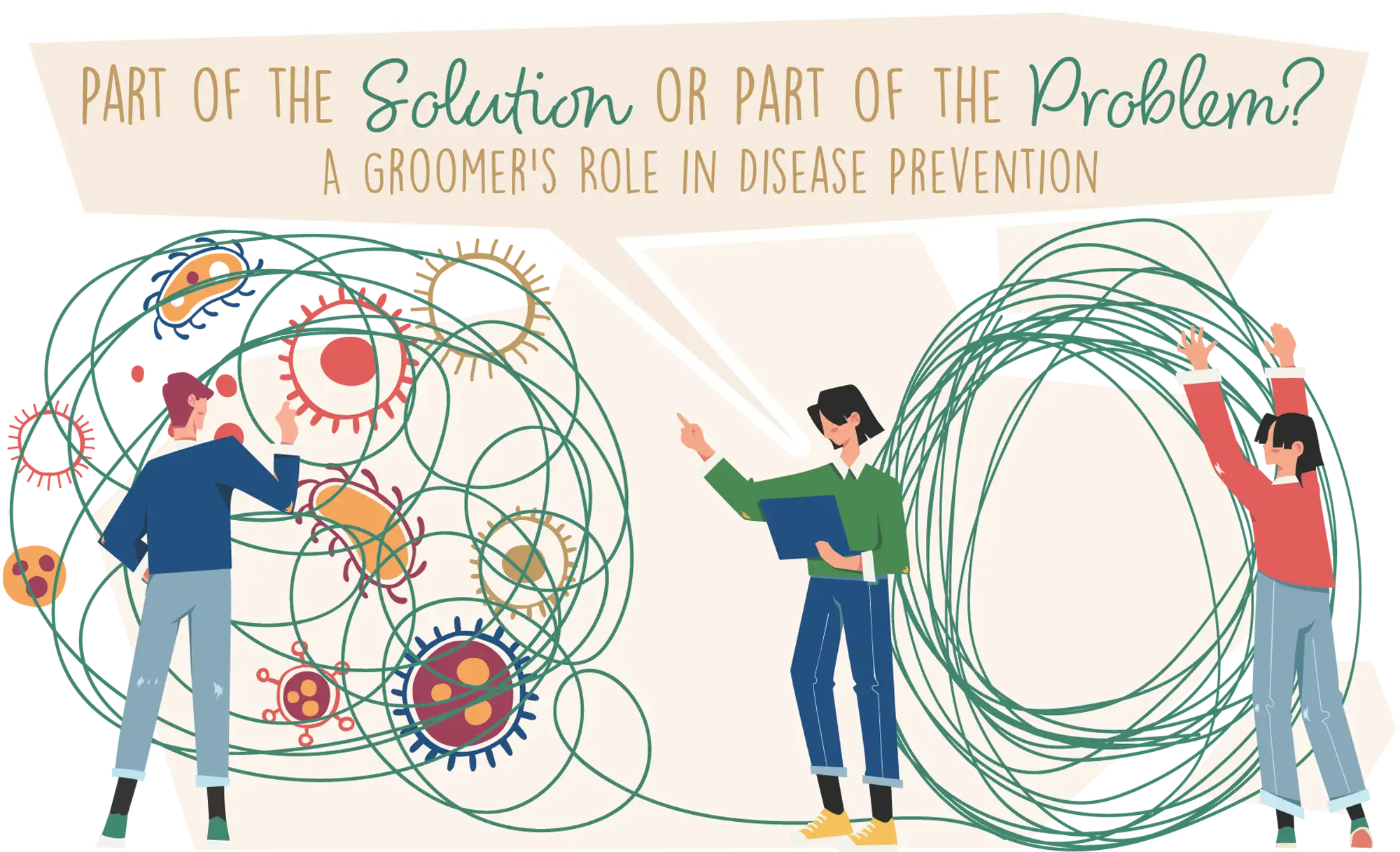
Be part of the solution, not part of the problem. Have a good vaccine protocol in place and follow an aggressive cleaning/disinfecting schedule to offer the best protection for the pets in your care.
Dr. Cliff Faver graduated with a BS in Biology/BA in Chemistry before getting a Veterinary degree in 1987. He is the past owner of Animal Health Services in Cave Creek, Arizona and now the US distributor for Iv San Bernard products, teaches the ISB Pet Aesthetician Certification program, and speaks internationally on hair and skin. His passion is to merge groomers and veterinarians to aid in helping and healing pets. He is also a member of AVMA, AAHA, AZVMA, Board member with Burbank Kennel Club, and has served on Novartis Lead Committee, Hill’s International Global Veterinary Board, and a Veterinary Management Group.