







Contents | February 2026
6
by Dr. Cliff Faver
48
by Blake Hernandez
ALSO INSIDE
todd@barkleigh.com
adam@barkleigh.com
gwen@barkleigh.com
rebecca@barkleigh.com
luke@barkleigh.com
laura@barkleigh.com
brandi@barkleigh.com
carlee@barkleigh.com
evan@barkleigh.com
allison@barkleigh.com
james@barkleigh.com
karin@barkleigh.com
christina@barkleigh.com
Daryl Conner
Lynn Paolillo
Amanda McGrath
Jennifer Bishop Jenkins
Blake Hernandez
ALSO INSIDE
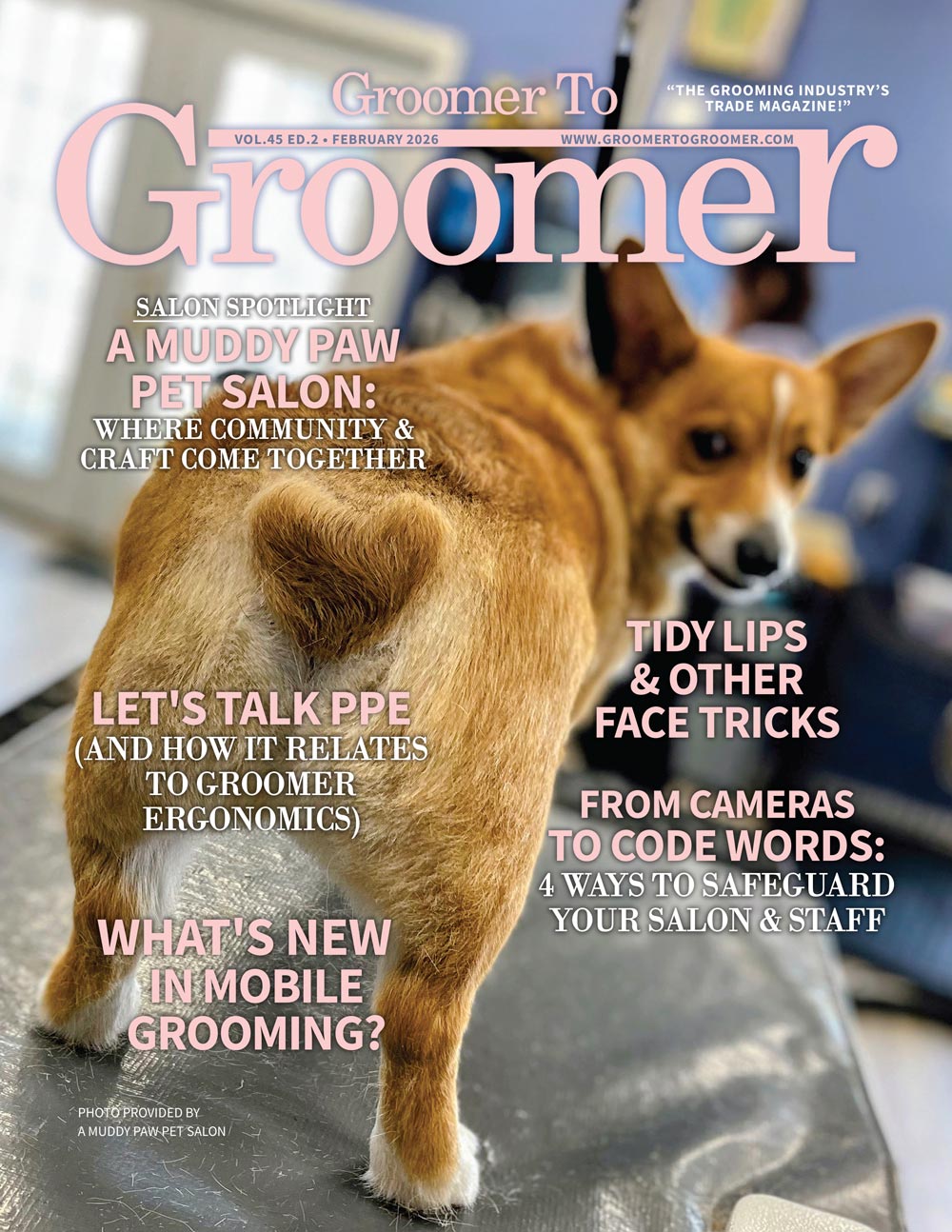
ON THE COVER
- Andis2
- Animal Photography10
- Bandanas Unlimited46
- Barkleigh Store – The Pet Stylist Resource Guide35
- Barkleigh Store – Release Forms45
- Best Shot Pet – 3 Step System9
- Best Shot Pet – Scentament Spa41
- Cosmos Bathing Systems42
- Direct Animal Products13
- Electric Cleaner Company46
- Envirogroom | Special FX Premium Products53
- Evolution Shears18
- Friedman Tax39
- Governor Insurance AgencyDigital
- Groom Expo West3
- Groomer’s Choice4
- Groomsoft37
- Hanvey Engineering & Design27
- IV San Bernard | Pet Skin Academy11
- John Stazko38
- Laube55
- Mobile Grooming World31
- Odorcide49
- Paragon School of Pet Grooming17
- Paw Brothers | Ryan’s Pet Supply56
- Pet Boarding and Daycare Expo West47
- Pet Boarding and Daycare Expo West51
- PetBizInsurance.com19
- Poly Pet Tubs34
- Puppy Playground30
- Quadruped Pet Care43
- Ryan’s Pet Supplies | Leading Edge Grooming AcademyDigital Only
- Stone Mountain Pet Products7
- SuperZooDigital
- Tidy PawsDigital
- UGroom Mobile Conversions28
- Wag’n Tails29
- Wags Supply15
Featured Spotlight Profile
Midmark






















 n the animal industry, we strive to do what is best for the pets in our care. But could we unknowingly be doing or not doing something that could cause harm?
The obvious first thing we think about is if the pet is safe in the salon (on the table, in the tub, etc.). Through tragedies over the years, our techniques and our attentiveness to pet care have been heightened. We have gotten away from restraints that were not quick-release. We have exchanged neck restraints for ones that go under the legs. We also monitor them more closely when they are in the tub or on the table, rather than walking away, as was more common in the past.
But what about some of the safety issues that are not as obvious? What is your policy for vaccinations? Do you require the Bordetella vaccine? How about the dog flu vaccine? I hear many groomers say it is not their job to ensure pets are vaccinated; that is a veterinarian’s job. And while that is true, as a salon owner, your responsibility is to stay in business.
I have gotten many calls from salons that have had an outbreak of “kennel cough” (Bordetella) or dog flu, and the groomer was scared of the ramifications. This is especially concerning when some of your clients’ dogs develop illness after grooming. My answer is always to have a good policy in place so that, from a risk management perspective, you have done your due diligence and taken adequate precautions to prevent dogs from getting sick.
Your next precautionary step should be to clean/disinfect—everything, constantly—throughout the day. We have all gone through COVID, so everyone (us and our clients) are super sensitized to the drill.
Cleaning and disinfecting are critical processes that so many don’t understand. Cleaning is meant to remove organic material. By doing this, we use the principle that the solution to pollution is dilution. We reduce the levels of bacteria, viruses and fungi, which is usually accomplished by using a detergent.
Disinfecting is the second process in which we use a product designed to destroy or kill the organisms. There are many types of disinfectants, so it is essential to know the product you are using and whether it is made for the organisms you are trying to kill, as well as how long the contact time must be to accomplish that.
Many people believe vinegar is a good disinfectant. It is not. It has a minimal range of what it can kill, and it may take up to 30 minutes of contact time to accomplish it. If we are not cleaning properly, we could be the source of the spread of organisms and disease.
Another area that sometimes gets overlooked is preventing the spread of organisms and parasites to other animals, including humans. This is critical if you are taking on animals that may be carrying anything contagious. Don’t assume that just by looking at an animal you can tell whether it is infectious.
Here are some suggestions to help prevent the spread of disease:





I’ve heard many groomers say, “I have been doing this for 20 years and never had a problem.” But the question is, would you actually know if it was you that created the problem? And if it was apparent, with this day and age of social media, you could die a quick business death if the chatter on Facebook was all your clients remarking that their dog got a disease in your salon.
Be part of the solution, not part of the problem. Have a good vaccine protocol in place and follow an aggressive cleaning/disinfecting schedule to offer the best protection for the pets in your care.
Dr. Cliff Faver graduated with a BS in Biology/BA in Chemistry before getting a Veterinary degree in 1987. He is the past owner of Animal Health Services in Cave Creek, Arizona and now the US distributor for Iv San Bernard products, teaches the ISB Pet Aesthetician Certification program, and speaks internationally on hair and skin. His passion is to merge groomers and veterinarians to aid in helping and healing pets. He is also a member of AVMA, AAHA, AZVMA, Board member with Burbank Kennel Club, and has served on Novartis Lead Committee, Hill’s International Global Veterinary Board, and a Veterinary Management Group.


Photos provided by Daryl Conner
 rooming dogs with fuzzy faces is fun, but it comes with some challenges. One of the biggest is what to do about the fur that curls under the lip line. These clumps of hair get wet, stained and smelly, and can even irritate the dog’s gums, leading to dental problems.
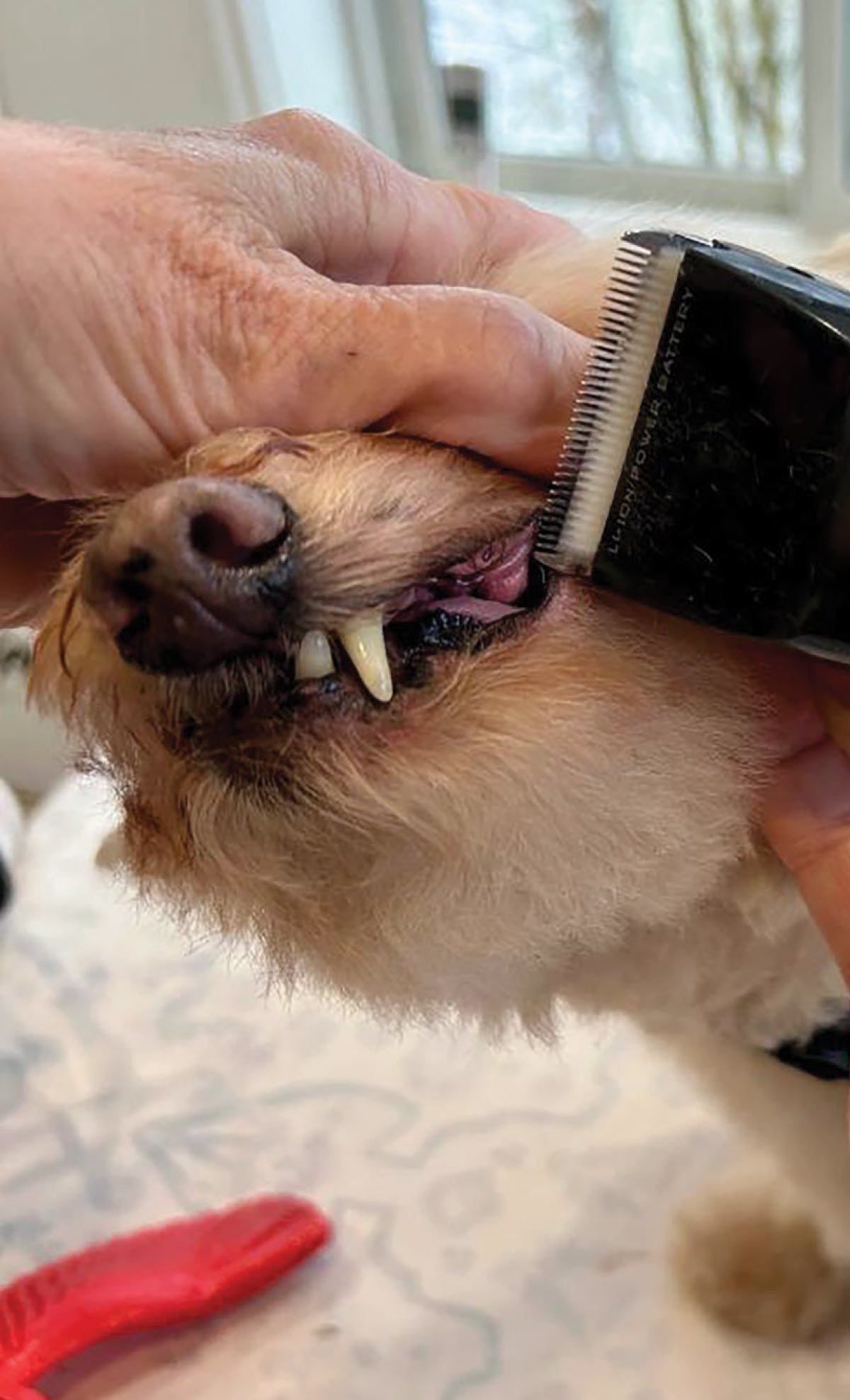
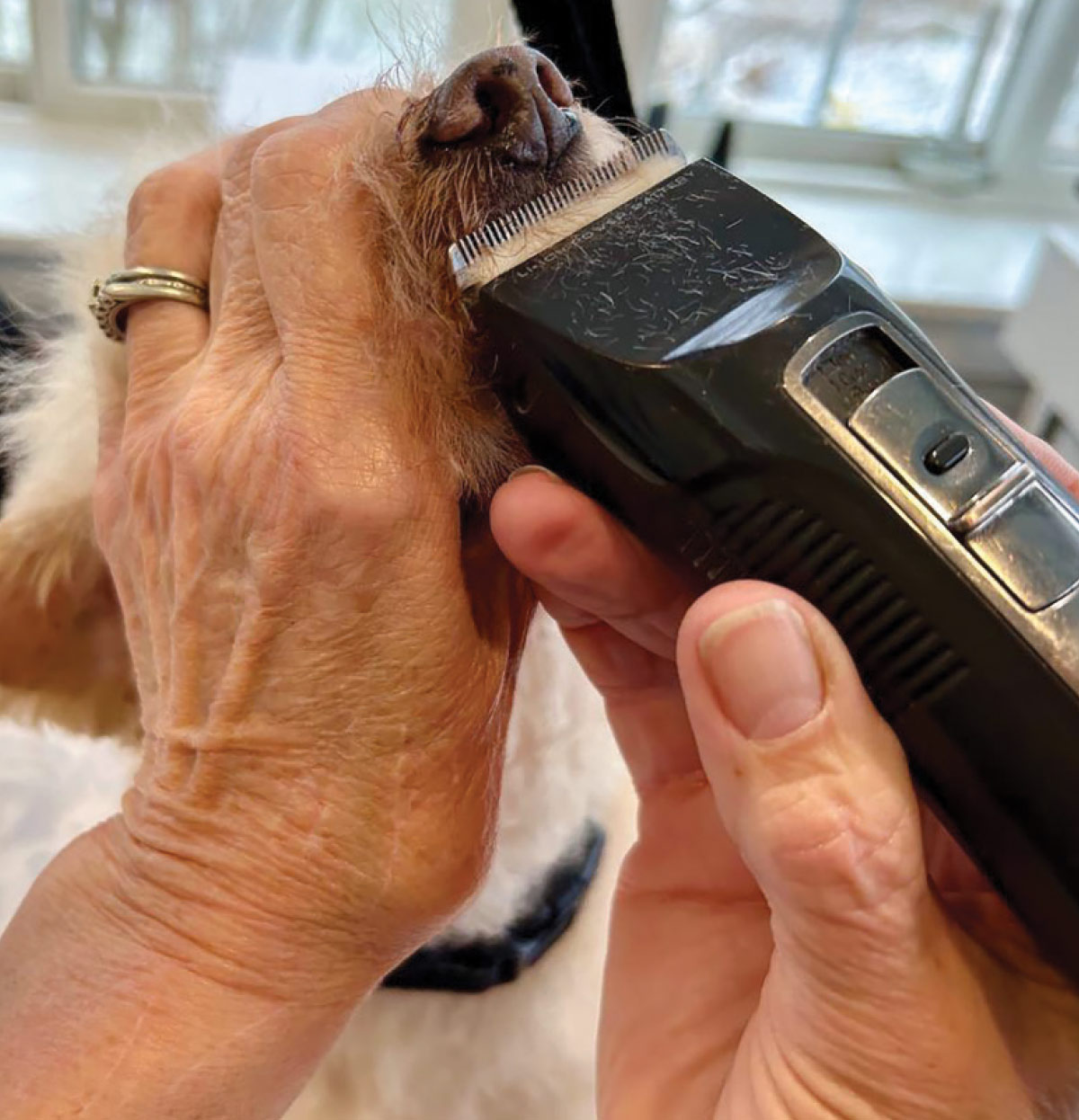
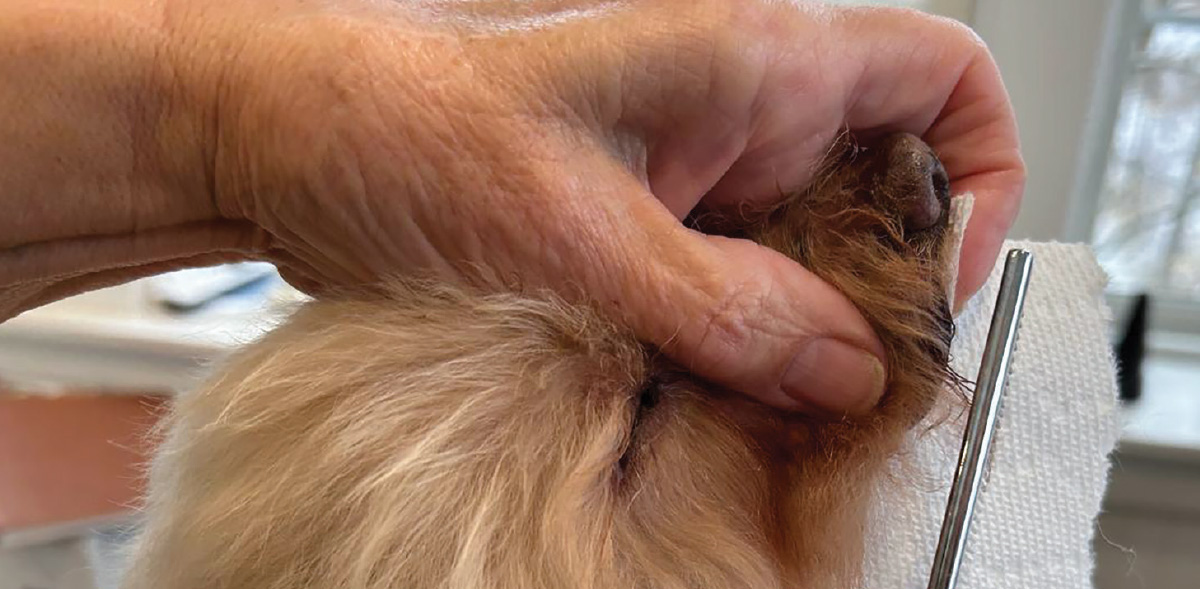
Working on a clean, dry face, brush or comb the fur on the face back towards the ears. Look for hair that is obviously discolored from exposure to the mouth and saliva and keep it separate. Holding the fur you want to keep with one hand, gently comb the damp bits that you want to remove forward. Next, use your trimmer, clipping from the corner of the mouth towards the nose (Fig. 1).
On many dogs, the hairs that grow under the nose are prone to growing under the lip and rubbing against the gums. Depending on the dog, I often clip this area very closely, about the width of the nostrils, leaving a smooth space between the nose pad and the upper lip. Some groomers call this look “kissy lips,” and it is tidy and quite cute on most dogs (Fig. 2).
Lip trimming can be particularly tricky on dogs that are missing teeth or have overly long tongues. Groomer Tina Patrick recently shared an absolutely brilliant tip in a groomer group on Facebook: Place a small section of paper towel under the gum, comb the wet hairs down, and then trim them. You can even place the paper towel right on the tongue if necessary. The paper towel protects the delicate tongue and gums and provides a clear view of the hair we want to cut (Fig. 3).
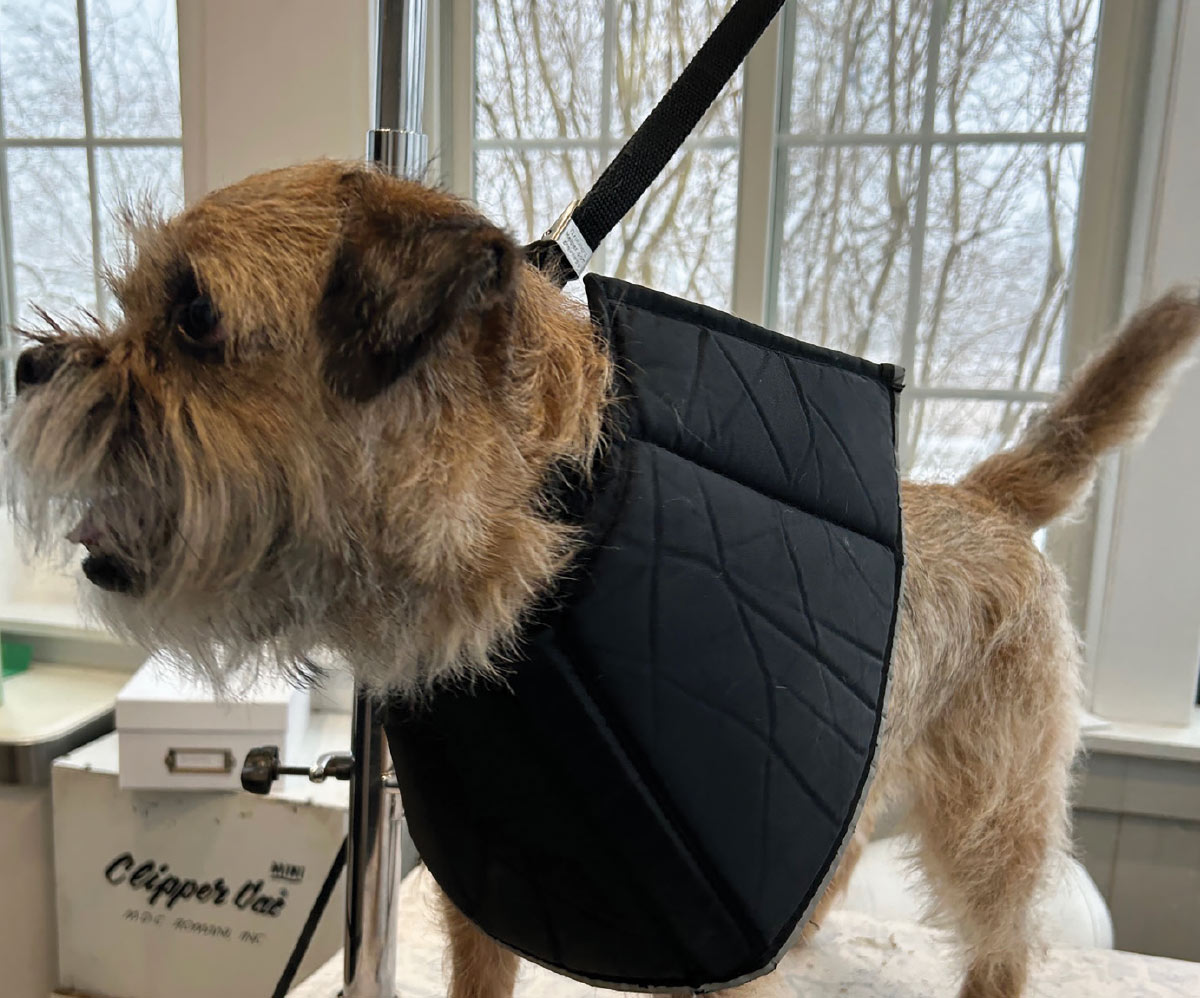
Here is another dandy tip that your skin will thank you for knowing: For those dogs that use their front legs to grab around your hands while you are grooming their heads, get out your Elizabethan collar (also known as a cone collar) and put it on the dog upside down. The collar will reduce the pet’s ability to use their front legs to scratch at your hands and arms while you are working, allowing you to finish the parts the dog dislikes more quickly (Fig. 4).
Lastly, let’s talk about drooly dogs—specifically the ones with fluffy faces you are trying to dry, brush and trim. Hold a folded-up paper towel or a small microfiber cloth in the hand you use to hold the face. It will absorb a lot of the saliva, leaving the fur dryer and easier to work on, and preventing saliva from getting all over you and the table.
Making furry faces adorable is a big part of our job. Incorporating handy tips like these will make your work easier and help you achieve great results.



by Jennifer Bishop Jenkins
 very one of us must learn the universal “rules of the road” when we first take our driver’s tests as teens and earn that all important driver’s license. We come to know that a red octagonal sign means to STOP, a yellow triangular sign means to YIELD and a traffic light that is green means GO.
Similarly, this is true for our relationship with dogs. There are eight commands that are universally taught in every basic obedience class, everywhere, to all dogs fortunate enough to go through those classes with caring owners. These are the universal rules of the road for dogs. The commands are: Heel, Sit, Stay, Stand, Down, Come, Off, Leave It.
There is a lot more to grooming safely than just knowing basic training commands, but communicating with our beloved dog clients is a foundationally important aspect. And it starts with clear communication done in ways that we can quickly, correctly, and easily engage with this whole other species in an effective and consistent way.
Individual, private professional trainers can be good, but they can also be all over the map, and even be problematic. Some pride themselves on developing their own individual or uniquely branded commands and techniques.
Another added benefit to taking an obedience class with your local kennel club is that you will meet lots of local dog people who will be thrilled to see a local professional groomer there learning about obedience training, and could even gain you some new clients. Of course, you will have to have a dog that you can take through these classes and practice with for a few minutes daily for the typically eight weeks of classes.

- HEEL: This is where the dog is walking on your left side, with their neck area aligned approximately to your left leg.
- SIT: This is the easiest command in the world for all dogs, and such a natural behavior.
- STAY: Usually given when the dog it sitting or lying down, this means don’t move from that spot until a release word is given.
- STAND: Meaning to stand on all four legs, preferably still, this is a very useful command for dogs on a grooming table.
- DOWN: This command means lie down, not get down if they are jumping up—that is the OFF command.
- COME: While not often used in a salon setting, where dogs are either crated or on a leash, it should still be practiced for reinforcement since responding to this command is paramount to a dog’s safety.
- OFF: This means do not jump up on me or can be used any time a dog is getting up on something they should not.
- LEAVE IT: This means drop something that’s in your mouth or don’t touch that thing that you’re showing interest in that we do not want them to.


Use these commands all the time with every dog, every time. Say their name and the command clearly, simply and authoritatively in a firm but friendly tone. And with each successful completion of the command, praise them!
There may be some exceptions such as very senior or disabled dogs that physically cannot accomplish the skill. You can allow physical adaptations that approximate what you want in these cases.
Puppies will not yet have the brain power for perfect compliance until after they are at least six months of age. While you still want to use the same verbal and consistent communications, you will likely be training and repeating while they are growing up so that they learn it consistently.
Every aspect of grooming will be aided by your using these commands repeatedly throughout the groom. Dogs love communicating clearly and they do really derive enjoyment from knowing what we are saying to them and responding properly to it.
If there are staff or other co-workers in a salon, make sure everyone is on the same page. If you are not the owner or manager, talk to them about the importance of using consistent obedience commands to ensure a safe foundation for a successful, happy and healthy business. When they understand that chaotic grooming areas are a danger to their businesses and bottom lines, as well as to the dogs, they should want all their staff to have this basic training knowledge.
Getting into the habit of communicating with dogs verbally in a way that is universally consistent with the rest of their lives is going to make our jobs easier and our relationships with our clients much happier and more successful. Basic training and universally used obedience language is just part of being a pet care professional, and it truly is a joy to be in real communication with a whole other species.

 very grooming salon—whether it’s a large facility or a one-person, home-based business—will face a crisis at some point. A dog may have a seizure on the table. A dryer may spark. A winter storm may cause a power outage. These aren’t hypothetical; all of this and much more could happen to you. Will you be ready when disaster strikes your salon?
A crisis doesn’t have to be chaotic when you already have systems in place. In fact, the more detailed your plan, the calmer and more confident you and your team will be when the unexpected happens. By taking some time to think through the worst-case scenarios you can:
- Protect the pets and clients that you serve
- Reduce liability
- Increase client trust
- Keep your team calm under pressure
- Create consistent responses from all staff
- Prevent small mistakes from escalating
- Build the professionalism our industry deserves
The following will cover some of the most common disasters that you should include in your crisis plan.
- What symptoms are considered an emergency
- Who makes the call to the vet or ER (include the phone numbers for the closest facilities)
- Who manages the pet
- Who communicates with clients
- Where emergency supplies are located
Training for yourself and your staff is paramount for medical disasters. The first step is knowing what constitutes an emergency and the signs and symptoms that occur. All staff should be fully trained to handle pet medical emergencies. Make this part of your staff meetings and review it regularly.
In the veterinary field, when there is an emergency, one technician or doctor is designated as the point of contact and essentially is “in charge” during the emergency. This is most often a senior or more experienced staff member. No one should wonder what to do; one team member should take charge and follow the flow sheet, assigning jobs to other team members as needed.
It is important that a laminated contact list is easily available. Time is precious during an emergency, and you don’t want your staff to be Googling phone numbers and wasting time. Your contact list should include:
- Local veterinarian
- Emergency/after-hours hospital
- Poison control
- Nearest human urgent care
Your intake paperwork for each pet should include multiple ways to reach owners as well as an emergency number if they are unreachable.
A well-stocked first aid kit should be kept in the salon, as not all animal emergencies require immediate veterinary care. However, training is essential. The last thing you want as a salon is for your team to think they can handle an emergency without veterinary care, leading to a much larger problem. Knowing what symptoms are considered an emergency and what aren’t is a skill all grooming staff should have.
Encourage or require pet CPR and first aid certification. Many groomers underestimate how much calmer they feel after hands-on training. Our industry has many pet-specific training options. Look for those near you, ideally as a hands-on course, to attend.
Emergency slip leads should be located at every station, on every table and near every exit. During emergencies, you won’t have time to search. If you are a salon that grooms cats, keep a stack of pillowcases near the kennel area. If a true emergency happens, you won’t have time to fight a cat into a carrier. Place the cat in the pillowcase, hold the top closed and get outside safely.
Role assignments should also be part of your plan. Decide ahead of time:
- Who grabs which pets
- Who checks the bathing room
- Who leads clients out
- Who calls emergency services
If you have a large team, assign roles by department: receptionists evacuate clients, groomers alert bathers, etc. Have a designated meeting point outside for all staff, and once everyone is safely out of the building, do a head count.
- Whether clients should be called for early pick-up
- How to handle partially groomed pets during extended outages
- Contact numbers for local power companies
If your facility does not have a generator or backup source of power, this plan is even more important. And remember, no power means no water if you rely on a well pump. Keep several gallons of water on hand for emergencies. This can save you from calling an owner to come get their soapy dog or from having to run to a store mid-crisis.
- Client or staff medical emergency
- Lost dog protocol
- Online slander or bad review
- Active shooter or theft
- Unclaimed pet
Once you’ve outlined all your crisis plans, put them into a binder and include the following for each:
- Step-by-step flow charts
- Emergency contact lists
- Scripts and templates
- Forms for documenting incidents
- Checklists for staff training
- Roles and responsibilities
- Maps and evacuation routes
Just like everything else in our industry, practice matters. Unexpected emergencies feel less overwhelming when your team has already rehearsed what to do. Include regular reviews of protocols in your staff meetings and do “pop-up” drills to help your staff stay sharp.

- Injury notifications
- Behavior issues
- Medical emergencies
- Equipment failures
- Unexpected service interruptions
Communication with owners during an emergency is not the time for speculation or excessive apologizing. It is often our nature to apologize profusely when something goes wrong, even if it’s not our fault. By doing this you may inadvertently start to convince the client that you were in the wrong.
Remember to document first, communicate second. This prevents inaccurate or rushed explanations and can help you prepare yourself for the conversation. Before calling the client, detailed notes should be taken as well as photos, if appropriate. Have a manager or second groomer review the facts.
When it comes to having the actual conversation, train staff in tone and language, emphasizing the following:
- Start with empathy
- State only the facts
- Explain next steps clearly
- Avoid defensiveness
- Always offer follow-up
Communication is often what determines whether a client becomes angry or appreciative. You want to state the facts, but by no means do you want to come across as cold or uncaring. Put yourself in the owner’s shoes and try to speak in a way that you would appreciate if it was your pet that something happened to.
Creating crisis management plans doesn’t mean you expect disasters to happen—it means you’re prepared if they do. Having these plans in place protects pets, reduces liability and builds trust with clients who want to know their pets are in responsible hands.
Start with one plan. Build one checklist. Create one script. Over time, you’ll develop a system that turns chaotic moments into manageable ones, and that’s the true mark of a professional grooming business.










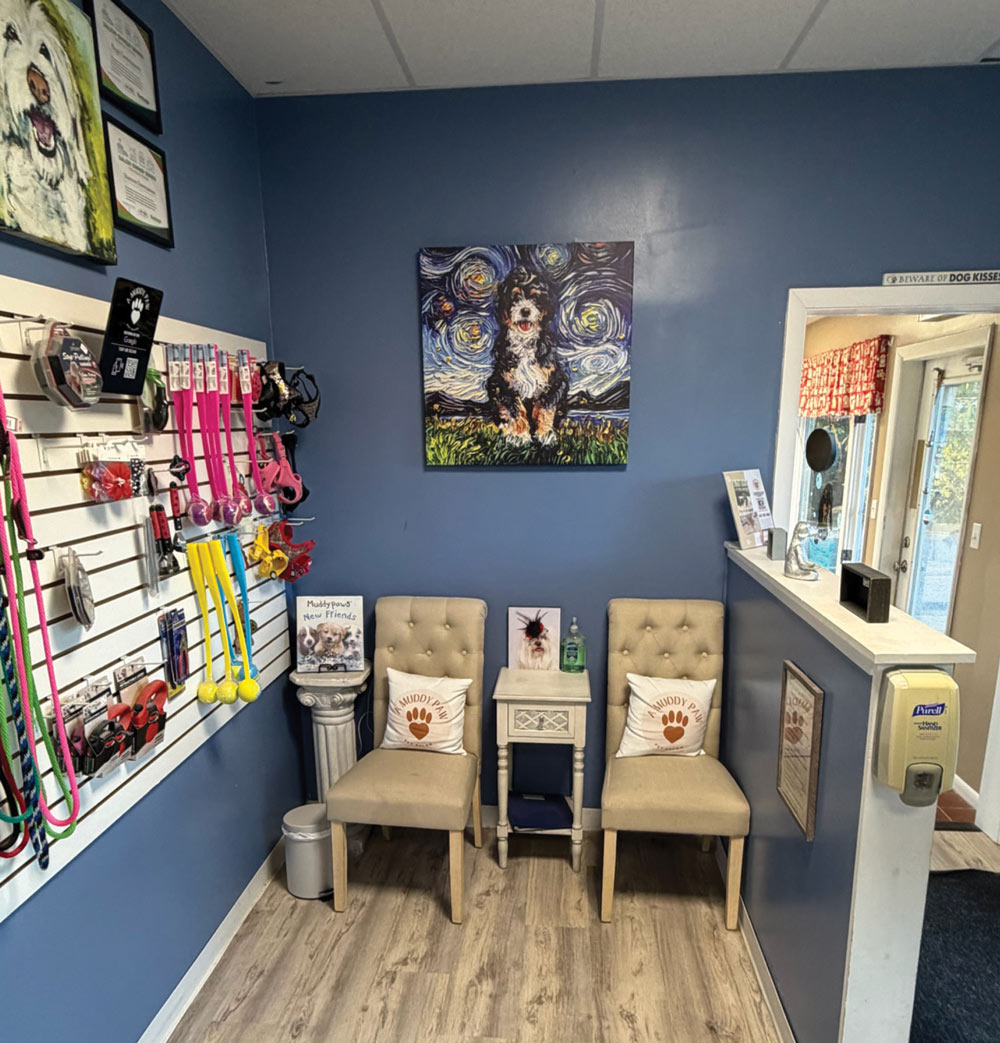


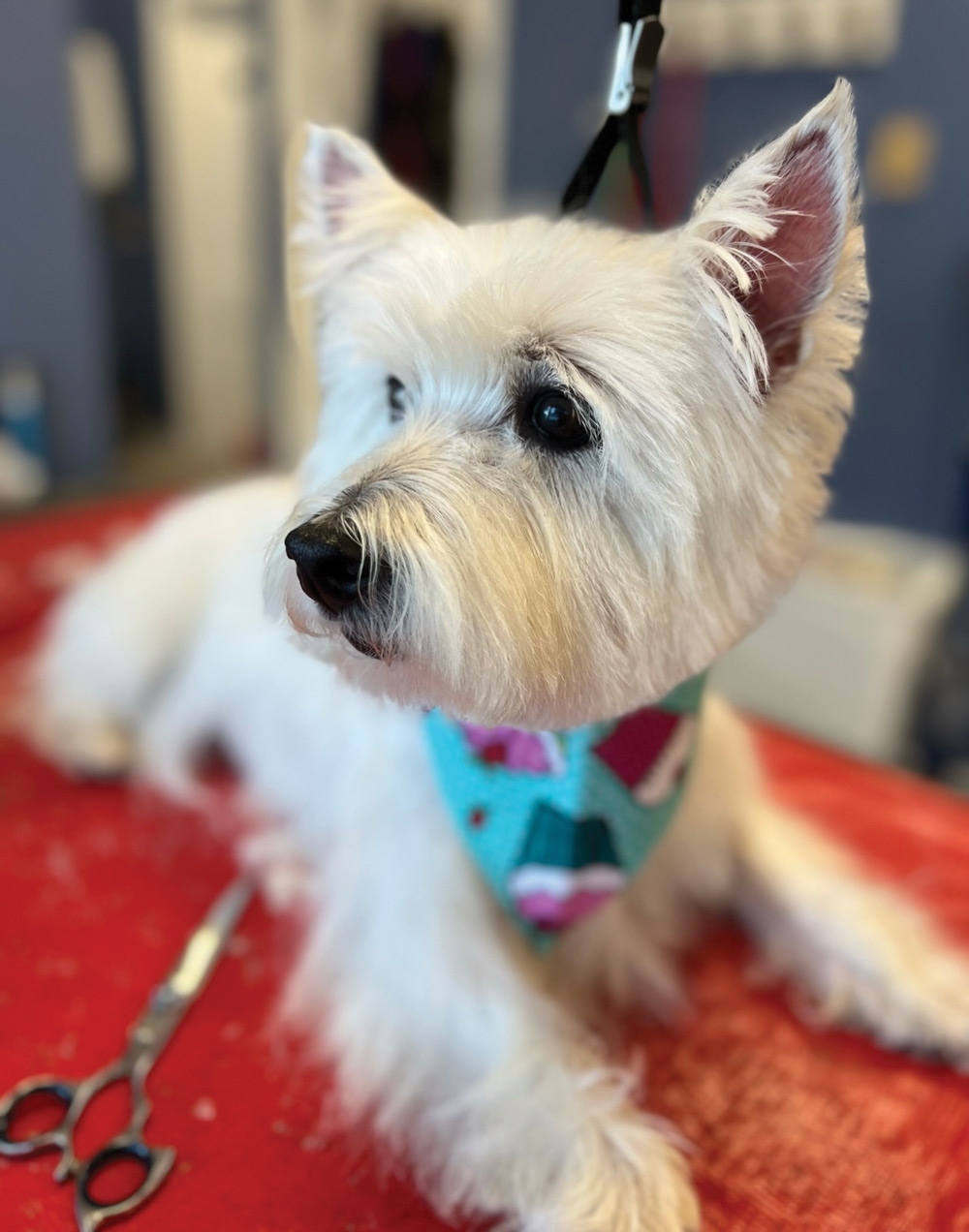
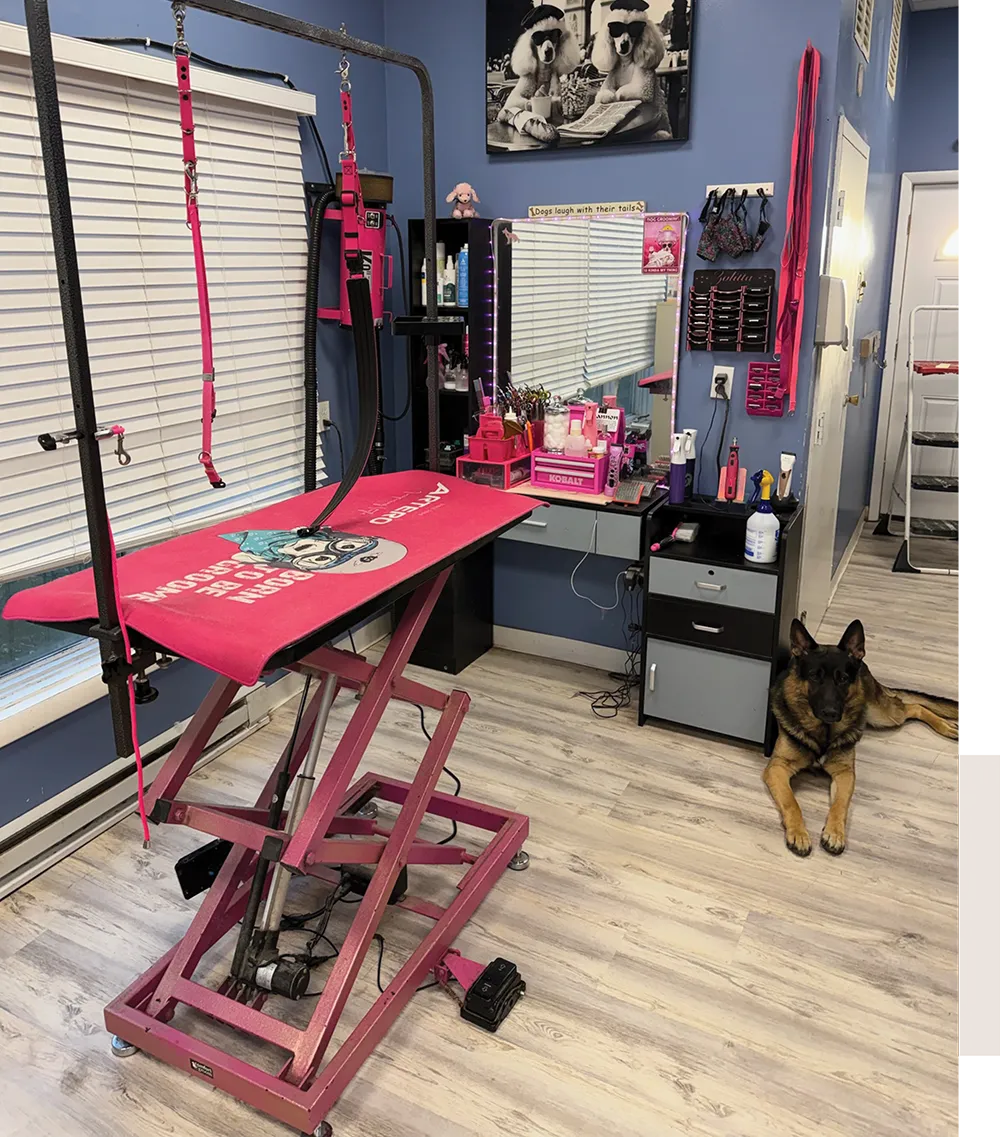
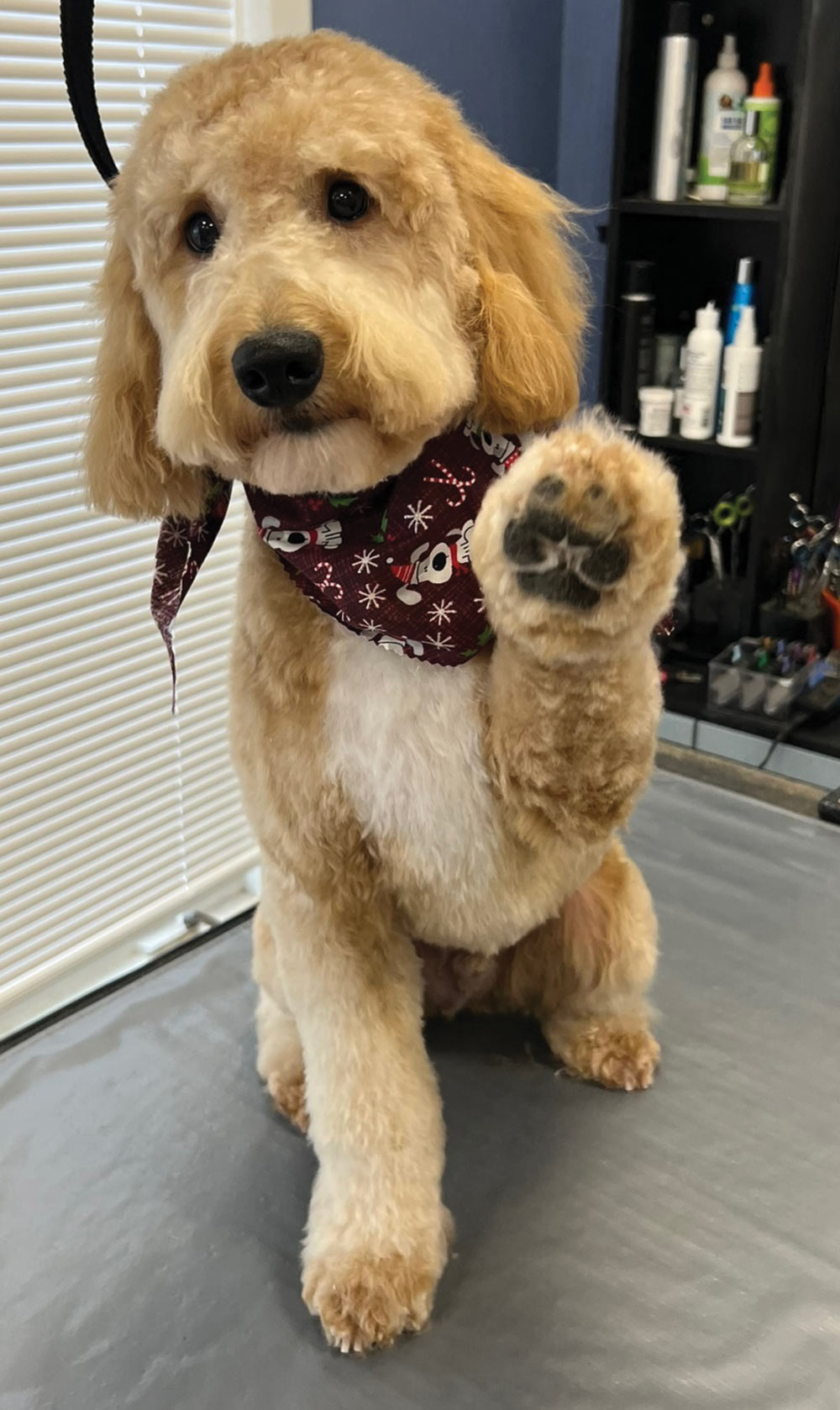
Photos provided by A Muddy Paw Pet Salon
 or Shannon Burr Desreuisseau, owner of A Muddy Paw Pet Salon in New Milford, Connecticut, a life centered around animals seemed almost inevitable.
“I grew up in 4-H with cattle, dogs, horses, chickens…what have you, so I’ve always been an avid animal lover,” she begins. “I knew I couldn’t be a veterinarian; I’m not good with blood and I couldn’t handle putting dogs down. Emotionally and mentally, that wasn’t something I could do.”
Shannon assumed she would become a teacher, and even began college on that path. But everything changed when she took a part-time job as a dog bather at Petco. The work quickly became full time, and something clicked.
“I stopped college because I fell in love with grooming,” shares Shannon.
A later move to an independently owned salon, A Muddy Paw, gave her exposure to a wider range of breeds and techniques, as well as the day-to-day operations of a smaller salon environment. In 2017, nine years into her grooming career, Shannon bought the business to run herself and immediately set her sights on improvement.
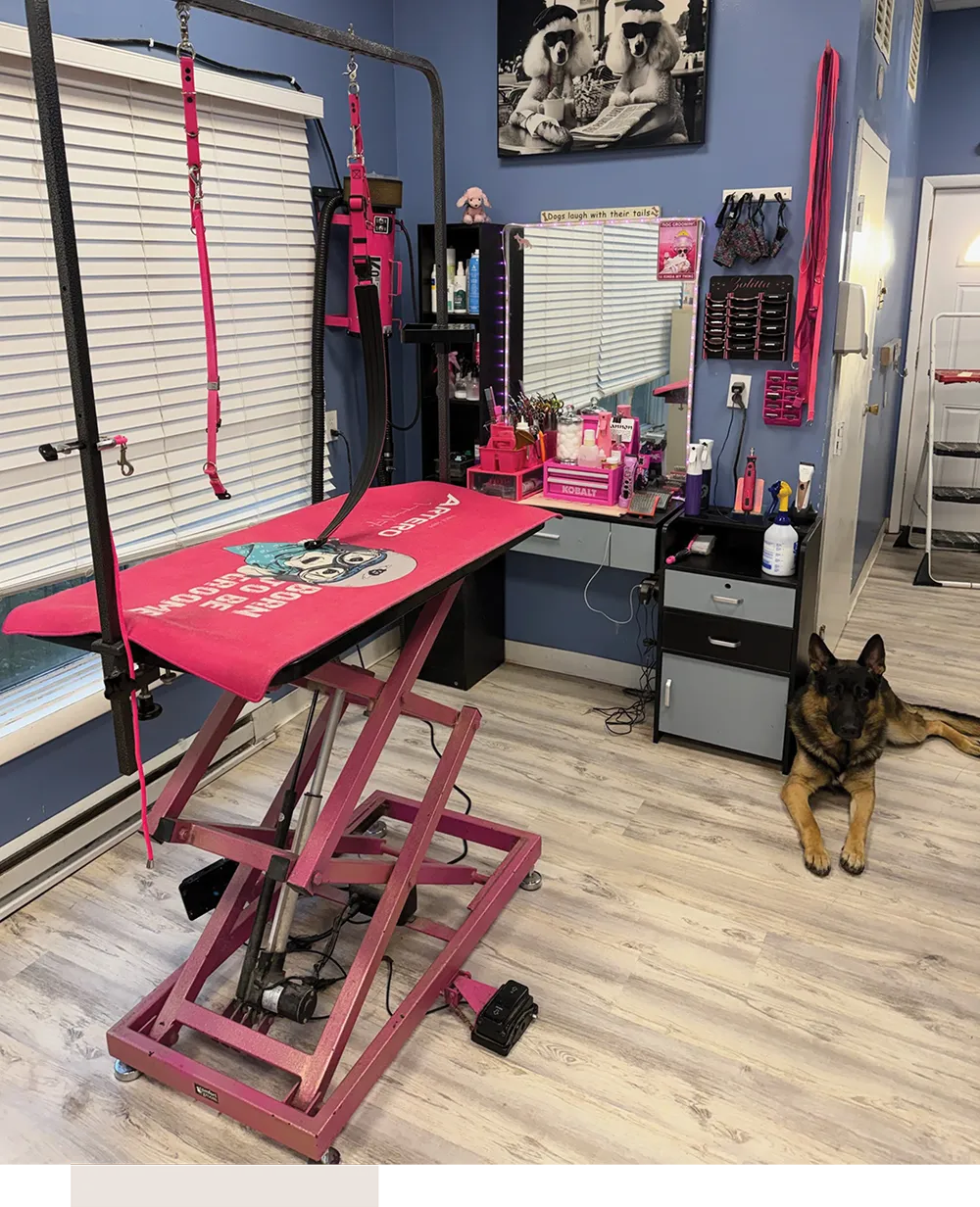
“I made a lot of changes,” she recounts. “The person I bought it from was very old-school—no credit card processing, one shampoo brand, and everything was handwritten on cards and paper.”
So, Shannon computerized operations, introduced credit card payments, expanded product offerings and created a strong digital presence.
“I leaned into social media and did a lot of charity work and events to get our name out there,” she shares.
A Muddy Paw also offers free grooms for local shelter dogs, which helps animals get adopted and spreads the business’s name. The salon has earned public recognition too, including a local “Best Grooming Salon” award and a feature in the town’s lifestyle publication.
“We have people from all over the state—and out of state—driving two hours to come here,” Shannon notes. “We have about seven vets in town, and every one of them recommends us. We’ve grown about four times the revenue from when I first bought it.”
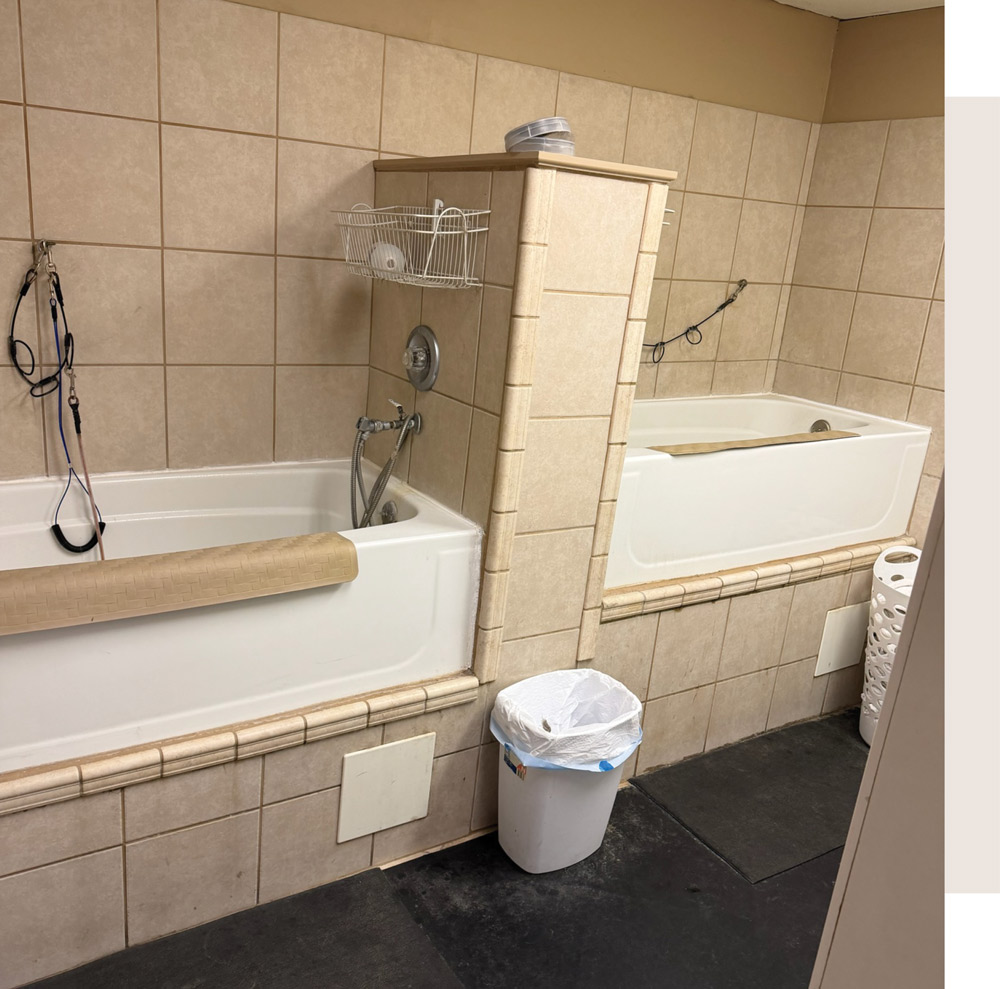
“COVID was when my business exploded,” she says. “Grooming was designated essential in Connecticut, but not in neighboring New York. We stayed open, and since New York is just 10 minutes from us, we got a lot of clients from there.”
Today, A Muddy Paw includes seven groomers, two bathers and a receptionist. And as the company expanded, Shannon’s husband, Roger Desreuisseau, joined the salon after a career in aerospace manufacturing and quality engineering.
“With the business booming, Shannon needed help,” he shares. “It was too much for one person—not just grooming, but overhead, employees, everything.”
Running a business together can be intense, but the Desreuisseaus make it work.
“We’re literally together 24/7, with five kids on top of it,” Shannon shares. “Of course there are arguments about who does more or less—that’s common in any marriage, plus running a whole business.”
Roger’s background in precision mechanics has translated surprisingly well to grooming.
“I approached grooming the same way—meticulously picking apart each aspect of the groom,” he explains. “After a little while, the speed came. I picked up on everything—quality grooms, learning dog behaviors. Three years into grooming now, I think I’ve come a long way.”
Roger discovered a niche in working with dogs that other salons turned away. His careful, patient approach built loyal clientele and expanded the salon’s skillset.
“I felt bad they were getting kicked out of other places with nowhere to go, and grooming is a necessity for some dogs,” he shares. “After that, the other dogs seemed easy.”

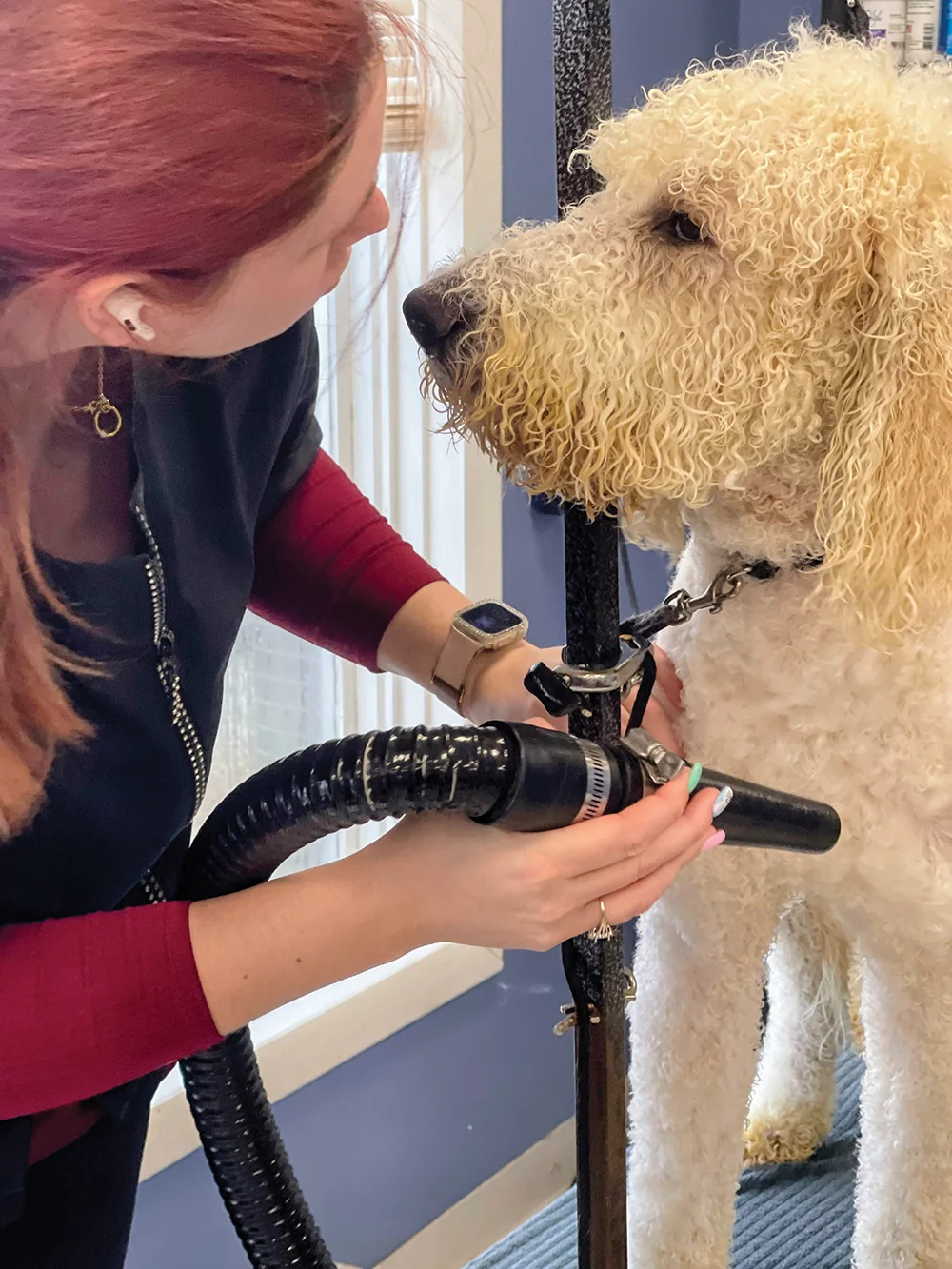
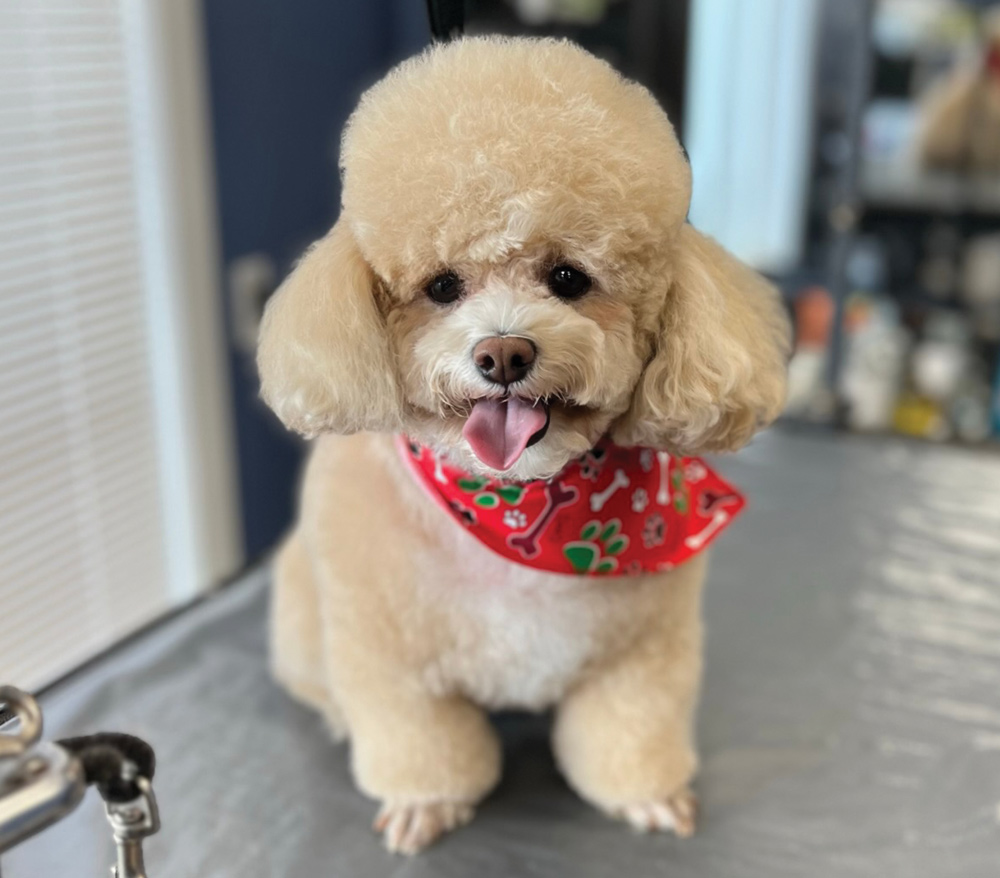
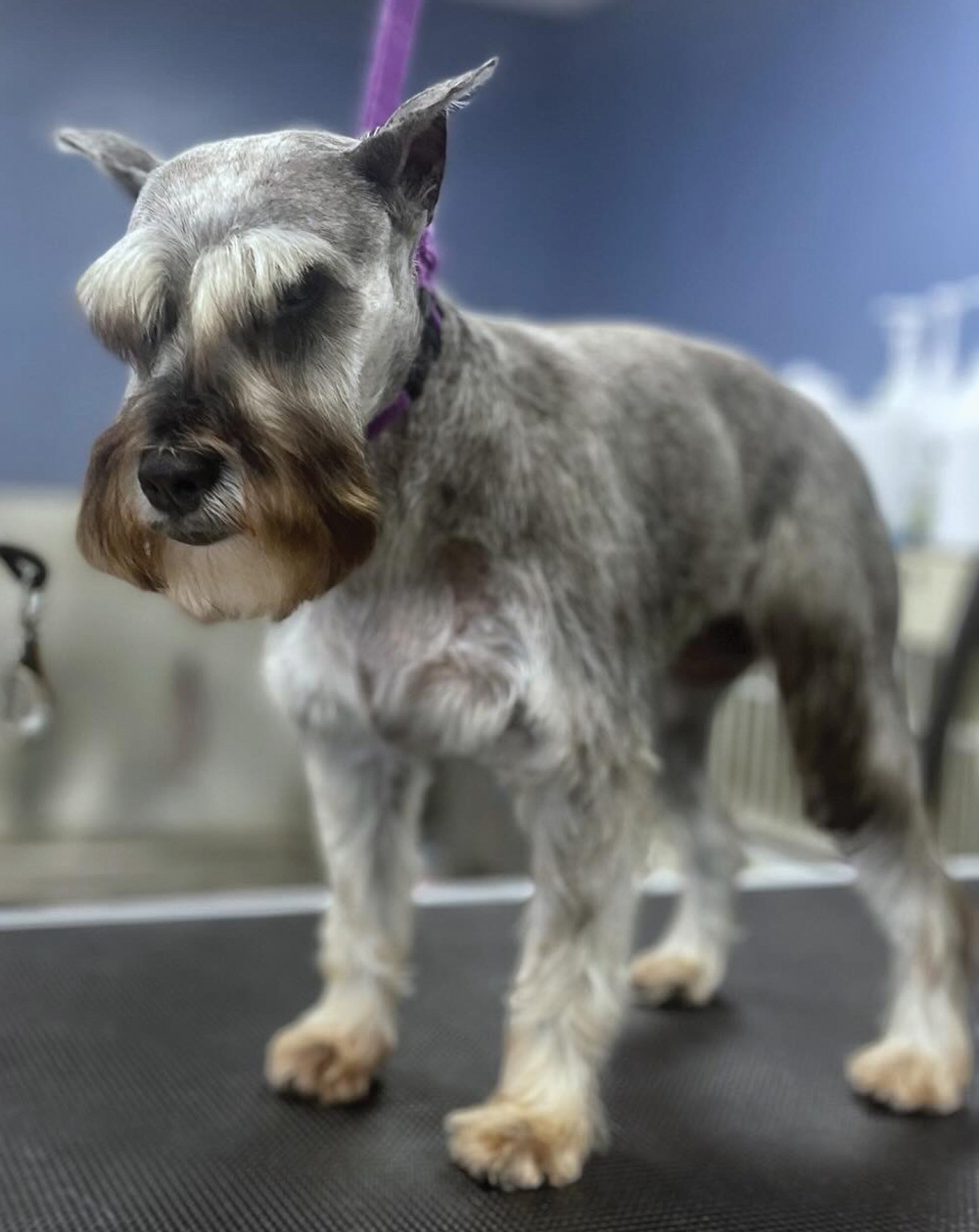
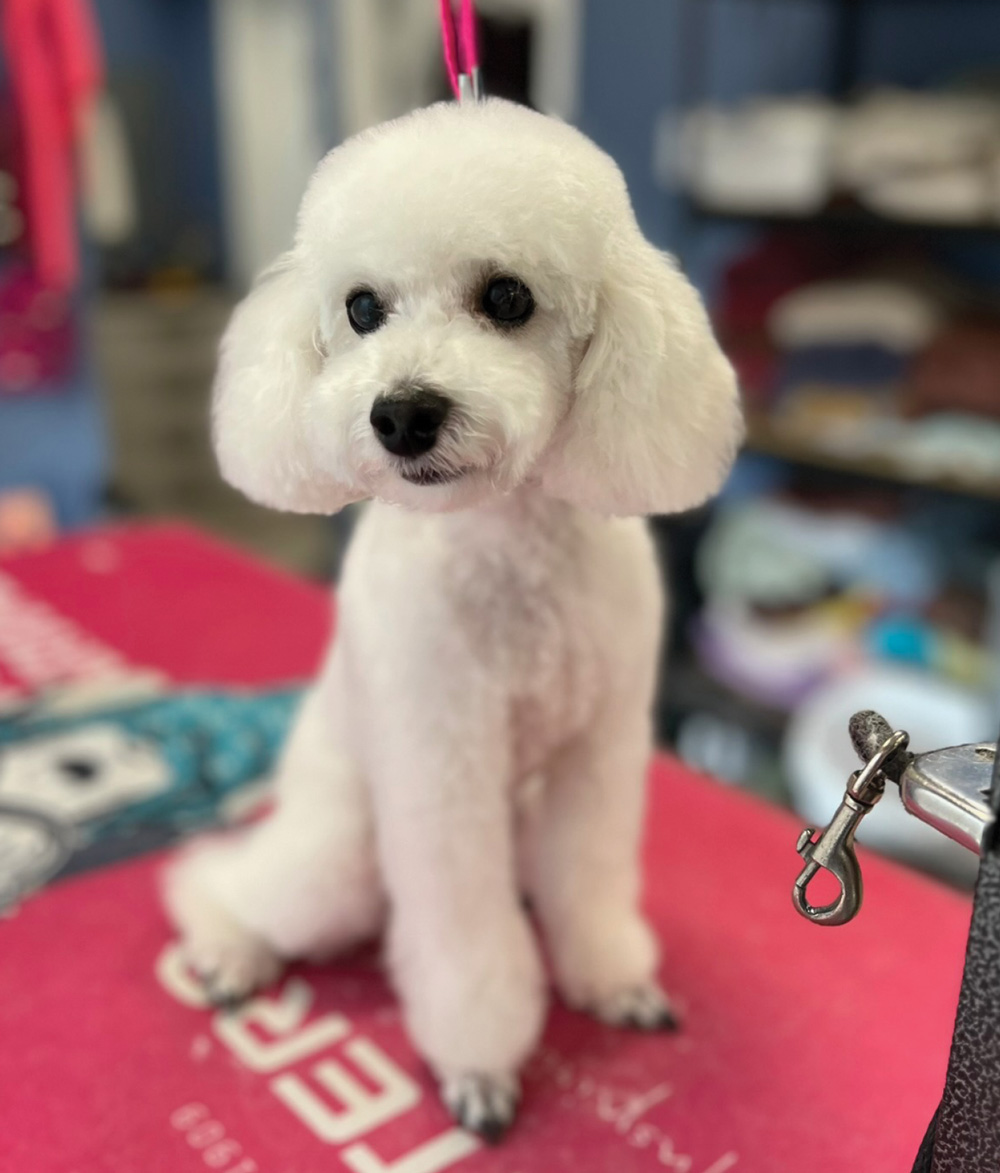
“I’ve gotten meticulous on poodles and schnauzers,” he adds. “We see a lot of German Shepherds—word gets around that we can do shepherds, and we get all the shepherds.”
When talking about her grooming philosophy, Shannon believes strongly in tailoring each groom to the lifestyle of the dog and the family.
“Every pet is unique—just like their owner,” she quips. “I build relationships with both.
“It’s important to know their lifestyle,” continues Shannon. “Are they hiking? Going to the city every weekend? What fits their lifestyle and budget?”
Those relationships extend beyond appointments, as her deep connections have helped the business prosper.
“I become very close to my clients and I’m friends with many,” explains Shannon. “I could tell you their kids’ birthdays and teachers. That connection with the owner as well as the dog is very important.”
The couple suffered a deeply personal tragedy, and the strength of those client bonds was solidified in an unexpected way.
“We lost our son, and my clients reached out and sent GoFundMe donations for funeral costs,” Shannon shares. “Your clients become part of your family—dog and human.”
In addition to their client base, Shannon has built a workplace where communication and collaboration are essential.
“We make sure groomers, bathers—anyone talking to clients—follow the same procedures,” she explains. “That includes handling sensitive grooming situations. If a dog is matted and needs to be shaved for humane reasons, the client knows up front. If it becomes clear mid-groom, we call or message so there are no surprises.”
In an effort to stay on top of the industry, Shannon invests heavily in continuing education for both herself and the staff.
“We go to grooming expos, take classes—I cover those,” she shares. “Everyone must be certified in pet CPR and first aid—I cover that too. I want it to be easy for groomers to get better.”

“I’m an extremely laid-back boss,” Shannon confesses. “No one is forced into a schedule—everyone sets their own.
“Groomers burn out easily, and I’ll do everything I can to avoid that,” she adds. “If you’re overwhelmed, move your dogs and take a week. We’ll figure it out.”
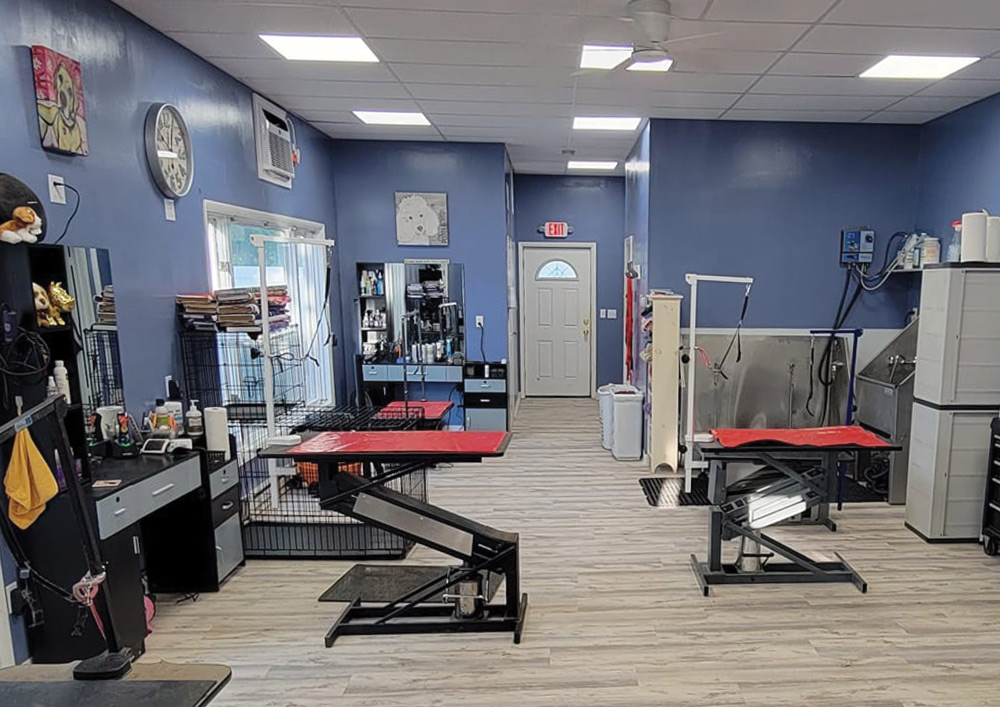
Today, the salon occupies what once were two separate storefronts, and the large size helps keep things running smoothly.
“There’s a doorway between the two sides and a receptionist desk on both,” explains Shannon. “The space features a calm atmosphere with thoughtful design touches. We run diffuser misters every five minutes so it smells nice—doesn’t smell like dog. It’s decorated in an elegant way and people feel welcome.”
The couple continues to explore new services and growth ideas. Roger hopes to expand into boarding, doggy daycare and training.
“We’ve grown so much, but we keep asking, ‘Can we grow more?’” he adds.
Meanwhile, Shannon envisions private one-on-one grooming rooms and possibly a second location. They are also exploring mobile grooming.
“A friend with a grooming van offered to lease it to us one week a month,” Roger notes.
With Shannon’s love for the challenge and variety of grooming and Roger’s appreciation for the problem-solving side, their partnership benefits the business in multiple ways.
“New products, new classes—there’s always something to learn. I’m never bored,” Shannon expresses. “With our know-how, we customize the salon to fit our needs. Sometimes we’ll grab PVC and build what we need.”
However, they both return to the same theme: community and trust. Which may be why, at A Muddy Paw Pet Salon, people don’t just book appointments—they build relationships.


 or many professional groomers, the leap into mobile grooming is fueled by a desire for greater freedom, control, and a more personalized experience for both the groomer and the pet. Today’s mobile groomers are embracing rapid evolution in power systems, and design and technology advancements are transforming mobile units into sophisticated, efficient and highly profitable grooming salons on the go.
These innovative advancements in mobile grooming trailers and self-contained units are transforming the mobile grooming world. New power systems, smart technology, custom designs, safety enhancements, and digital tools are all elevating mobile units to levels of efficiency and sophistication that were unimaginable just a few short years ago.
Whether you are considering a mobile expansion or preparing to venture into mobile grooming for the first time, here’s a look at the innovations and industry leaders that are shaping the future of mobile grooming.
Wag’n Tails, whose units are developed and built “by groomers for groomers,” has been a leader in the mobile industry for over 30 years. Their newest CleanPower™ System, the Endura, adds a fourth battery to the system and features dual inverters operating in tandem to provide higher-power output across all appliances. With plug-and-play operation, groomers can plug in overnight and wake up to a recharged van ready to go with reliable, quiet power.
In addition to the CleanPower™ System, Wag’n Tails also offers diesel or gasoline generator options, as well as optional solar panels to help power the mobile salon.
“We are keenly focused on making the most efficient salon for people to work in,” says Anthony Pastrick, VP of Marketing for Wag’n Tails. “With six different vehicle options, we make sure every groomer gets a unit that fits their dream and workflow. In addition, our Ford Pro and Mercedes Expert Upfitter certifications maintain your original equipment manufacturer warranty, protecting your business for years to come.
“At Wag’n Tails, we are with groomers every step of the way,” Anthony continues, “from choosing their van and the graphics to securing financing or exploring leasing and providing continuing support after the sale.”
Dani Ruiz, who co-owns Mobile Grooming World with her husband, Oscar, has been a mobile groomer for over 10 years. The company does custom van and trailer conversions, with an emphasis on efficient use of space.
“We design our vans to allow the groomer to utilize every inch possible and also for the ease of cleaning the unit,” shares Dani. “Everything in the conversions is customizable. Our clients can pick the colors they want as well as the layout. I actually custom make the countertops with an epoxy resin to create a design that is unique for each client.”
“It gives groomers peace of mind,” explains Dani. “With the Invertor Power System, your van doesn’t have to sit and idle or run a noisy generator. The inverter is not connected to the van at all, but has enough power to run everything the groomer needs.”
Having all the advancements and incredible innovations can propel your mobile career into the stratosphere, but only if you know how to use them. And Hanvey Engineering and Design has got you covered.
Hanvey is launching a new education platform for its van owners. Ashley Hanvey, a mobile groomer herself, is spearheading a new online education system for van owners.
“Groomers who purchase a van from us will get complete access,” Ashley says. “It’s an online learning system with detailed orientation on the entire Hanvey Van, plus individual classes on equipment. They get a groomer teaching groomers how to use their van and take their business to the next level. We want to set them up for success from day one.”
Hanvey’s newest van is the BVE, Big Van Energy. And it’s all electric powered.
“With the BVE, you simply plug in the fast-charging plug at night and you have power for a 10-hour day,” explains Chris Hanvey. “The advancement in lithium batteries makes it possible.
“All the BVE vans come with remote monitoring,” he continues. “We can remotely troubleshoot, diagnose, and update settings. The customer can also tap into the same platform and see their specific van. It allows us to be proactive, not just reactive, and helps resolve issues before they become a problem.”
Hanvey also has a QR code system, which is basically an electronic manual. If a client has a question or a problem with a piece of equipment, you scan the QR code on the equipment and it will take you to a webpage with a video talking about the product with text and related content below that.
“Hanvey vans are built with groomer safety in mind,” Chris shares proudly. “For example, there is an interior bulkhead between the cab and the work area that has a lockable door. In case of an accident, equipment from the back will not go in the cab, and it allows the groomer to step into the cab for safety—whether escaping from a reactive dog or removing themselves from a client that makes them feel uncomfortable.”
“The heart of our business is a passion to help groomers start and grow their business,” shares Brenda. “A trailer is a more affordable way to get into mobile grooming. Also, if your vehicle breaks down, you can hook up to another vehicle and keep grooming—no down time.
“Our trailers can be customized with any of the brand-name tubs, tables, dryers, and other equipment that the groomer wants,” she continues. “Most of our trailers are equipped with a 13,000-watt tri-fuel generator. We put a huge focus on building trailers that are durable, functional, and easy to clean.
“We’re not just building trailers; we’re building relationships and helping our clients succeed in their businesses,” Brenda adds.
Joe Virag of Gryphon Trailers started as a dog groomer 25 years ago, and for the last 20 years, Gryphon Trailers has been doing conversions of vans, buses and trailers, selling new and used units.
“Lithium battery power packs are the newest thing in mobile grooming—they are real game-changers,” expresses Joe. “You charge them overnight and they have 10-12+ hours of run time. They are virtually silent, no carbon monoxide, no exhaust, no maintenance or repair. The battery systems are more expensive than generators, but they have a 10-15-year lifespan.”
One unique feature available in the Gryphon Trailer conversions is an exterior warm-water bathing system for large dogs that can’t fit in the grooming tub. They also offer many custom options, such as awnings, which are great for when groomers go to local events or dog parks to promote their services.
“Mobile is something that is reachable for those that want to go into business for themselves,” Joe explains. “We have information to help groomers learn how to increase their credit score and how to get their EIN #—things that will help them on their journey to financial independence.
“Everyone needs to be in control of their career, earnings, and potential, and we try to be a resource for them,” he adds.
From all-electric vans and remote diagnostics to hands-on education platforms and financial assistance, the mobile grooming world is evolving quickly. Groomers entering this space today have more support, smarter tools and better vehicle technology than any previous generation.
So whether you’re dreaming of hitting the road or actively shopping for your first mobile unit, now is one of the most exciting and empowering times to step into mobile grooming.




 ello groomers! It’s time to talk about something that can seem seriously unsexy: Personal Protective Equipment, or PPE. I said seem because as glamorous as goggles, ear protection and a mask might look, I guarantee that it’s a better look than an eye patch, a limp, a chronic cough or yelling “What?” during every conversation.
Back in the dark ages, when I started grooming, PPE wasn’t really a thing. Sure, it existed; there were usually a pair of scratched-up goggles or hairy earplugs in the back of a drawer somewhere, but no one wanted to wear the uncomfortable equipment. It was even a running joke at one salon I worked at that all groomers eventually go deaf. Not only was it not funny, but I think we all deserve better. So let’s talk about some basic PPE that we use—or should be using every day—and how it relates to groomer ergonomics.
PPE and ergonomics are like science cousins; different but connected. If a piece of PPE does not fit the user properly or is uncomfortable to wear, then it either won’t be used or won’t actually work—sometimes creating more harm than good. Ill-fitting hearing protection or masks are a prime example of this.
For longer than I care to admit, I didn’t wear a mask while drying dogs. I knew that I should, but was convinced that my glasses would make it impossible, or at least impractical and uncomfortable. That was until the world changed and we had to learn real quick how to make masks work. Because when properly fitted, they will work.
We have all heard examples within the grooming community of “groomers lung”—better known to your doctor as hypersensitivity pneumonitis. This is a type of inflammatory response in the lungs caused by prolonged exposure to inhaled allergens, such as pet dander, and can lead to permanent, irreversible lung damage. Luckily, something as simple as a well-fitting KN95 or N95 mask can prevent this. That includes glasses wearers; as long as the seal is tight around the bridge of your nose, you won’t have the fogging-up problem.
OSHA has regulations in place to protect our hearing, limiting decibel exposure. For example, 90 dB maximum exposure over the course of an eight-hour day, but with anything exceeding 85 dB, employers need to provide hearing protection and monitor noise levels.1 That may not seem like a big deal, until you realize that your beloved dryers produce an average of 107 dB.2
Since the time decreases as the noise gets louder, without doing intense math, it’s safe to estimate that drying one doodle could put you well into hearing damage territory. Properly fitted earplugs will reduce the dB levels by 15-30; taking you back into safe levels. While actual scientific sound level meters are more precise, even our smartwatches can tell us that our dryers are indeed too loud for auditory safety.
It’s important to note that noise canceling and noise blocking are different; what you are looking for to protect your hearing is noise blocking or protecting. Noise-canceling headphones use active protection to create soundwaves that dampen ambient noise and noise-blocking headphones use a physical barrier, like foam earplugs or over-the-head earmuffs, to create a tight seal around the ears and stop loud noises from playing your eardrums like, well, a drum.
Remember, employers: Some form of hearing protection for your employees is far cheaper than an OSHA complaint. And for our audiobook and podcast enthusiasts, a set of over-the-ear earmuffs lets you enjoy your true crime in your earbuds while protecting your hearing for years to come.
The key takeaway is that PPE only works if you use it, and you’ll be more likely to use it if it’s comfortable. Whether masks annoy you or earplugs are uncomfortable, they’re still less annoying than having chronic lung issues and hearing loss. There are a variety of types of both masks and hearing protection built for a wide variety of people, and you are worth finding the one that fits you the best. Your future self will thank you.
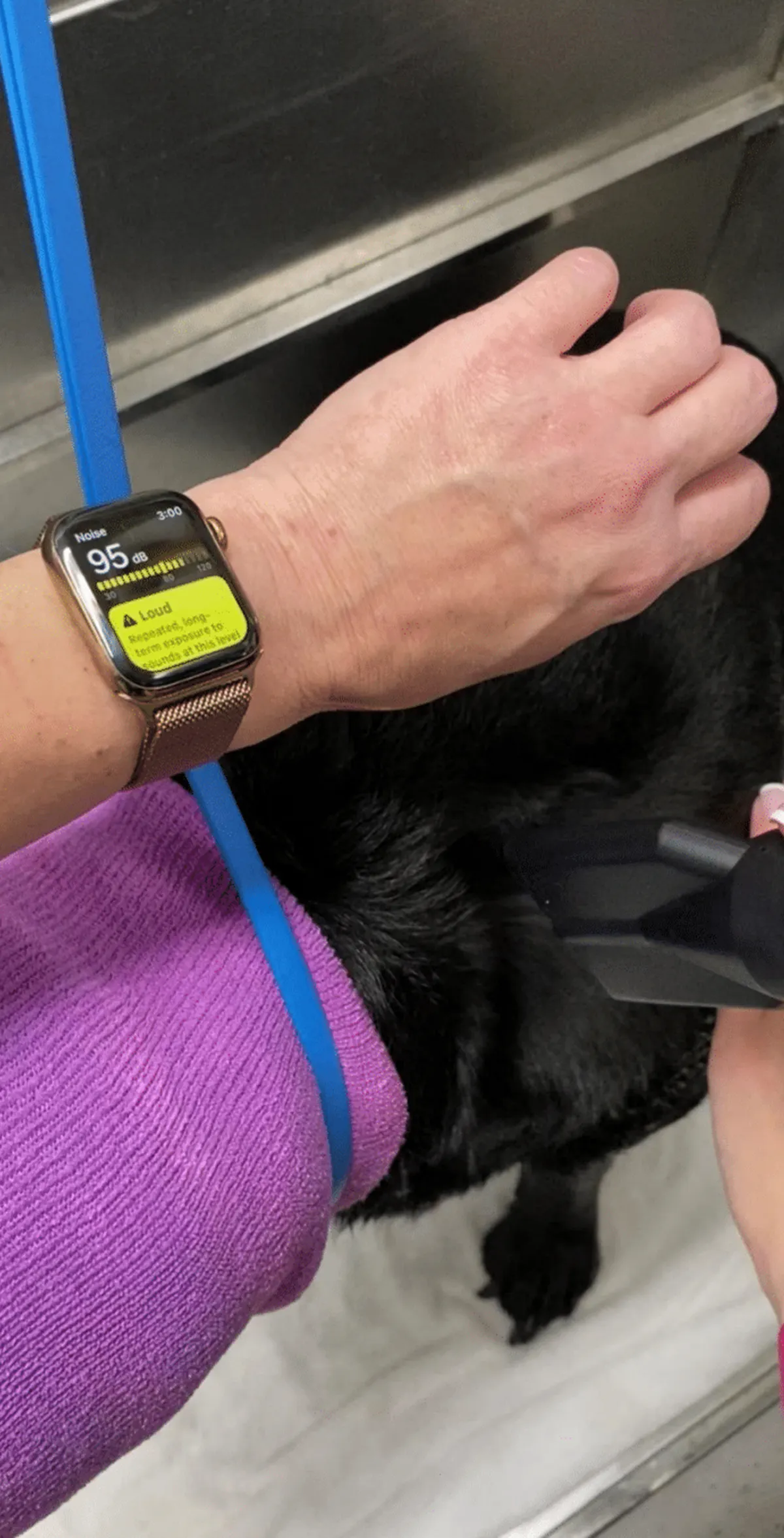
Photo courtesy of Anjie Coates.
- Occupational noise exposure. Occupational Safety and Health Standards. https://www.osha.gov/laws-regs/regulations/standardnumber/1910/1910.95
- Scheifele, P. M., Johnson, M. T., Byrne, D. C., et al. (2012). Noise impacts from professional dog grooming forced-air dryers. Noise & Health, 14(60), 224.

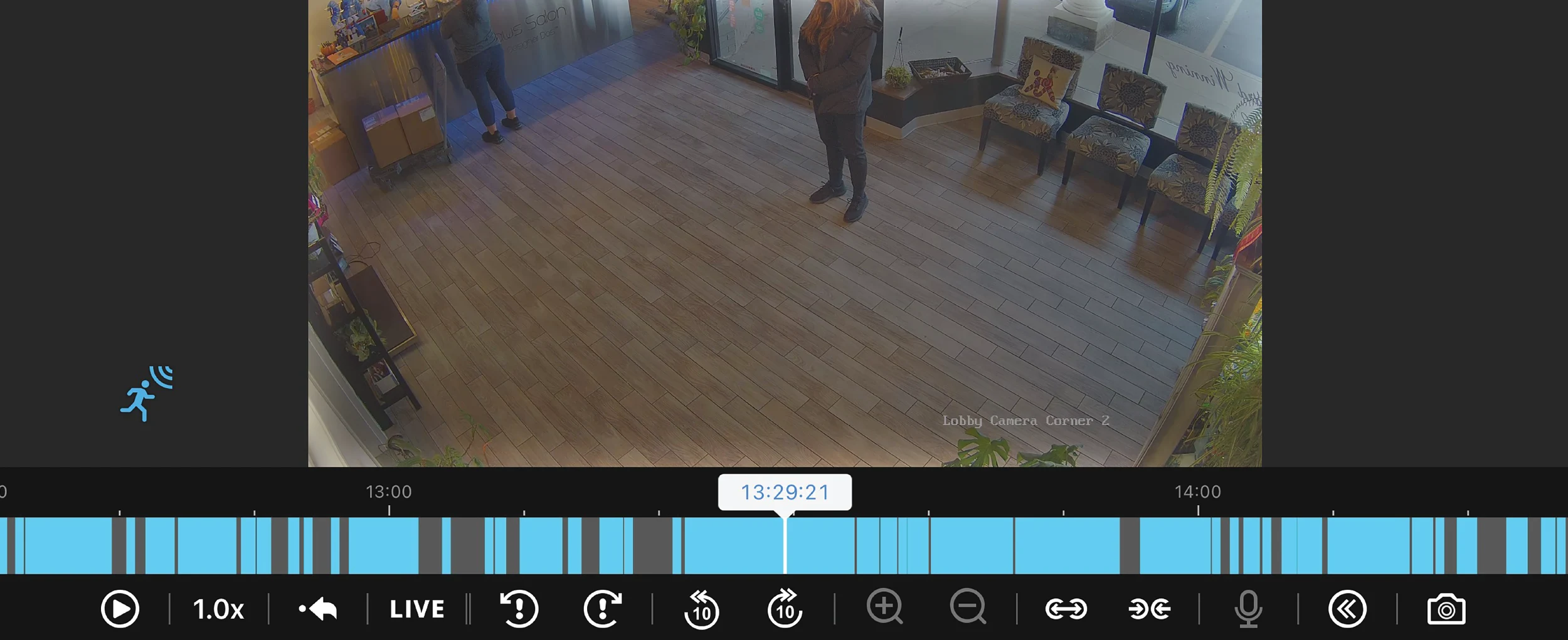


Photo provided By Misty Gieczys
 he atmosphere of a professional grooming salon is a precise blend of art and chaos: the gentle whir of clippers, the humid warmth of the drying room, the shimmer of freshly washed coats. We invest heavily in the tools that make this magic happen, and we know quality equipment improves the groom. But there is a silent, often overlooked set of tools that protects something far more valuable than a perfect poodle topknot: your business, your staff and your peace of mind.
For salon owners and managers, the reality is that the unexpected can turn a routine Tuesday into a high-stakes emergency, whether it’s a false liability claim, an aggressive customer or a sudden medical crisis. Achieving true operational safety and serenity comes from establishing clear, proven protocols that protect against these moments.
The following details four vital, yet often neglected, layers of defense that move your salon from simply good to reliably safe: electronic surveillance, call recording, covert communication and mandatory staffing protocols.
Visible Accountability: Your Digital Witness
Do not skimp on the security camera purchase either. While the initial investment for a high-quality system may seem profound, the camera will pay for itself many times over by reducing financial and legal risk.
Today’s technology provides high-resolution imagery that allows you to zoom in and out of a recorded event, revealing intricate details. This level of clarity is vital for capturing the exact condition of a dog’s coat before a groom, documenting the precise handling of a pet, or accurately recording the moment a client slips on a clump of hair or freshly mopped floor.
The undisputed evidence provided by a camera can instantly disprove frivolous claims of injury or negligence, potentially saving you thousands of dollars in legal fees and liability settlements. This is the definition of Return on Investment (ROI) in safety; a single high-resolution image can be worth more than a lawyer’s entire retainer.
For full protection, cameras must cover all grooming stations, bathing tubs, kennel areas, lobby and check-out desk. If a situation happens in your salon, it must be on video to protect your staff and demonstrate the professional level of care a pet received.
Modern systems also offer advanced operational features—notably, remote, two-way communication. If a manager or owner is away, they can securely log into the system via a smartphone app, view the live footage and verbally communicate with staff through the camera’s speaker. This capability allows for instant guidance or real-time issue resolution, transforming surveillance from a purely reactive tool into a proactive management and safety aid.
These recordings can be used to ensure staff accurately inform an owner about fees (such as a $30 late fee or $50 no-show fee) when they later declare, “I was never told!” You can also verify a client’s specific instructions regarding an appointment, such as an owner confirming to keep the appointment active and then subsequently not showing up.
However, the audio recording feature comes with a critical legal warning that all salon owners must heed. The use of audio surveillance is much more strictly regulated than video. While video recording in public areas of a business is generally permissible, state laws vary significantly regarding the consent required to record sound. This legal difference is substantial and carries severe penalties for noncompliance.
In “one party consent” states, you only need one person involved in the conversation (which can be the staff member) to be aware the conversation is being recorded. But in “all party consent” or “two party consent” states (like California, Florida, Illinois and others), everyone involved in the conversation must be informed and provide consent to the recording. To be fully compliant, it is essential to consult legal counsel and meticulously check your state and municipal laws.
If you utilize audio recording, you must post a clear and conspicuous sign at your entrance stating that both audio and visual recording are taking place. Depending on your state, you may also need to implement an additional recorded message or notification informing callers that the conversation may be recorded before they speak to a person. Failing to adhere to these rules can expose your business to severe criminal penalties and civil lawsuits, completely defeating the core purpose of the security measure.

For instance, an urgent alert can be triggered by a specific, innocent sounding phrase like: “Do you want me to call Princess Fiona’s parents and let them know you are going to be late?” The response dictates the action. If you respond, “Yes, please go ahead and let them know,” it is the coded signal to call 911 immediately. A less urgent need for support might be met with the response, “Check with me in five minutes,” which signals the colleague to stay close and be ready to intervene if the situation cannot be resolved swiftly. If the response is, “No, not at all,” it means the colleague should still stay close, keep a phone ready, as this interaction should be wrapped up quickly.
The most crucial procedure in this protocol is to ensure the backup staff member moves to a separate room to make the emergency call while keeping eyes on the situation. Crucially, this covert method prevents the conflict from escalating further. If you openly tell a volatile client you are calling the police, that sudden announcement can trigger a desperate, aggressive and potentially violent reaction. Instead, when the police unexpectedly walk through the door, it immediately changes the dynamic. This element of surprise is a vital layer of protection for you and your staff.
To ensure these vital safety codes and emergency actions can be executed under duress, they must be tangible and accessible. It is crucial that the entire protocol, including all coded phrases and their corresponding staff actions, is printed clearly on a single document or laminated poster. This document should be posted in a discrete, yet highly visible location within the grooming area, preferably right next to the door.
This physical cheat sheet must also clearly display the emergency number (911) or, for situations requiring less immediate intervention, the local police non-emergency number. In moments of extreme adrenalized stress, the human brain is subject to cognitive shut down; having this consolidated safety poster prevents staff from scrambling to recall critical information, ensuring the correct lifesaving action is taken every time.
This minimum staffing is critical for customer conflict backup, ensuring that one person can focus on de-escalation while the other executes the code word protocol. More importantly, it is a crucial defense against a physical safety crisis or medical emergency.
We have heard cautionary tales of groomers being crushed by a malfunctioning hydraulic table while doing maintenance, who were trapped for hours until a client walked in and raised the alarm. Similarly, consider the scenario where an employee experiences a severe allergic reaction (anaphylaxis) to a chemical, aerosol or animal dander and needs their EpiPen. If that employee is suddenly incapacitated and unable to retrieve their medication, a second person is a lifesaving measure who can immediately retrieve the medication, administer aid and call emergency services.
The two-person minimum also extends to basic after-hours safety, ensuring that one person can safely escort the other to their car, especially during dark winter hours, deterring potential criminal activity outside the salon.
Furthermore, consider installing panic buttons in high-risk, isolated areas, such as the front desk or a separate cat grooming room. These are inexpensive tools that provide huge returns on peace of mind, allowing staff to instantly alert colleagues in the main grooming area that they need immediate assistance.
Beyond personnel, we must also consider strategic barriers. Train your staff to utilize simple but effective large objects like a front counter, a rolling shelf or a sturdy grooming table. These pieces of furniture become an immediate barrier between a staff member and an aggressor. This buys precious moments of time and makes it harder for the aggressor to physically reach them, often providing the window necessary for the other staff member to execute the emergency call.
The best clippers and shears only make a groom easier. Well-planned security systems and staff protocols make the entire job safer. Planning for the worst-case scenario isn’t negative thinking; it’s responsible ownership and a profound demonstration of care for your team.
By implementing these layers of protection, you are building a safe, confident staff who can focus on what they do best: providing excellent pet care, secure in the knowledge that their safety is the salon’s top priority.



 riving in the pouring rain with all the windows rolled down probably doesn’t sound ideal, but it is when the alternative is death by carbon monoxide poisoning.
I knew I had an exhaust leak, but I didn’t realize the hole in the pipe was positioned directly under the cab of my van. I had scheduled the repair for my upcoming vacation so clients wouldn’t need to be rescheduled—something they got used to with my aging vehicle—but that plan changed in an instant.
The danger revealed itself thanks to the battery-operated carbon monoxide detector in my work area. The latch on the door between the cab and workspace was broken, so the door would swing open while driving. As soon as carbon monoxide began spilling from the cab into my workspace, the detector sounded.
Had the detector been hard-wired into the generator instead of battery-powered, I never would have been alerted—because I was driving, not running the generator. Carbon monoxide is odorless and colorless; without that alarm, I might not be here to tell this story.
The half-life of carbon monoxide in the body is about five hours—meaning it takes that long for half of the gas to be expelled from your system, then another five hours to cut that amount in half again. Ten hours later, you may still have 25% of the original CO exposure in your body.
Carbon monoxide poisoning isn’t limited to engine exhaust leaks. CO can enter your workspace through:
- Poorly sealed or aging floors, plus open windows or doors allowing exhaust from idling vehicles or generators to drift inside
- Malfunctioning or improperly vented kerosene, oil or propane heaters (which also pose fire hazards)
- Fuel-powered equipment operating nearby, with intake fans pulling exhaust into your work area
- Parking too close to buildings, walls or thick shrubs, which can force exhaust back into the vehicle
A spokesperson for the Portable Generator Manufacturers Association (PGMA)1 advises mobile groomers to establish a safe generator zone before each appointment, direct exhaust away from doors and windows, and install carbon monoxide (CO) detectors inside their work areas.
- Headache
- Drowsiness or fatigue
- Nausea or vomiting
- Feeling faint
- Rapid or irregular breathing
- Confusion or disorientation
- Weakness
- Chest pain (especially in people with heart disease)
- Impaired judgment
High concentrations can cause unconsciousness, coma or death—sometimes before symptoms are even recognized. Individual reactions vary based on age, health and genetics. One person may develop a headache in minutes, while another may die in the same timeframe.
While it’s not always preventable, you can still make sure you’re alerted to its presence by installing battery-operated carbon monoxide detectors in your grooming area. These are available at hardware stores, pet industry suppliers or online retailers like Amazon. It’s best to replace the batteries at least once a year and also keep a spare unit in your vehicle.
Needless to say, that exhaust repair originally scheduled for my vacation was moved up immediately and those clients rescheduled. Carbon monoxide poisoning is no joke. The consequences can be deadly.
- The Portable Generator Manufacturers Association. www.pgmaonline.com
- Your resource for portable generator safety information. PGMA. www.takeyourgeneratoroutside.com

 at grooming isn’t all cute toe beans and cuddly floofs. Sometimes it’s knowing when to stop—or not even start. For professional cat groomers, one of the hardest (and most important) skills to develop is recognizing when grooming isn’t safe or appropriate. And what’s even harder than that is saying no.
But here’s the truth: There is no shame in the referral. In fact, there’s a lot of skill, professionalism and care behind the decision to say, “This cat needs a vet.” or “This cat needs to be groomed at a vet.” We’re not here to be heroes. We’re here to be safe, responsible caregivers. And that means prioritizing the cat’s wellbeing over our pride, our schedule and even the owner’s wants.
Recently I had a severely matted senior DLH come in. Her owner thought she was just “being fussy,” but within seconds of handling, it was clear she was in significant pain. She flinched, screamed and tried to bite when we touched certain areas—more than just a bratty reaction to grooming.
I stopped the groom, documented everything, and referred her to the vet for sedation and evaluation. That’s when the owner admitted they had already been to their vet, who had recommended sedation, but said that they could see if I could try without it first.
Within a few months I saw the cat again for their maintenance grooming after having the mats shaved off while under veterinary sedation. It was clear she was stiff with arthritis, but the bath and blow-dry went smoothly with minimal handling needed.
Why Groomers Struggle to Say No
The fear of disappointing a client or losing the appointment can sometimes override our better judgment. Some groomers are also afraid of being seen as inexperienced or unable to handle difficult cats. But referring out isn’t a sign of failure, it’s a sign of maturity.
A seasoned cat groomer knows their limits. They’ve seen the warning signs and they’ve had the scratches to prove it. Sending a cat home or recommending a veterinary groom is often the most compassionate thing we can do.
- Severe matting with skin irritation, bruising, sores or wounds underneath
- Cats who cry out when touched, resist being handled or exhibit sudden aggression
- Rapid breathing, panting or excessive drooling during the groom
- Ingrown nails that have embedded in paw pads
- Visible signs of illness such as nasal discharge, labored breathing or lethargy
- Behavioral history of multiple failed grooms or known sedative dependence
Even if the owner insists “she’s just dramatic,” we need to trust our instincts and observations. There’s an obvious difference between a cat who’s nervous and one who’s in distress.
Explain to your clients that certain cases require sedation—not because the cat is bad but because it’s the kindest and most humane option. Painful matting, compacted feces or fragile health conditions are all situations that often require more than a skilled groomer.
Work with vets who see you as part of the care team, not as a last resort or unnecessary luxury. Share notes, photos and/or details when you refer out. And when those clients come back, help the cat maintain a schedule that avoids the need for sedation again.

We need to trust our instincts and observations. There’s an obvious difference between a cat who’s nervous and one who’s in distress.
Document your decision to send a cat home or refer to a vet. If possible, have a client sign a release form or write a quick note in your system. Keep photos of skin issues, overgrown nails or severe matting as part of the cat’s grooming history. These not only protect you, but also provide a record for tracking changes over time.
Start with compassion, not blame. For example, “I know this isn’t what you expected today, but Fluffy is showing signs of pain and stress that are telling me we need to take a different approach.”
If possible, have a short list of trusted veterinary offices or groomers at veterinary clinics to refer to. Make it easy for the client to take the next step. And don’t forget to mention that you’d love to see the cat back after the vet visit, on a regular schedule, to prevent this situation from happening again.
We’re not miracle workers. We’re not the last stop on the train. We’re highly trained professionals making judgment calls every day about what is best for the animal in front of us.
Teach your staff to speak up, support your fellow groomers when they share tough decisions, and if you’re a mentor or educator, model the language and boundaries you want your students to have.
Referrals are not just about risk—they’re about responsibility. You’re showing your clients and your community that you take feline grooming seriously, that safety matters more than squeezing in one more appointment, and that you know when to proceed and when to pass the brush. Saying no isn’t giving up—it’s stepping up.




by Blake Hernandez
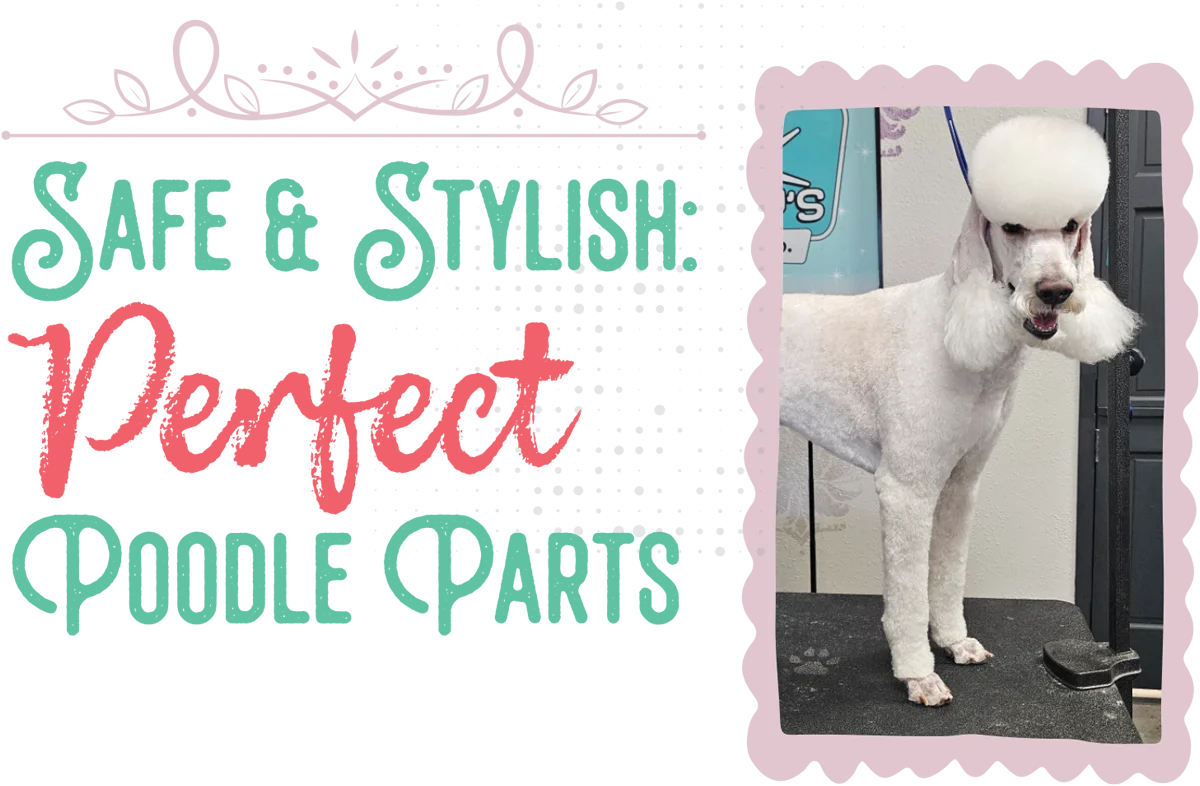
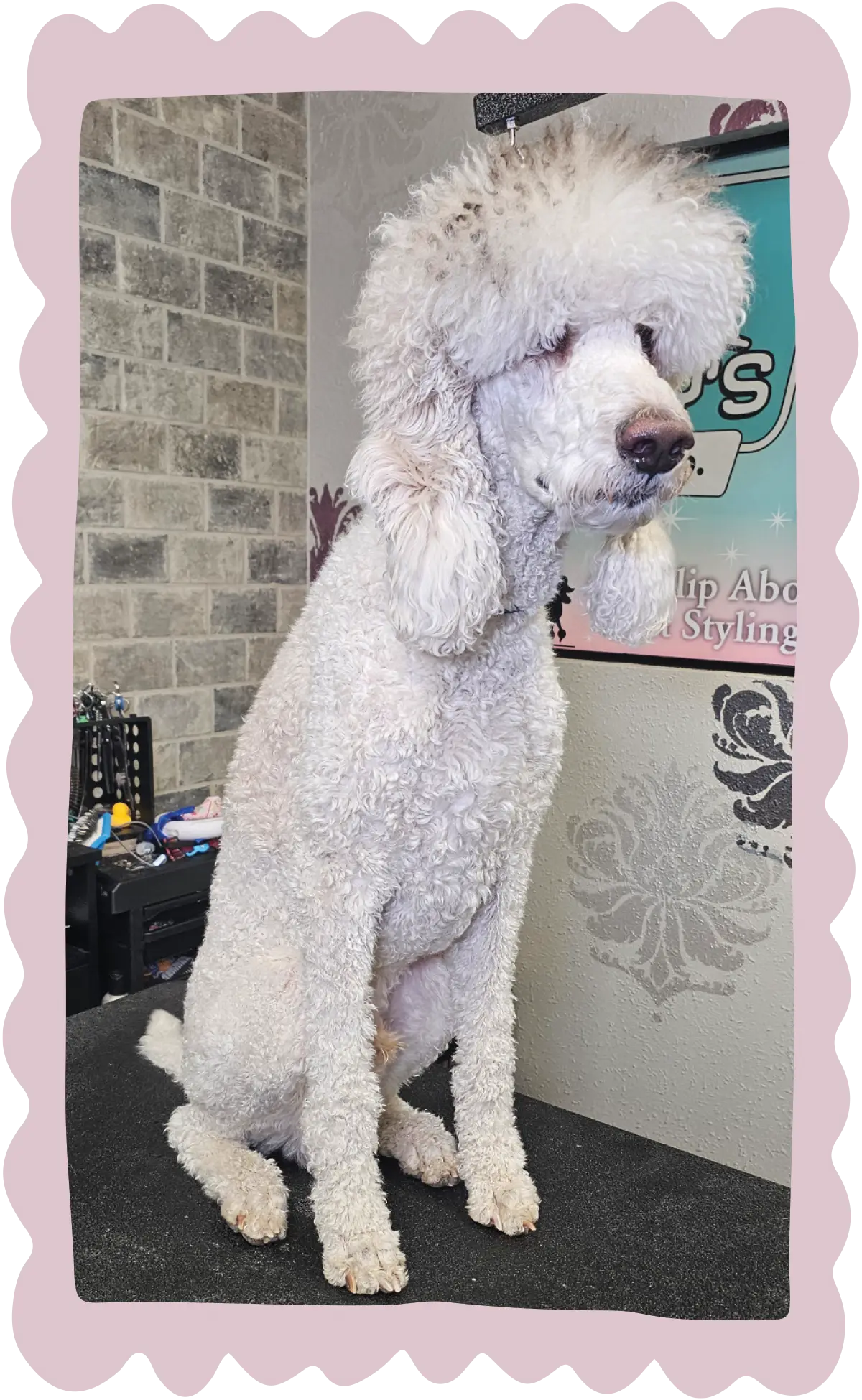
 efore you assume this is another article about shaping the perfect topknot, you’re wrong! A successful poodle trim is all in the details, and sometimes executing those details can pose larger safety risks. The following key points will help you achieve those poodle-specific steps without injuring the dog.

by Blake Hernandez
efore you assume this is another article about shaping the perfect topknot, you’re wrong! A successful poodle trim is all in the details, and sometimes executing those details can pose larger safety risks. The following key points will help you achieve those poodle-specific steps without injuring the dog.
Fig. 2) Shaving the feet should be done in multiple steps, as each part requires a different angle and technique. For instance, I do the nail bed in reverse with the back of my blade; the bottom of the cuff I do with a carving technique; and the webbing of the feet can be safely reached by splaying the toes to create a smooth surface. Also, never cross over the center of the webbing with a moving blade, as the skin is very soft and sensitive.
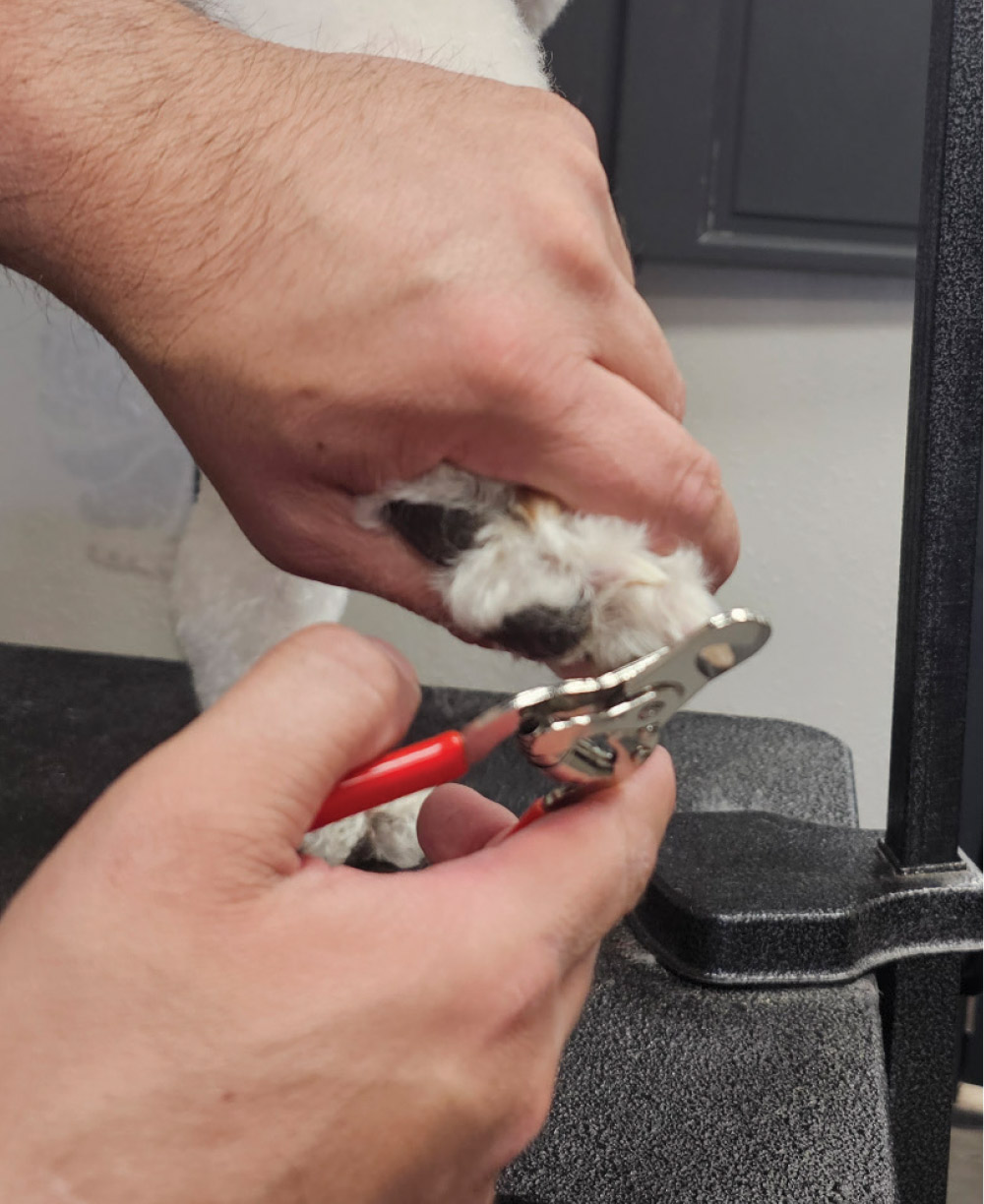
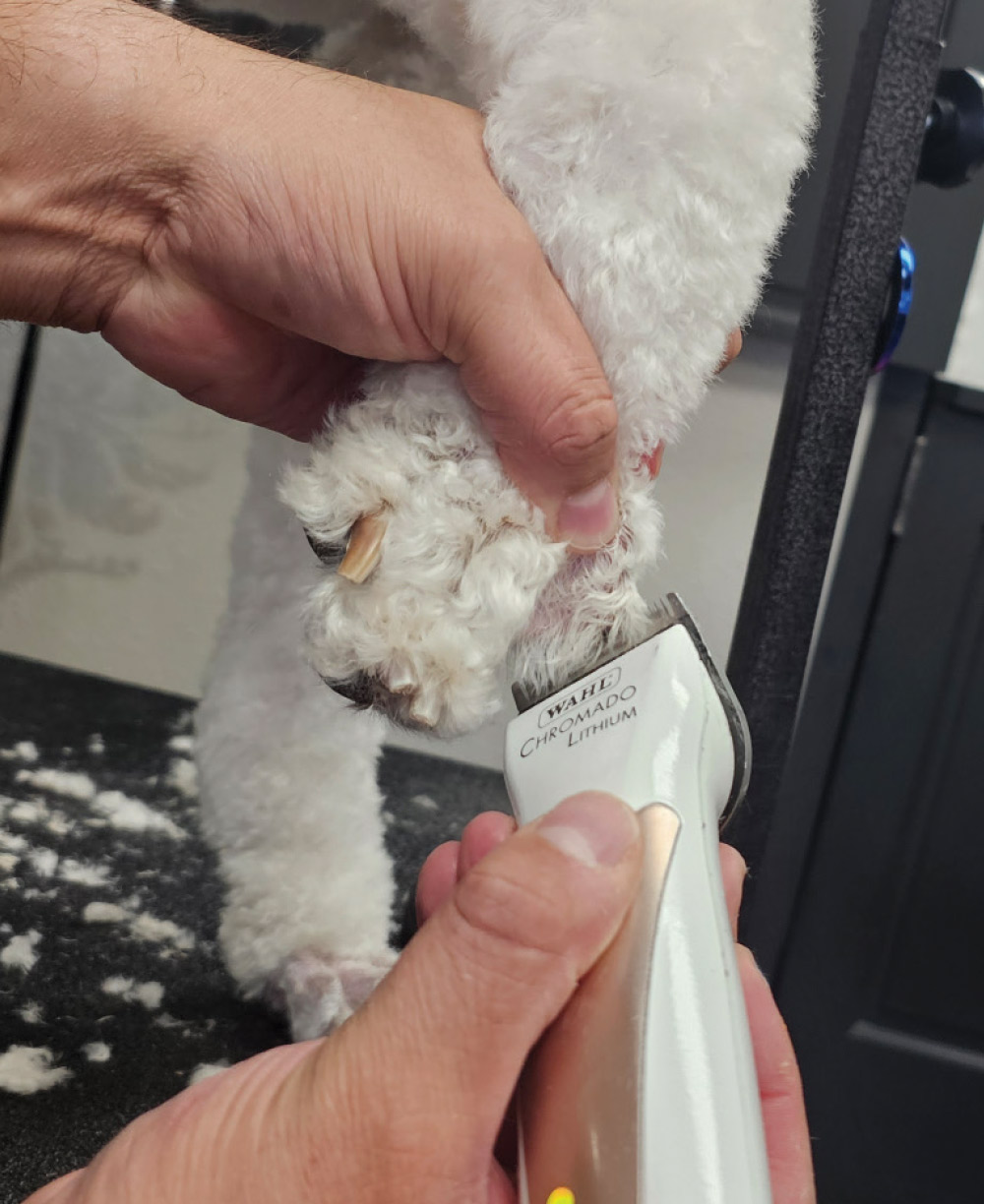
Fig. 4) Male or female, intact or not, you should only shave the side of the genitals that you are lifting the leg on because it is more clearly visible and the skin is pulled taut.
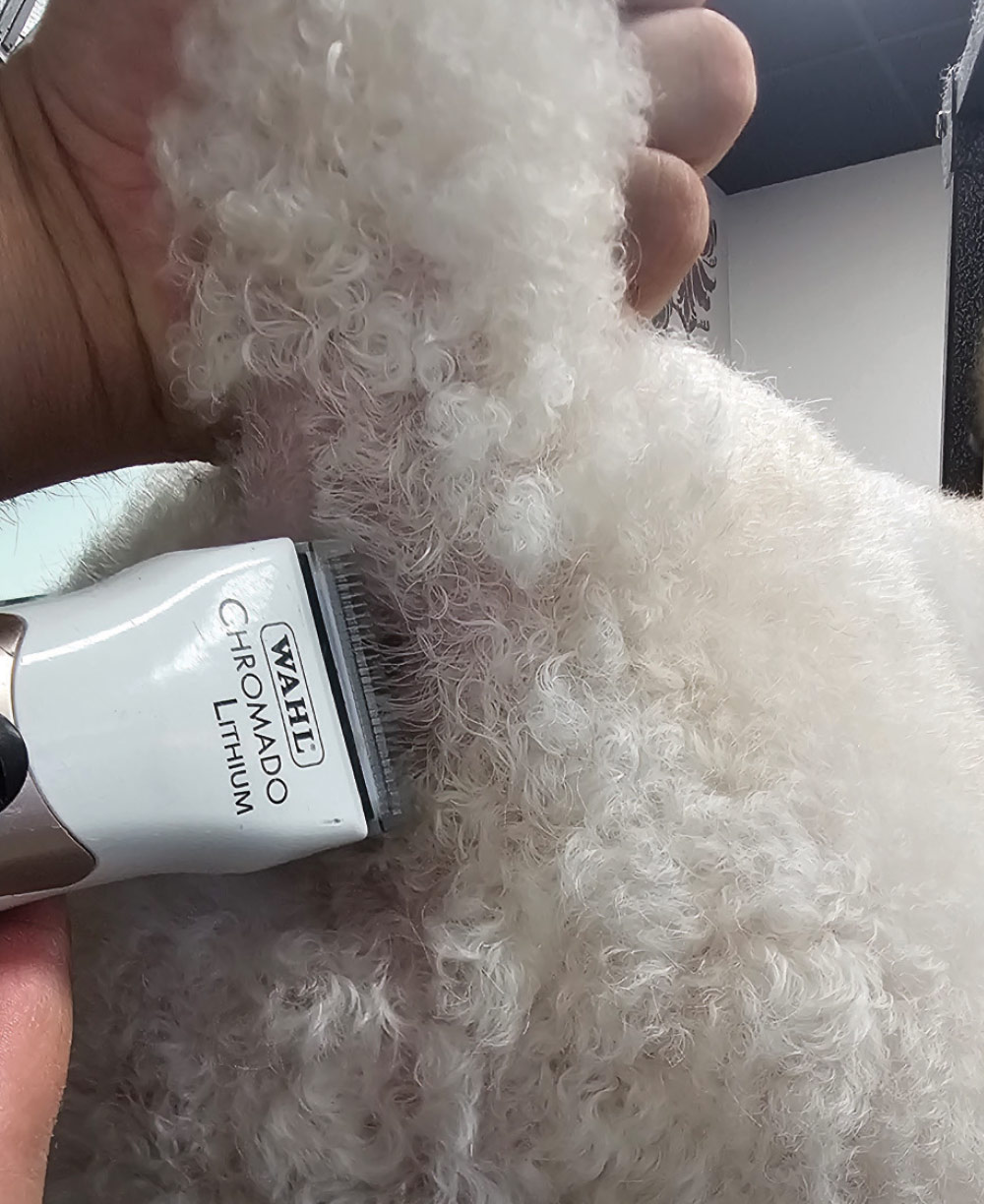
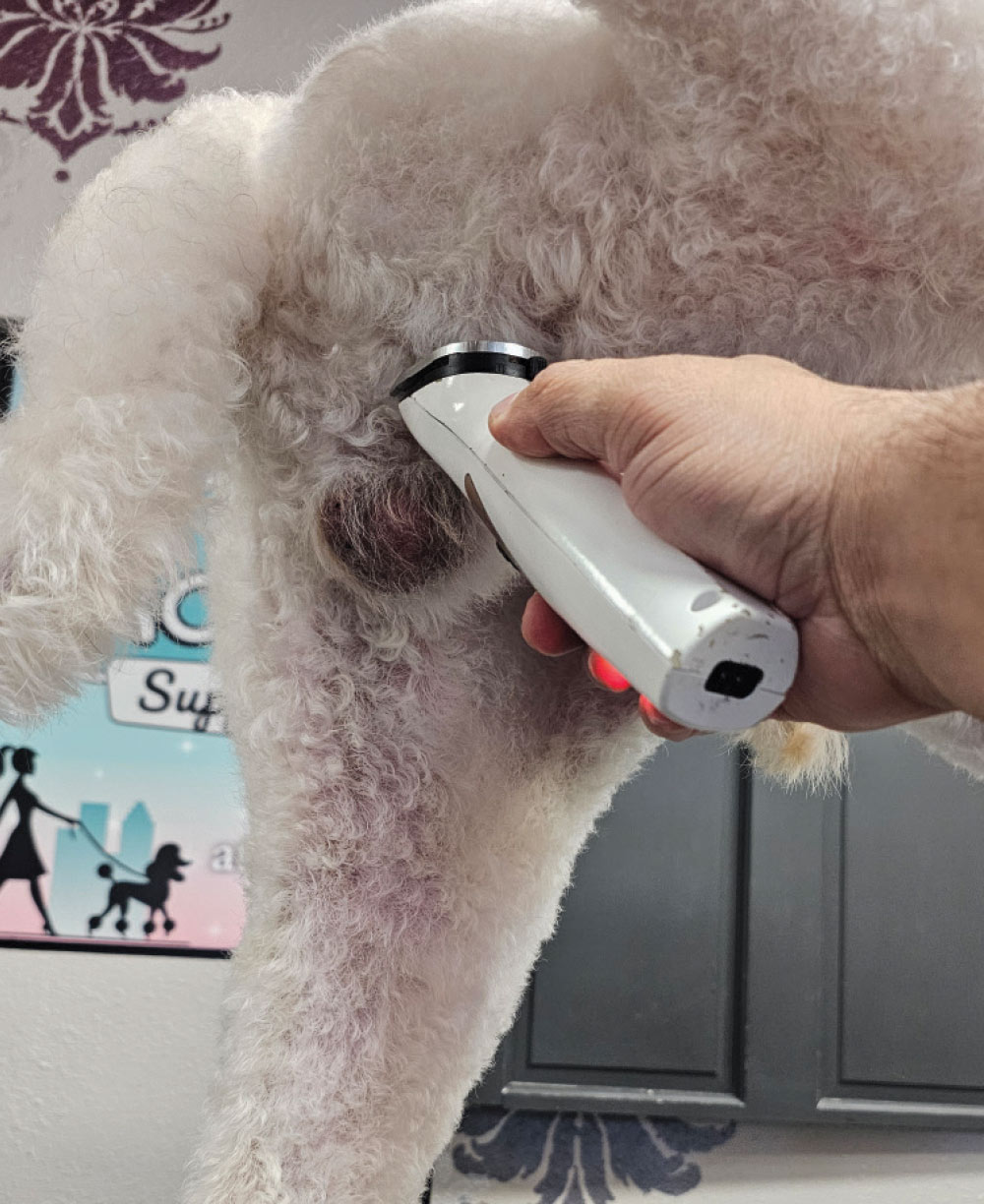
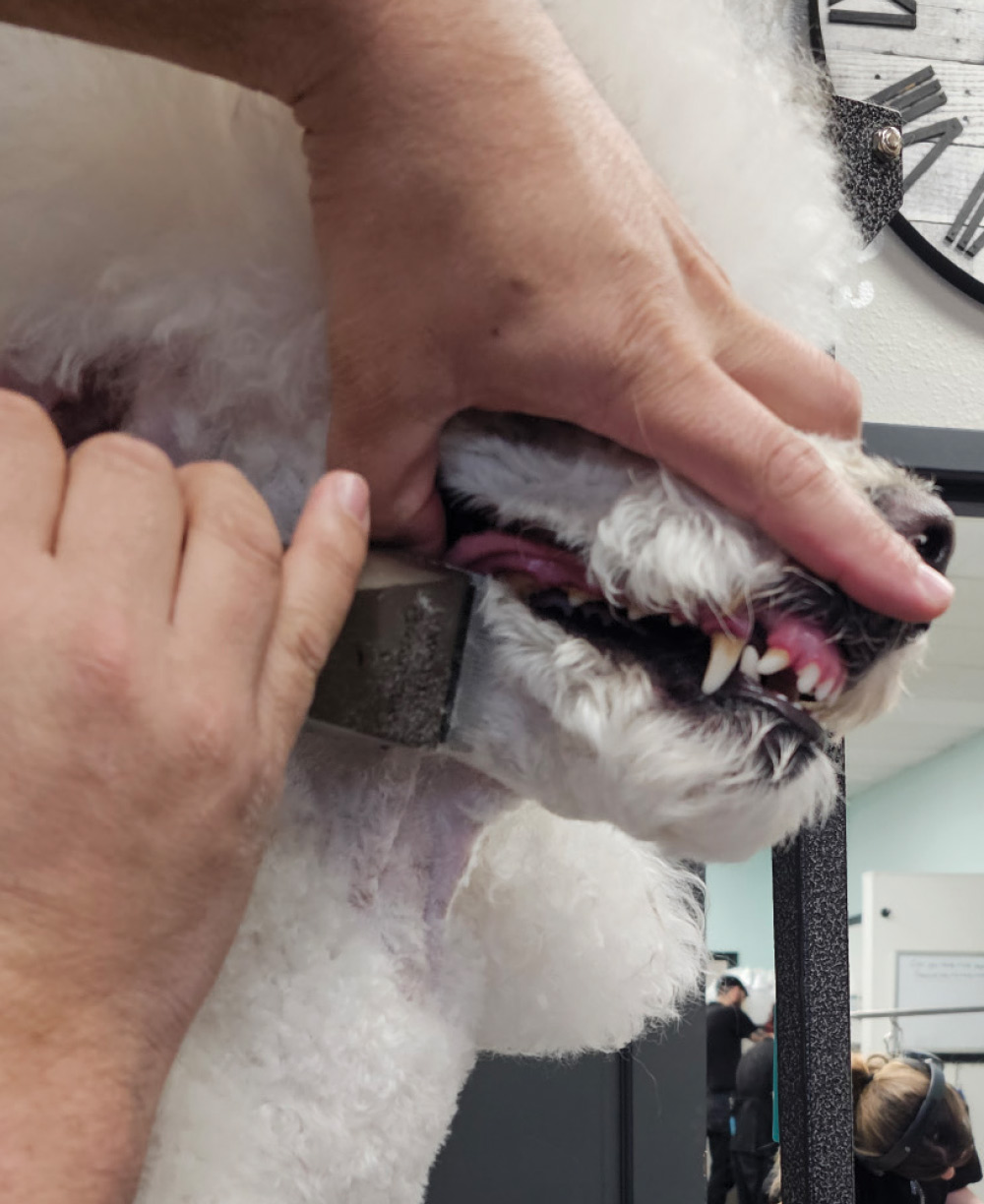
Fig. 6) To form a smooth surface around the mouth, take the corner of the dog’s lip and pull back and slightly downward to stretch out the wrinkle.
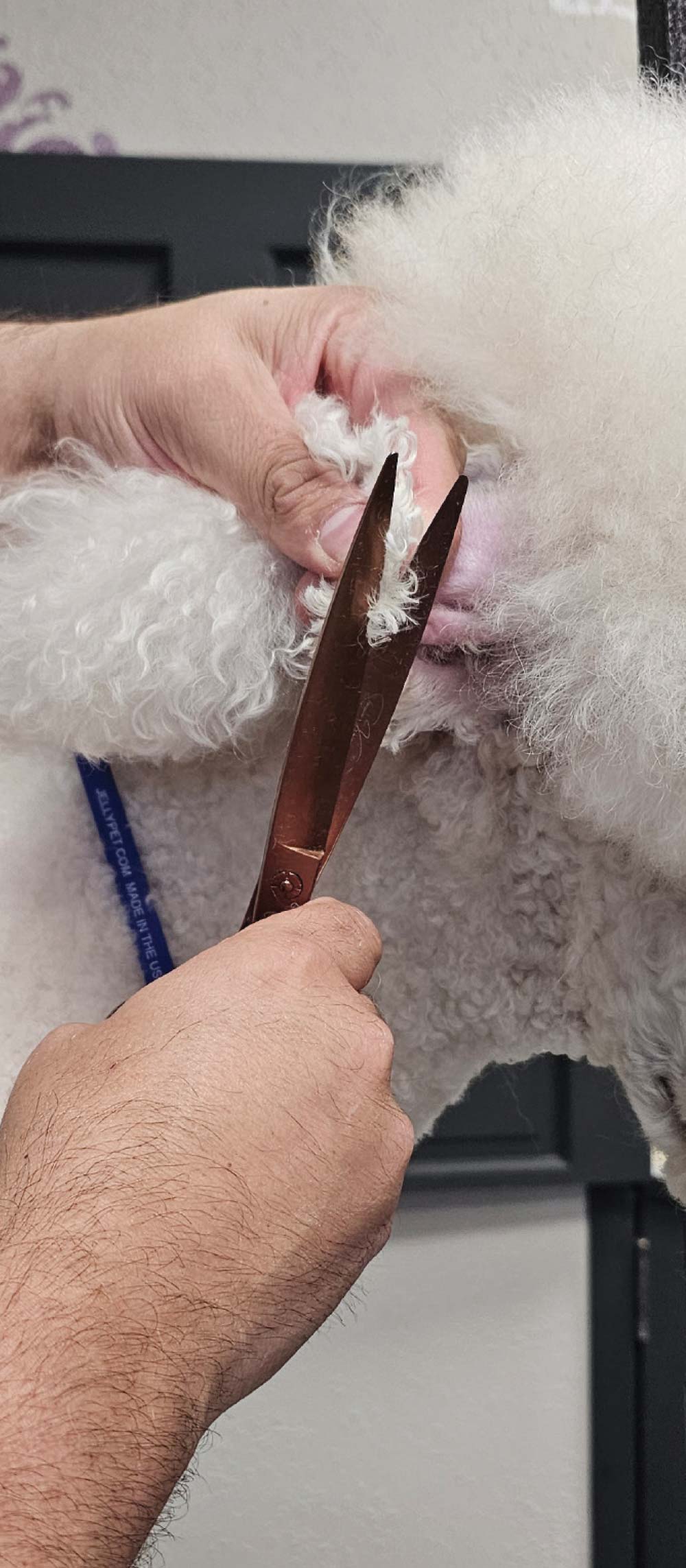
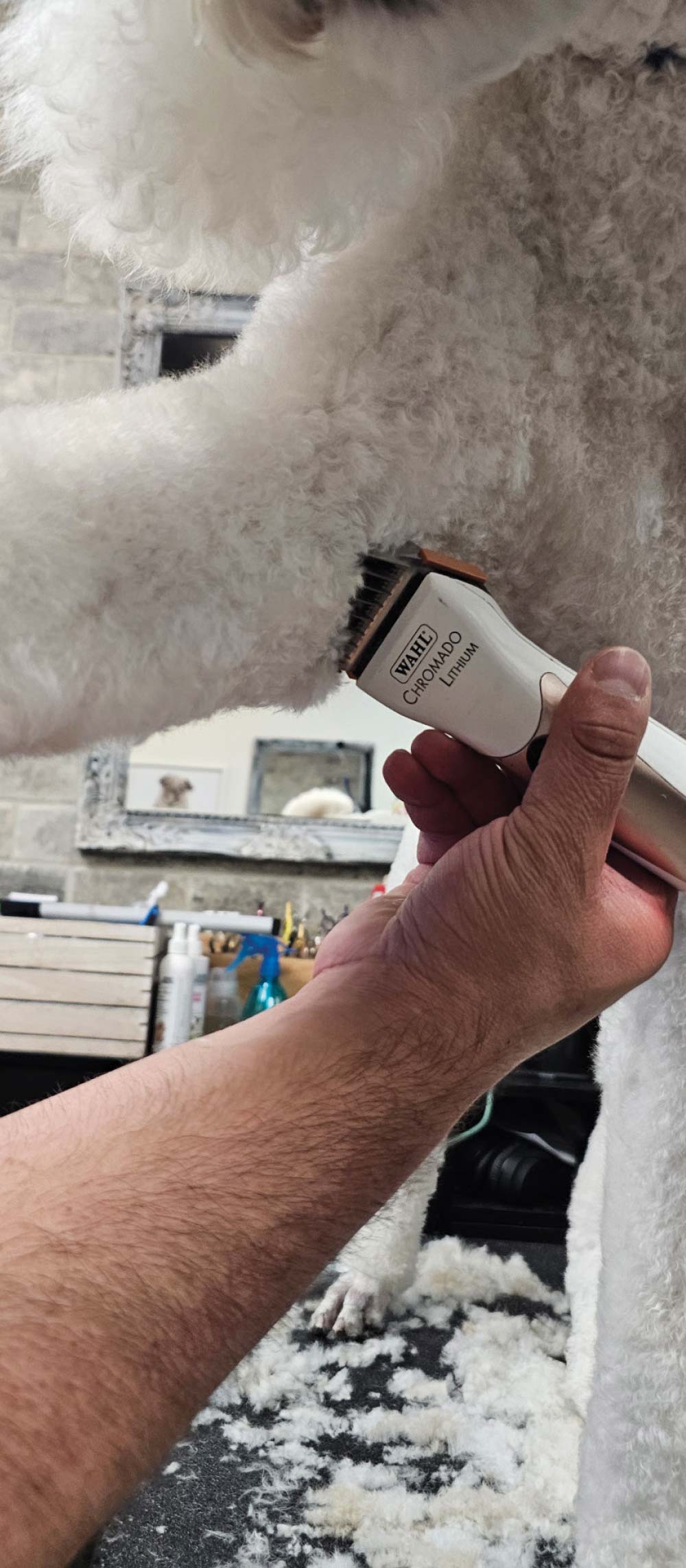
Now, keep making those poodles cute and fresh by confidently and safely tightening up those details!
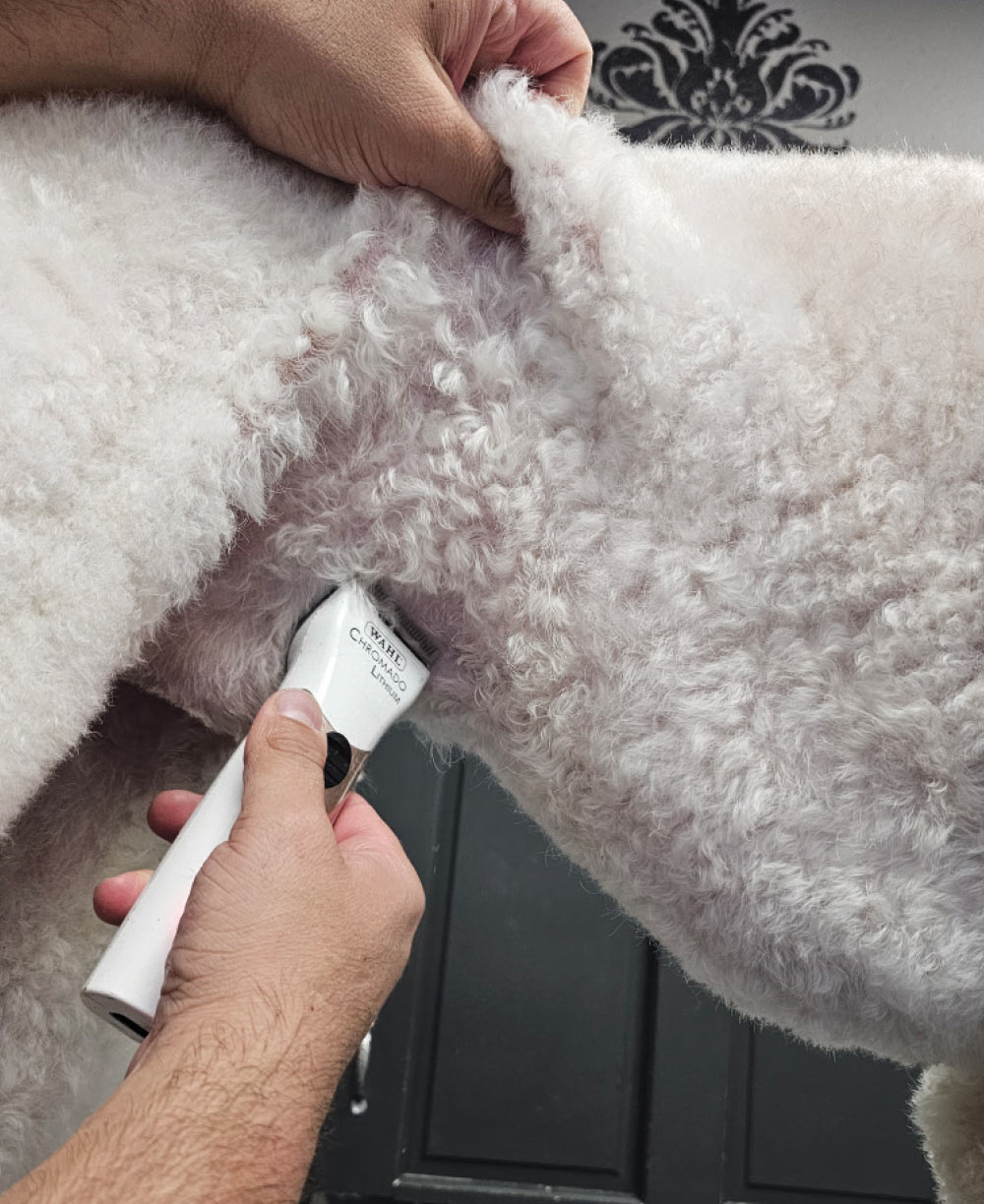
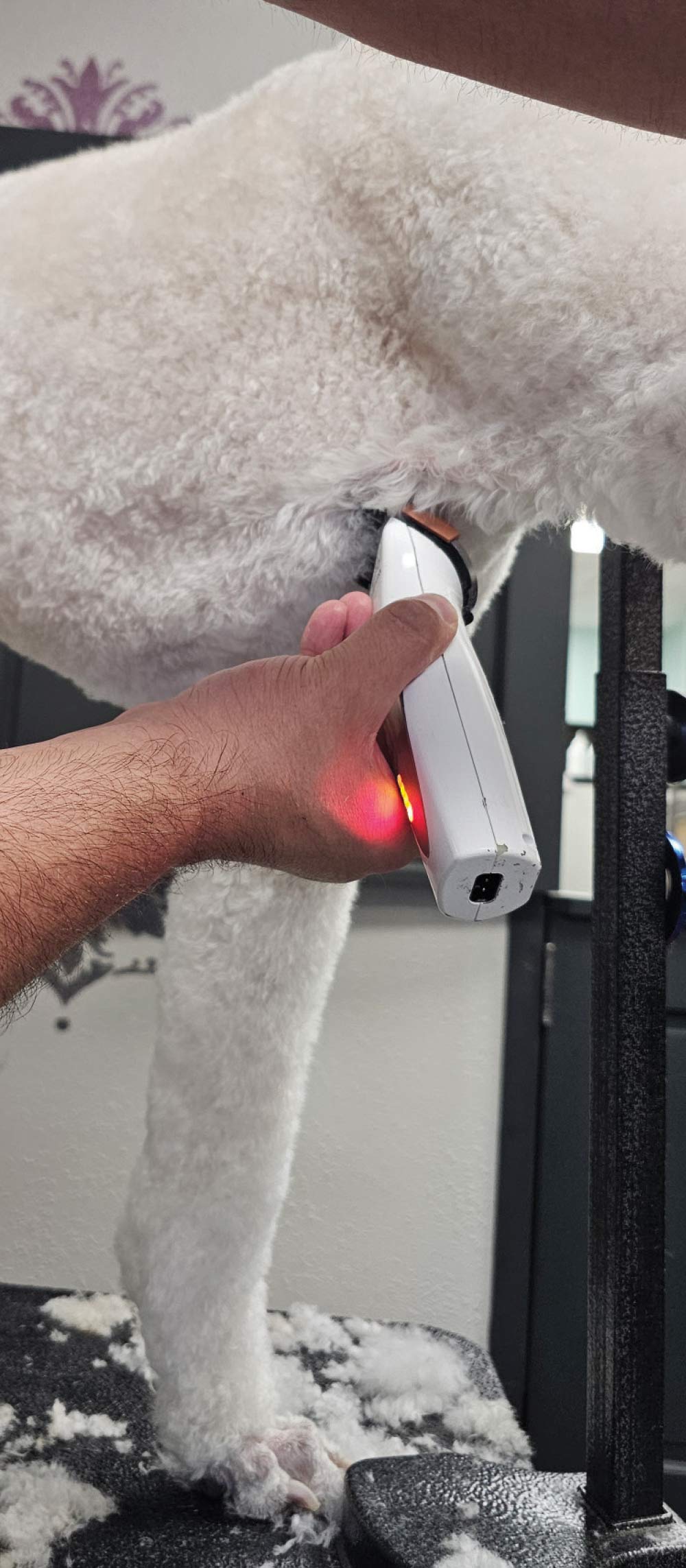
Fig. 8) To access the inside of the armpit, stand in front of the dog and pull the front leg forward.
Fig. 9) While the leg is still pulled forward, step to the outside of the dog to access the outer area of the armpit.
Now, keep making those poodles cute and fresh by confidently and safely tightening up those details!


Classified
Groomer Needed
Precious Goldendoodles in NJ looking for someone to love us while keeping us beautiful. Our mom has an in-home grooming spa—you just need to bring your own tools! Someone looking for intern hours is also welcome. Needed for 5-10 Goldendoodles every 6-8 weeks. Text 973-229-0142.



Thanks for reading our February 2026 issue!