



Photos provided by Mercedes Schenk
 f you’ve ever wondered what house-call cat grooming was all about or whether it’s something that could work for you, the following real-life interview pulls back the curtain a bit and provides an honest look into one groomer’s journey to a business working with cats in their own environment and developing a style of care that is deeply rooted in understanding feline behavior and stress.
Mercedes Schenk didn’t start out as a groomer. In fact, her path into the industry came through education. She went on to build a career in teaching, developing animal husbandry and horticulture curriculum for Montessori schools, and working as both a Montessori guide and a public school educator.
Like a lot of people who find their way into grooming, there wasn’t one single moment that changed everything for Mercedes, but there was a realization that it was possible to build a career that felt more aligned.
“I started to feel burnout after having our third child,” she shares. “And it doesn’t feel great to say it, but the real decision was financial. I made in one weekend grooming cats in my regular neighborhood community than I did an entire week of teaching.”
“There’s a luxury and relationship you get from coming into someone’s house to groom. The animal never leaves the comfort, familiarity, or safety of their own home.”
– Mercedes Schenk
“I’m a first-generation and second-career groomer,” Mercedes explains. “I always wanted a career working with animals, but I didn’t love working in a veterinary setting.”
Like many groomers, her business model didn’t start fully formed. House-call grooming was originally meant to be temporary.
“I started house-call because it was accessible,” says Mercedes. “The idea was to build clientele and eventually get a mobile unit.”
But as her business grew, what was supposed to be a stepping stone quickly became the foundation of Mercedes’ entire business and was exactly the right fit for both her and the type of clients she serves.
“There’s a luxury and relationship you get from coming into someone’s house to groom,” she shares. “The animal never leaves the comfort, familiarity, or safety of their own home.”
Depending on travel and timing, Mercedes typically grooms between six to nine cats per day. That number alone often surprises groomers who assume house-call work is slower or less productive, but efficiency comes from experience, planning and knowing what each appointment will require before you even walk in the door.
There are definitely other misconceptions about house-call grooming, especially within the grooming industry.
“I think there’s a stigma that house-call is kind of… not legitimate,” Mercedes notes. “Like you’re doing it because you can’t afford something else.”
In reality, she has seen the opposite. There is a strong demand for in-home grooming, especially among senior clients, busy households and cats that are anxious, reactive or have medical concerns. And the setups inside clients’ homes are often far more functional than people expect.

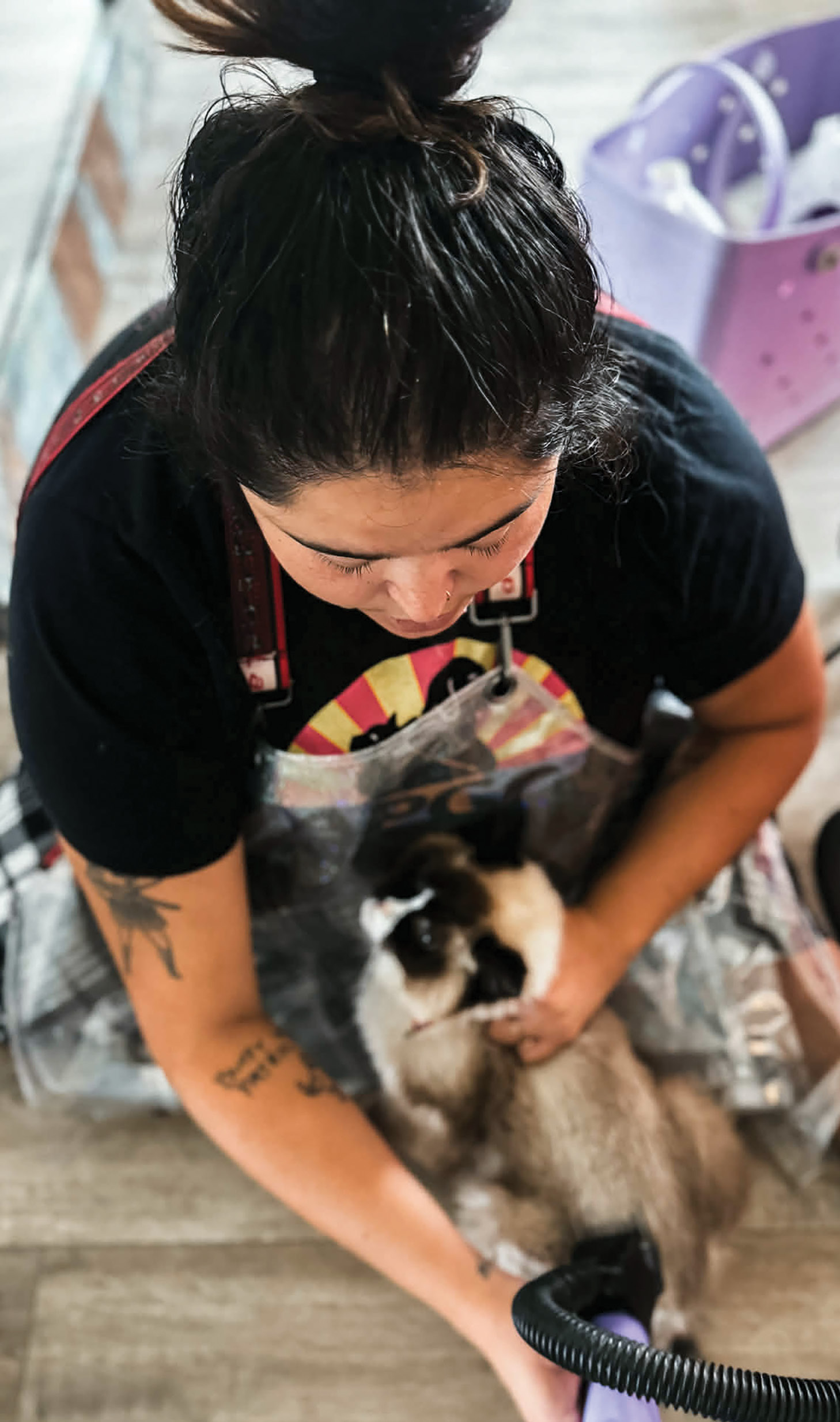
Some clients even go as far as designing or remodeling areas specifically for grooming, and she’s had people tell her they look for homes with washable spaces when they’re buying.
Working inside someone else’s home comes with its own challenges, however.
“Odor and cleanliness is probably my biggest ick,” Mercedes admits.
There is also the reality of being in a person’s private environment and learning how to filter what you notice, whether that is clutter or personal situations you would never encounter in a salon setting. And sometimes the challenge is not about time or difficulty, but energy.
“Certain appointments can be emotionally draining, which is something many groomers do not fully understand until they experience it themselves,” Mercedes notes.
Despite those challenges, the connection she builds with her clients is one of the biggest advantages of house-call grooming.
“Nothing beats the relationship, trust, communication, and connection that you make working in this type of environment,” shares Mercedes.
With the owner being present, they see exactly how their cat responds and become part of the process. That naturally shifts the conversation and it becomes less about the finished groom and more about how the cat is tolerating the experience.
It also opens the door for better education, helping owners understand that grooming is not just about appearance but about hygiene and preventative care as well.
Safety is a major consideration when working alone in clients’ homes, and it is something Mercedes takes seriously. She carries two phones—one for clients and one that shares her location—and approaches each day with that awareness in mind. And just as important as safety is learning how to set and maintain boundaries.
“The hardest lesson I’ve had to learn is to stop explaining myself,” says Mercedes.
Over time, she realized that over-explaining decisions often invites more pushback rather than resolving it. Now, she trusts her instincts. If something feels off or she dreads going back to a client’s home, she simply does not rebook. And if necessary, she is willing to end an appointment and refer the client elsewhere.
Mercedes’ personal approach to grooming is often described as holistic, but she is quick to clarify what that actually means.
“When people hear the word ‘holistic,’ they think of crystals, essential oils—all of that,” she explains. “But it means looking at the whole picture and understanding how behavior, stress, environment, and physical health all work together.”

“What we know about anxious cats is their tolerance is directly linked to changes in their environment,” she notes.
Grooming cats at home removes a significant layer of stress before the groom even begins. They are not dealing with transport, unfamiliar smells or a new environment, and that alone can increase their ability to tolerate the grooming process.
When it comes to technique, Mercedes emphasizes adaptability over rigid systems.
“There is no single right way to work with cats,” she states.
Instead, Mercedes encourages groomers to develop a wide range of handling skills and approaches so they can adjust based on the individual cat in front of them. A big part of that shift is letting go of canine-based handling concepts and truly understanding how cats function physically and behaviorally.
For groomers thinking about adding house-call services, her advice is practical and direct: “Start with safety, build a system, and make sure someone always knows where you are,” Mercedes advises. “Beyond that, personality matters. If you genuinely love people as much as you love cats, you’re going to be successful.”
Just as importantly, though, she says is to treat it like a real business. Too many groomers are undercharging, skipping policies or hesitating to set boundaries because they feel less legitimate without a physical location. In reality, you are the business, and how you present and value yourself matters.
At the end of the day, everything Mercedes does comes back to one clear boundary: “If I think it will hurt the cat psychologically or physically, I won’t do it,” she expresses.
Mercedes knows what she is capable of as a groomer, but capability is not the same as responsibility. The question is not whether she can complete the groom, but whether she should. If the cat cannot tolerate the ideal result, then the priority shifts. Progress can be gradual or it may stop where the cat is comfortable.
And in true Mercedes fashion, she sums it up in a way that is hard to forget: “It’s a cat, not a car.”