





Groom Expo West 2026 Open Creative People’s Choice Winner Alyssa Kasiba
Photo by Animal Photography
www.animalphotography.com



Contents | July 2026
16

by Chris Anthony
28

ALSO INSIDE
todd@barkleigh.com
adam@barkleigh.com
gwen@barkleigh.com
rebecca@barkleigh.com
luke@barkleigh.com
laura@barkleigh.com
brandi@barkleigh.com
carlee@barkleigh.com
evan@barkleigh.com
allison@barkleigh.com
james@barkleigh.com
karin@barkleigh.com
presley@barkleigh.com
Daryl Conner
Amanda McGrath
Dr. Cliff Faver
Blake Hernandez
Melissa Viera
ALSO INSIDE
ON THE COVER
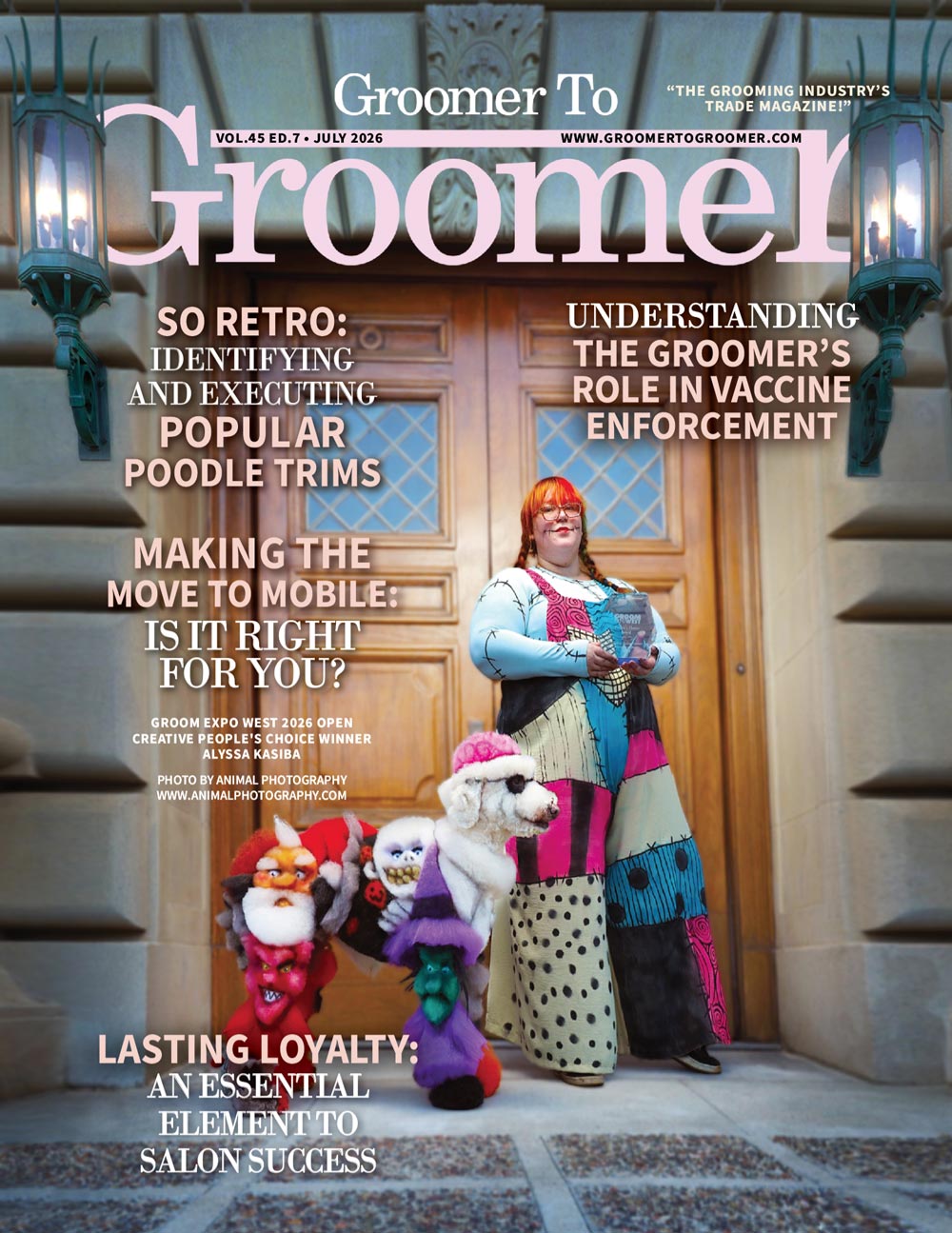
Photo by Animal Photography
www.animalphotography.com
- Andis2
- Animal Photography33
- AnimalsINK15
- Barkleigh Store – Groom Curriculum38
- Barkleigh Store – Holistic Pet Grooming39
- Barkleigh Store – Pet Release Forms25
- Barkleigh Store – The Pet Stylist Playbook43
- Barkleigh Store – The Pet Stylist Resource Guide24
- Barkleigh Store – The Ultimate Guide to Salon Creative28
- Barkleigh Updates46
- Best Shot Pet – 3 Step System47
- Best Shot Pet – UltraMAX21
- Cosmos Bathing Systems31
- CU1000 Pet Shears41
- Direct Animal Products9
- Double K Industries3
- Electric Cleaner Company7
- Evolution Shears11
- EZ Groom37
- Groomer’s Choice4
- IV San Bernard32
- Laube55
- Midmark36
- Mobile Grooming World56
- Odorcide23
- Paragon School of Pet Grooming27
- PetBizInsurance.com8
- PetLift51
- Puppy Playground17
- Quadruped Pet Care13
- Stallergenes Greer29
- John Stazko35
- Stone Mountain Pet Products22
- Wag’n Tails52
- World Pet Association | SuperZooDigital Only
Featured Spotlight Profile
Midmark



























by Kathy Hosler
 asey and Dani have each owned their grooming businesses for five years. Both are talented, highly skilled professionals capable of producing beautiful grooms day after day. On paper, they’re equals—but in reality, their businesses tell two very different stories…
Casey is booked out months in advance and has a waiting list of clients eager to get in. Dani, despite her ability, still finds herself worrying about slow weeks and inconsistent income.
So what makes the difference?
It’s not talent. It’s not tools. It’s not even location. It’s client loyalty.
Here’s a truth many groomers learn the hard way: A thriving business isn’t built one groom at a time—it’s built one relationship at a time. Loyal clients aren’t just repeat customers; they believe in you, they trust you and they choose you, over and over again. That kind of loyalty doesn’t happen by accident.
At the heart of every client relationship is one simple but powerful principle: kindness. Be kind—to both the pets and their people. When you treat every pet and every client the way you would want to be treated, it will set you apart in ways no marketing ever could. If clients feel that you genuinely care, they remember it.
Every new client costs you something—time, energy, marketing, emotional effort, etc. You answer their questions, manage expectations and work hard to make a strong first impression. But when that pet owner becomes a loyal client, they rebook without hesitation, refer friends and family, respect your pricing and trust your recommendations.
Loyal clients also make your days go smoother by understanding your process and respecting your time. There’s less explaining, less negotiating and far less stress. You get to know them, their pets and often their lives. These are the clients who sustain your business long-term. They’re not just part of your schedule—they’re the foundation of it.
When you are a newer groomer starting to build your business, it’s tempting to say yes to every pet and every client. Going the extra mile to establish a strong client base can make a big impact. But when you take the time to fully explain your process, follow up after a first visit and be available to answer questions, pay close attention to how the clients respond. Some will truly appreciate your effort, follow your recommendations and respect your time, while others will simply expect more…and more…without ever valuing what you do.
As your business grows, you’ll become more selective about who you add to your client base. The goal isn’t to keep everyone, but to keep the right ones. The clients who value you will become loyal. The ones who don’t will drain your time, energy and confidence. It’s okay to let those clients go; in fact, it’s often essential for long-term success.
One of the most powerful ways to build client loyalty is through continued education. When you go to grooming shows, attend to seminars, invest in advanced training, work toward certifications and join professional grooming organizations, you acquire new skills, gain knowledge and build confidence.
The clients who value you will become loyal. The ones who don’t will drain your time, energy and confidence. It’s okay to let those clients go; in fact, it’s often essential for long-term success.
In every groomer’s life there are difficult days—late clients, missed appointments, miscommunications and stress. How you handle those moments matters more than you might think. It’s easy to feel frustrated by some clients, and those feelings are valid. But reacting with anger, raising your voice or speaking harshly is rarely the answer.
Professionalism is not about avoiding boundaries; it’s about how you enforce them. You can be firm without being harsh, you can be clear without being cold, you can be direct without being disrespectful and you can absolutely hold clients accountable without ever raising your voice.
When you stay calm, communicate clearly and handle challenges with professionalism, you build a deeper level of trust. Clients feel safe with you—and not just because of your skill, but because of your character.
Loyalty isn’t one-sided, either. The best client relationships are built on mutual respect. When clients feel appreciated, they’re more likely to stay committed, refer others and support your business through any changes, whether that’s price increases, policy updates or schedule adjustments.
Business growth doesn’t always come from adding more clients; it often comes from strengthening the relationships you already have. Your best clients truly are worth their weight in gold. They keep your schedule full, your income steady and your workdays more enjoyable.
A loyal client base doesn’t happen by chance. It’s built intentionally through consistent actions over time, clear communication, thoughtful service, and a genuine commitment to both pets and their people. It’s built through kindness when it’s easy and professionalism when it’s not. When you create relationships rooted in trust and respect, you’re building a business that lasts.
In our industry, trends will change, techniques will improve and styles will evolve, but one thing remains constant: People (and their pets) stay where they feel valued, understood and cared for. Provide that, and you won’t just have customers—you’ll have loyal clients for life!


 s the grooming industry evolves, one trend is impossible to ignore: the steady shift from traditional brick-and-mortar salons to mobile grooming. It raises an important question: Is going mobile the right move for you? The answer isn’t one-size-fits-all. It depends on your goals, your work style, and how well you plan for both the opportunities and the challenges.
When speaking with groomers who have made the transition, a common theme emerges: the independence. Working alone, setting your own schedule and eliminating much of the day-to-day salon drama is incredibly appealing. And honestly, who wouldn’t want that level of control? But independence comes with responsibility. Mobile grooming requires a strong mindset, solid time management and a clear understanding of what it takes to generate a sustainable income.
If you’re no longer working for someone else, the structure shifts entirely onto your shoulders. You need to know your numbers, including what you must earn to cover expenses, maintain your equipment and still be able to pay yourself a living wage. That takes discipline and consistency. Freedom is a major benefit, but it only works if you can manage it effectively.
One of the first hurdles is the cost of entry. Purchasing and outfitting a grooming van can be comparable to building out a salon space. Some groomers choose to buy used units to reduce initial costs, and while that can work out well, it can also come with hidden risks. Repairs on a used van can be expensive—not just financially, but in lost income. If your van is in the shop for several weeks, what happens to your clients? Do you have a backup plan? Are your clients loyal enough to wait or will they move on?
For established groomers with a strong client base, these situations are easier to manage. But for someone just starting out, unexpected downtime can be much more damaging. Planning for these possibilities ahead of time can make all the difference.
Scheduling is another critical factor. In an ideal scenario, your appointments are grouped closely together to minimize travel time. The more efficient your route, the more profitable your day. Travel time is one of the biggest factors that can eat into your income. Some groomers dream of setting up in a neighborhood or community space where multiple clients come to them in one location.
Pricing is where many mobile groomers undervalue themselves. It’s important not to fall into the trap of competing directly with salon pricing. Mobile grooming is a premium service; you’re bringing convenience directly to the client’s door, saving them time and effort. And that has real value.
Think of it this way: Services like food delivery charge more than dining in, and customers accept that because of the convenience. The same principle applies here. If a salon charges $80 for a groom, a mobile service should reasonably charge more, often $120 or higher, depending on your costs.
When setting your pricing, factor in fuel, travel time, the fact that you only do one dog at a time and the added value you provide. The goal is to ensure your pricing supports your business, not undermines it.
Fuel costs are another consideration. As gas prices fluctuate, you may need to adjust accordingly. Some businesses implement a fuel surcharge when prices exceed a certain level. Framing it this way helps clients understand that the increase is tied to external factors and may not be permanent. Transparency builds trust, and most clients will appreciate the honesty.
Insurance is an area that should never be overlooked. Operating a mobile unit increases your exposure to certain risks. Vehicles can break down, accidents can happen and unexpected situations can arise. While risks exist in a salon setting as well, mobility introduces additional variables. Having the right insurance coverage protects not only your business but also your peace of mind. It’s always better to be prepared than to face a preventable setback.
Financial management becomes even more important in a mobile business. Repairs, weather disruptions and seasonal fluctuations can impact your income. Building a financial cushion allows you to navigate these challenges without unnecessary stress. Planning ahead for slower periods or unexpected expenses helps keep your business stable.
Then there are the everyday logistics of mobile grooming. Where will you get water? Will you use a generator or connect to a client’s power supply? Where will you dispose of gray water? What about the basic need for use of a bathroom during the day? These are all manageable challenges, but they require thoughtful planning. The more prepared you are, the smoother your operation will run.
Mobile grooming can be an incredibly rewarding path, offering freedom, flexibility and the ability to build a business that reflects your lifestyle. However, it is important to recognize that this is not an easier route; it is simply a different one. The independence that makes mobile so appealing also requires a higher level of discipline, planning and accountability.
Success in mobile grooming does not happen by chance. It comes from understanding your numbers, managing your time with intention, preparing for setbacks and consistently delivering value that justifies your pricing. When done well, it allows you to build a business that is not only profitable but also more personal, more focused and often less chaotic than a traditional salon environment.
There will be challenges—equipment will need repairs, schedules will shift and unexpected situations will arise. These moments can feel overwhelming if you are unprepared; however, they are manageable when you have built a strong foundation and thought through the details in advance.
If you are considering making the move, be honest with yourself about what you want and what you are willing to commit to. Seek out mentors, learn from those who have experience and take the time to plan carefully. The more intentional your approach, the greater your chances of long-term success.
Mobile grooming is not for everyone. But for the right person, with the right mindset, it can be one of the most fulfilling and empowering directions you can take in this industry. Make the decision with clarity, prepare with purpose and move forward with confidence.
Dr. Cliff Faver graduated with a BS in Biology/BA in Chemistry before getting a Veterinary degree in 1987. He is the past owner of Animal Health Services in Cave Creek, Arizona and now the US distributor for Iv San Bernard products, teaches the ISB Pet Aesthetician Certification program, and speaks internationally on hair and skin. His passion is to merge groomers and veterinarians to aid in helping and healing pets. He is also a member of AVMA, AAHA, AZVMA, Board member with Burbank Kennel Club, and has served on Novartis Lead Committee, Hill’s International Global Veterinary Board, and a Veterinary Management Group.



 abies is a zoonotic disease, meaning that it is transmittable between people and animals, and once symptoms appear, it is almost always fatal to the animal or the person. The rabies vaccine is legally required for all dogs and cats in all 50 states and U.S. Territories, and most places in the world. But not all countries are as compliant, and the disease is still globally present everywhere.
Many nations also have large populations of stray dogs, including the United States. Stray dogs globally are mostly unvaccinated but still live in and around people to survive. So the risk remains real, even in our own country.
Rabies vaccines are usually required of puppies somewhere between four and six months of age, well after their earlier puppy wormings and shots. As groomers, we are legally obligated to check for rabies vaccinations with all of our grooming clients regardless of age.
It is also advisable if you own a grooming business to check with your property insurance company for what they require you to carry in terms of insurance to cover transmissible disease risks and for liability. Many states also legally require groomers to report all dog and cat bites for this very reason.
Other potentially deadly and very serious diseases that dogs should be vaccinated for include Parvo and Distemper. Canine parvovirus (CPV) can be airborne, and while people cannot get CPV from dogs, we can get another form of parvovirus, Parvo B19, that is transmissible between people.
Laws will vary in different locations. For example, rural areas versus urban areas will carry different requirements and regulations regarding vaccines. One reason is because of the large numbers of rats in urban areas that carry Leptospirosis, which might change the laws required for those vaccines in various counties. Every groomer should check the exact laws for the localities in which they work.

Many of us remember the horrific wave of a mutated bird flu from Asia that turned into the Canine Flu, H3N2 virus, that started killing dogs in Chicago in 2015 and spread nationally like crazy. The hardest part about that deadly epidemic was that there were no vaccines for this new mutation, and dogs were dying rapidly and in large numbers. It goes without saying that disinfecting every surface an animal touches—tub, table, crate—also plays a role in disease control.
Whenever we groomers get a new client, we should give them a legally constructed client contract, and they should have to produce all vaccine records and any updated relevant health records. We should know who their veterinarian is and we should discuss with the owner in advance the access to the veterinarian while the pet is in our care. We should also include language in our client contracts about owner financial responsibilities and veterinary records access.
Groomers aren’t just haircutters—we care for dogs. We are paid to be an expert in what we do and to be professional with the pets we care for. That’s why this important detail work of vaccination compliance should be built into the heart of your grooming business.

by Chris Anthony
 s a house-call groomer, the connections we make with our clients and their pets can be far deeper than those made in a salon setting. Being able to see the pet in its own environment and watching their genuine interactions with their family can be so rewarding. However, there is an “elephant in the room.”
There is always that first meeting—and even the first few appointments—where we’re entering a stranger’s home and setting up shop for a few hours. This requires not only a strong sense of self to tell someone what to do in their own home but also how to keep ourselves safe while we’re doing it. So, let’s dive into the deep end and talk personal safety as a house-call groomer.
It starts with the first contact. That very first call or text with the client can tell us a lot. If you are more comfortable with texting, by all means follow up by text, but a brief phone call is highly recommend. Not only is tone easier to read on a call as opposed to text, but it’s also a good way to tell if the person matches the voice. If they give you a bad feeling, don’t book the appointment.
Once you’ve had a phone conversation and, most importantly, gotten their address, do your research—Google searches and street views are your friend. Did they say it was a house and an apartment shows up or, worse, an abandoned-looking lot? A 30-second search may have just saved you. Getting the client’s address before officially confirming their appointment eliminates the stress of being in your car, ready to go, waiting on a text back before you head there. It also allows you to plan your route.

When it comes to any appointment, you should have a schedule or calendar that a friend or partner has access to so someone always knows where you are supposed to be. But when you go into a newer client’s home, make a safety call to a friend or partner. It can even be a message left on voicemail—no one needs to know you’re talking to a recording. This lets the client know that someone else knows exactly where you are and expects to hear from you in a specific time frame. There are also apps like Life360 that track where you are, which you can use as an added layer of protection to let your family keep track of you.
There is always the chance that you are mid-groom and something seems wrong—maybe the vibes are off or someone on the premises is displaying outright bad behavior. Getting out is your first priority. If you feel in danger and time is an issue, you are more valuable than all of your equipment—get out of the home and leave all your stuff if you need to. Make the call from a safe place (like locked in your car), and the police will escort you back to the home to gather your equipment.

The most important thing about staying safe during house-call grooming is listening to your gut. We trust our instincts with the pets in our care, and we should listen to them for ourselves as well. Pay attention to your surroundings—even while focusing on the pet, we can keep an ear out for what’s going on around us.
More of the skills we already have are transferable to house-call grooming than we realize. Listen to and trust your instincts—you are wiser than you know!

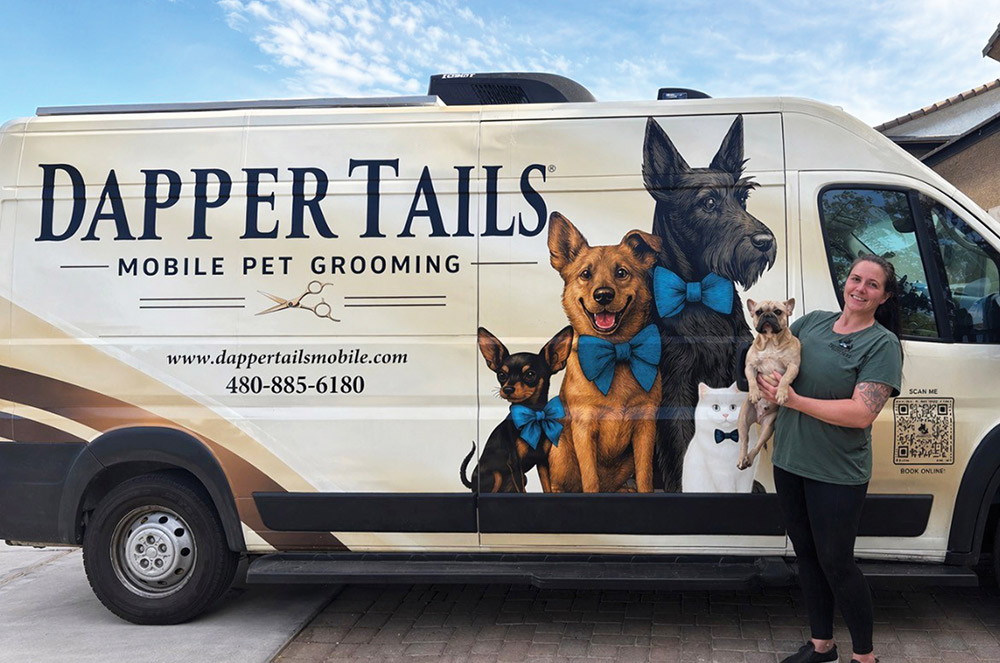
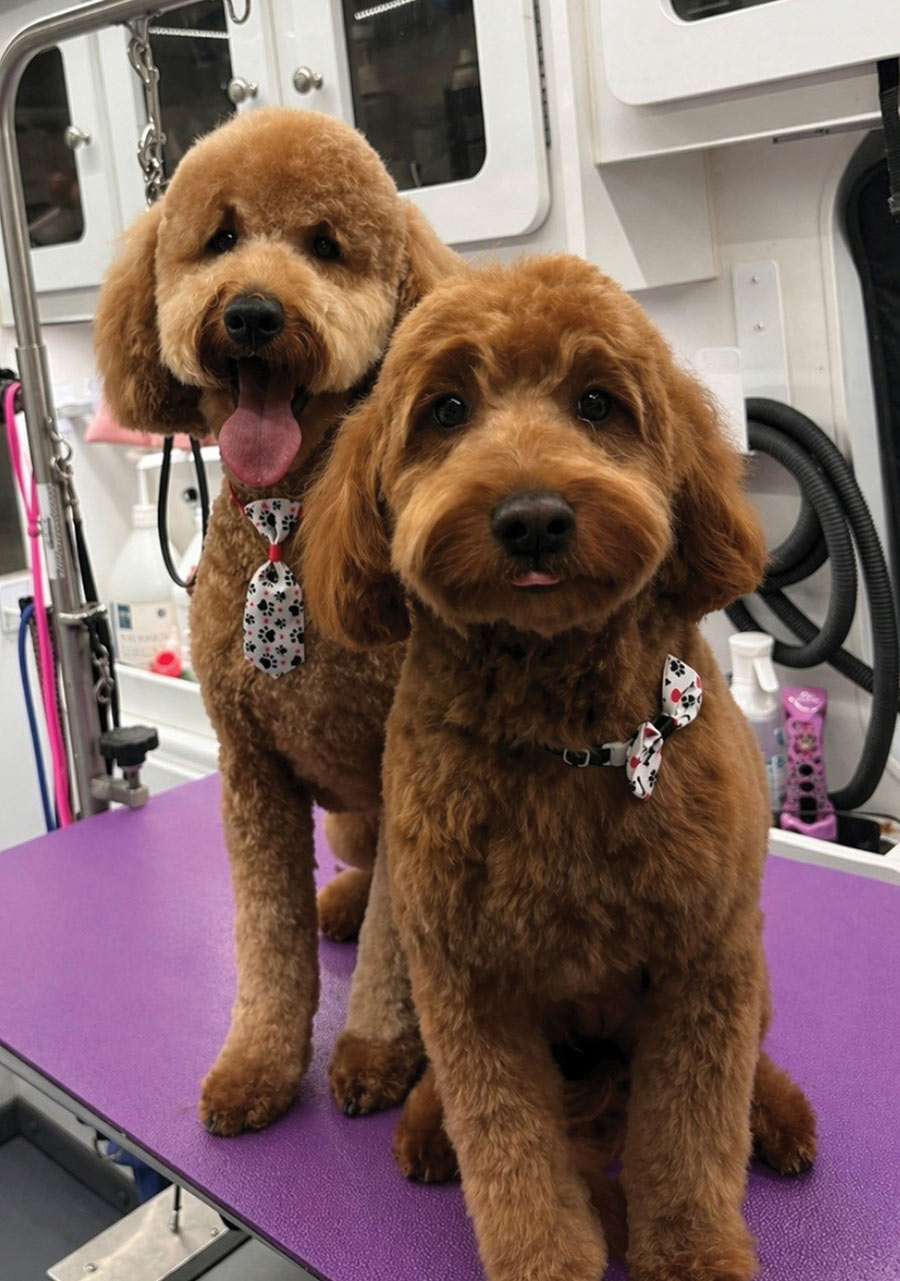

Photos provided by DapperTails
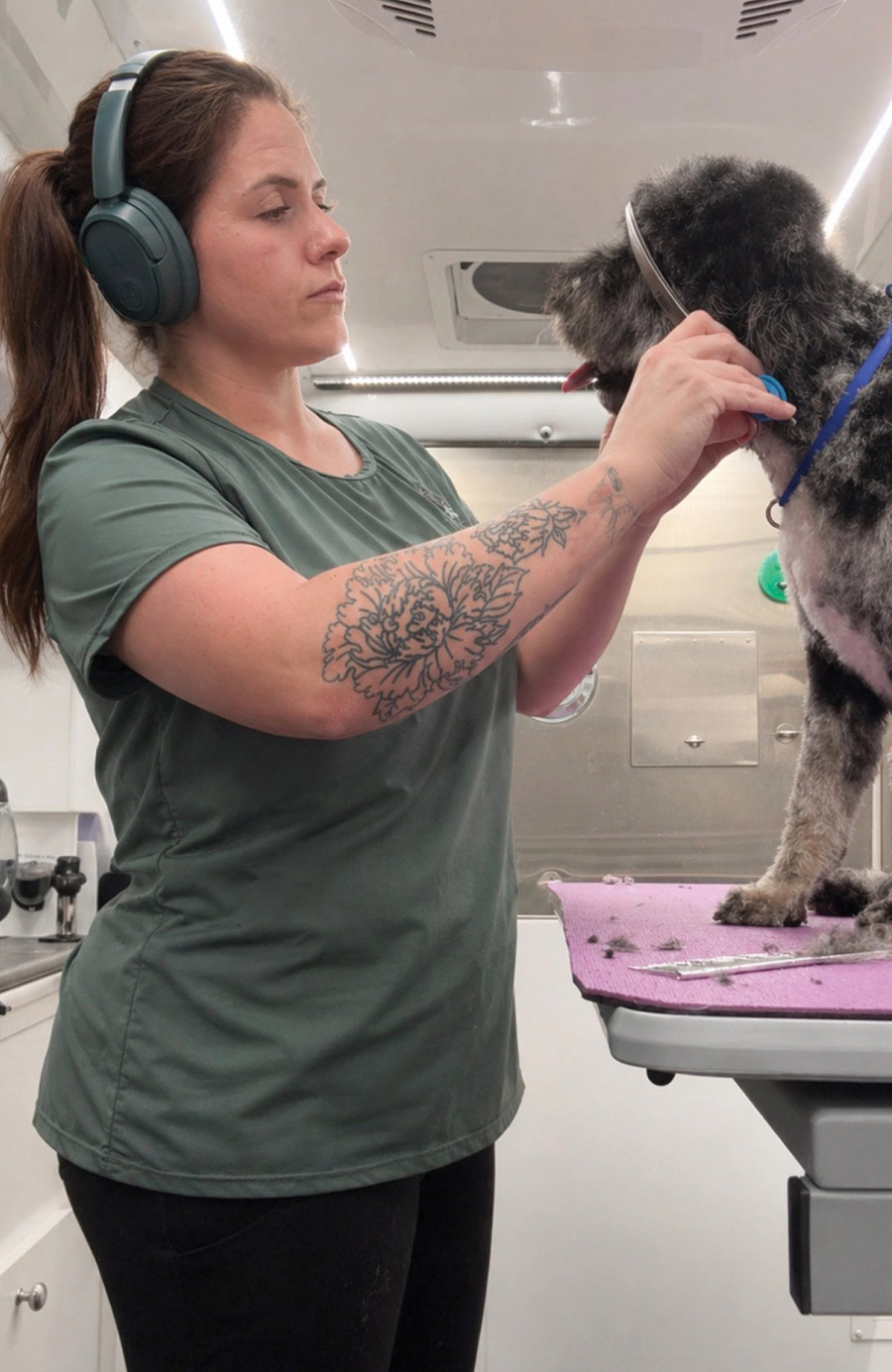
 was about 15 or 16 years old when I just walked into a shop and said, ‘Hey, I like dogs,’ and they took me under their wing,” recalls Scottsdale, AZ-based mobile groomer Heather Finegan.
What started as a simple introduction quickly turned into something much bigger, with an unexpected turn. Within a year, the grooming shop owner suddenly left the business behind.
“At 17, the owner actually left her shop to me,” Heather says. “Obviously, I was too young.”
Still in high school, she adapted the opportunity to fit her life, moving the operation into her home and continuing to groom while finishing school. It was an unconventional start, but one that shaped her career and her future.
“I’ve always had a really strong work ethic,” explains Heather. “I chose to work instead of going out with friends. I just loved being around the dogs.”
That early dedication carried through her 20s as she continued learning in different shops, refining her skills and gaining experience. Heather also consistently sought out new knowledge, learning from other groomers, trade shows and her own hands-on experience.


Beginning with a single van and no clients, the business grew quickly through a combination of persistence and grassroots marketing, and within a year, they were up to four vans.
At one point, however, burnout caused her to step away from grooming entirely. After years in the industry, the pace and pressure of shop environments began to take a toll.
“I actually quit grooming for a while,” Heather confesses. “I didn’t think I was going to go back.”
Luckily, the pull of the profession and the connection she felt with the animals proved too strong to ignore. Heather’s return to grooming came through an unexpected opportunity in mobile grooming, a segment of the industry she hadn’t previously explored.
“I had never done mobile grooming before,” she recounts. “I didn’t know what I was doing.”
“I was grooming a client’s dog, and she connected me with the owners,” explains Heather. “We started DapperTails here in Arizona from the ground up.”
Beginning with a single van and no clients, the business grew quickly through a combination of persistence and grassroots marketing, and within a year, they were up to four vans. The rapid expansion reflects both the demand for mobile grooming and Heather’s ability to connect with clients.
“It’s taken off in a way I didn’t expect,” she adds enthusiastically.
In the early days of DapperTails, growth depended less on traditional advertising and more on direct outreach and community engagement.
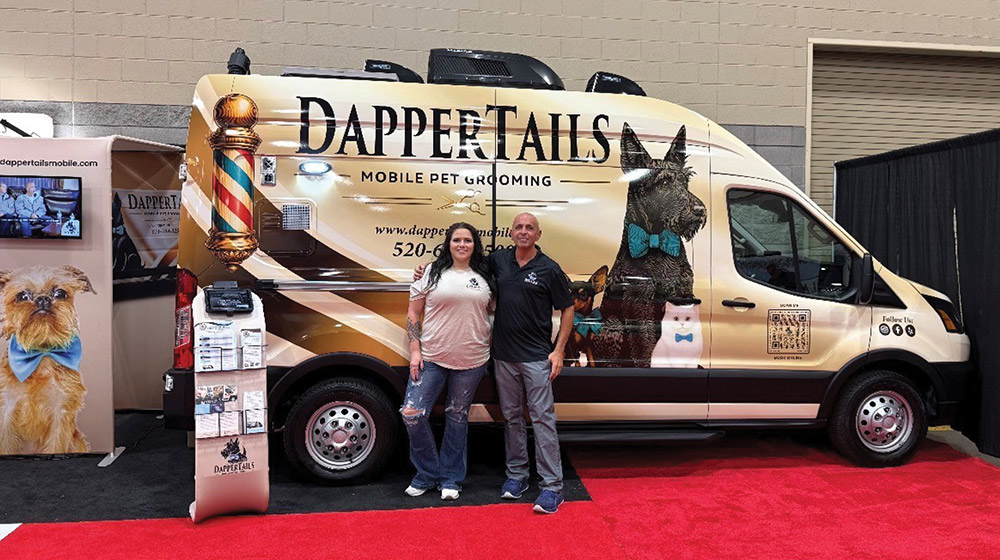
For Heather, the mobile grooming setup offers a level of control and comfort that traditional salons can’t match.

For Heather, the mobile grooming setup offers a level of control and comfort that traditional salons can’t match.
That hands-on approach helped DapperTails establish a client base quickly, supplemented by word-of-mouth referrals.
“A lot of it was just putting myself out there,” Heather says. “And then once people found us, they stayed.”
Today, many of Heather’s clients feel more like extended family. And that personal connection is a hallmark of mobile grooming, where appointments are one-on-one and often take place right outside the client’s home.
“I know so much about my clients,” she shares. “You build real relationships in this business.”
For Heather, the mobile grooming setup offers a level of control and comfort that traditional salons can’t match. Each van is fully self-contained, equipped with water, electricity and climate control, allowing her to operate independently throughout the day.
A typical appointment begins with a brief introduction at the client’s door, followed by the grooming process inside the van—from bath and dry to haircut and finishing touches.
“I take before and after pictures and send them to the owners,” Heather says. “They love seeing the transformation.”
The experience is streamlined but also highly personalized, with each dog receiving her full attention. And one of the biggest advantages of mobile grooming, Heather notes, is the reduced stress for animals.
“There’s no loud noises, no other dogs, no cages,” she adds. “It’s a calm environment.”
That setting allows Heather to work with dogs that may struggle in traditional salons, including seniors or pets with behavioral challenges.
“I have the patience to work with older or nervous dogs,” she says. “I can take my time and help them get comfortable.”
Over time, Heather has seen significant changes in some of her clients. And that transformation is one of the most rewarding aspects of her work.
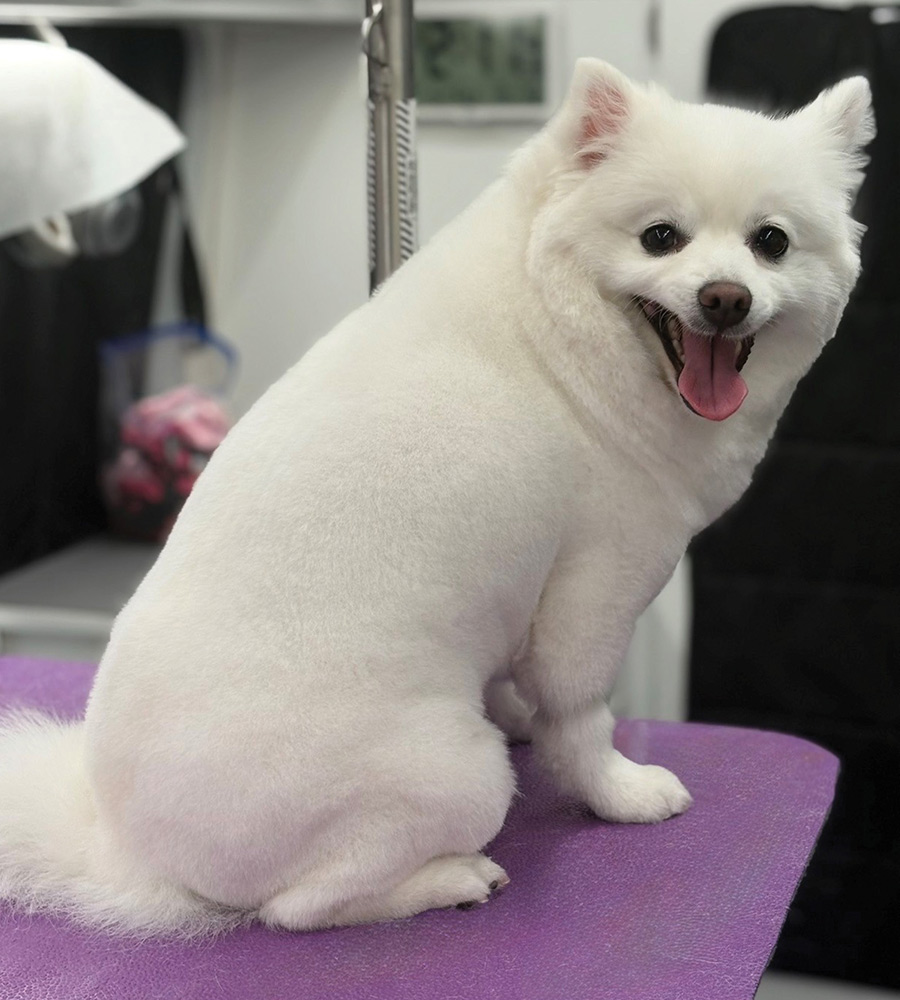

Beyond the benefits for pets, mobile grooming has also improved Heather’s own quality of life by allowing her to make her own schedule. As a mother of 15-year-old twins, the flexibility allows her to prioritize her family without sacrificing her career.
“If something comes up, my clients are understanding,” Heather says. “Family comes first.”
The contrast with her previous experience in salon environments is stark.
“In a shop, there’s so much pressure to get through a certain number of dogs,” explains Heather. “By the end of the day, you’re exhausted.”
In mobile grooming, however, she has found a pace that works better for both her and the pets.
Operating a mobile business requires careful scheduling and route management—something DapperTails has streamlined with the help of technology.
“We use a system that helps with routing,” explains Heather. “It tells us the best days to schedule clients based on location.”
While she services a wide area across the Valley, she tries to keep travel time manageable.
“We don’t like to drive more than 30 minutes,” Heather notes. “But we’ll go further if needed.”
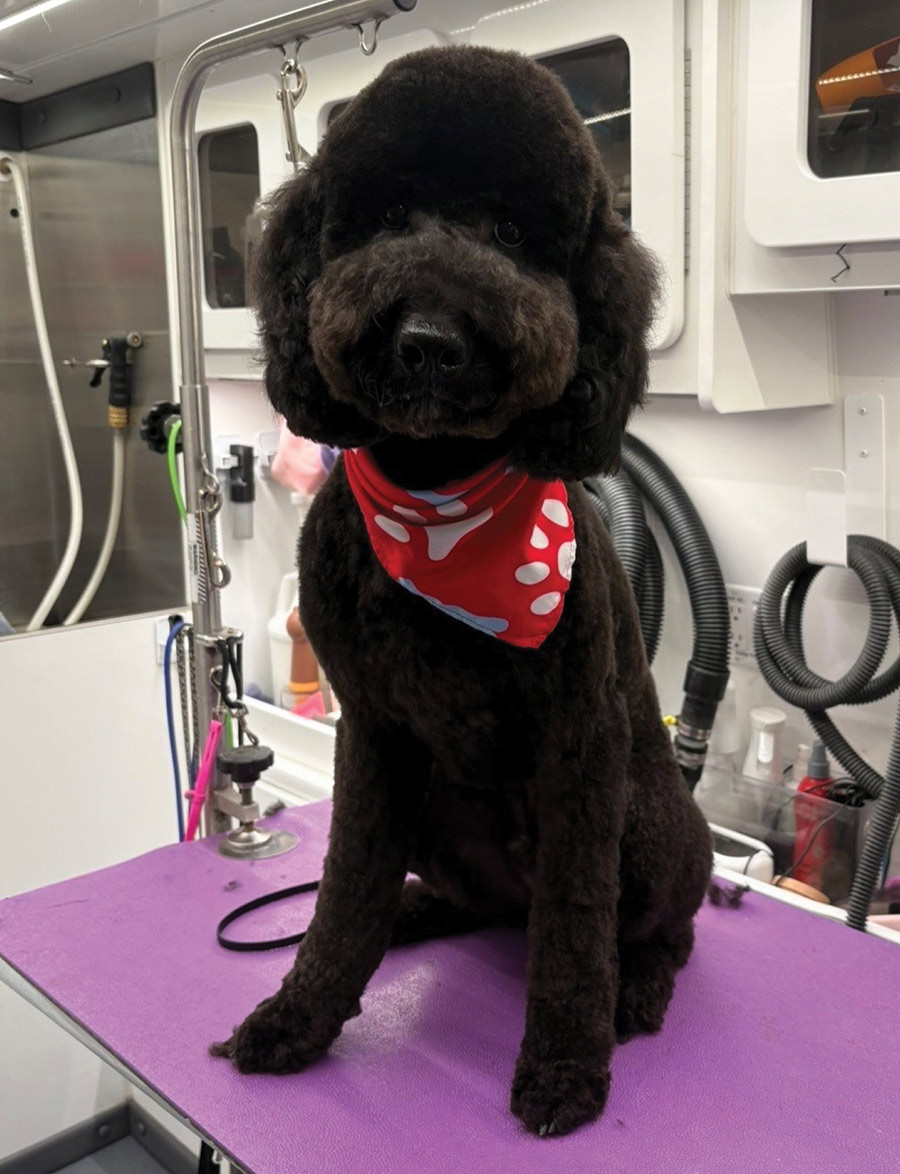
“I’m always researching,” she shares. “Whether it’s new styles like Asian fusion or the best shampoos to use.”
That curiosity helps her stay current in an industry that continues to evolve, particularly with the growing popularity of doodles and other high-maintenance breeds.
For Heather, though, grooming is about more than appearance—it’s also an opportunity to support pet health. Over the years, she has identified lumps and other concerns that owners might not have noticed, allowing them to seek veterinary care sooner.
“That means a lot to me,” she explains. “You’re helping in a bigger way. I really do enjoy being around the dogs. It’s what makes me happy.”
With DapperTails continuing to grow, Heather sees plenty of opportunity ahead. The Arizona operation has quickly scaled to multiple vans, with plans for additional growth and potential franchise opportunities.
“I’d love to continue expanding and be part of that,” she shares.
At the same time, Heather remains focused on maintaining the quality and care that have driven the business’s success.
“I have an incredible team,” she adds. “That makes all the difference.”
After more than 20 years in grooming, Heather still finds joy in the work she does every day. From her early days walking into a shop as a teenager to helping build a fast-growing mobile business, her journey reflects both resilience and passion.
“At the end of the day, it’s about the dogs and the people who love them,” concludes Heather.


 hile mobile grooming attracts people who want either convenience or a calm environment for their pet, groomers with all different business models can benefit from understanding who their ideal customer is and how to reach them. For many, reaching puppy owners is important. However, it takes more than marketing to keep new puppy owners returning to your business; you also need the skills to successfully introduce puppies to grooming.
A positive introduction to grooming benefits both the puppy and the groomer. When done correctly, it can set a puppy up for a lifetime of success. If the majority of dogs you see on your table are well-behaved, you’ll be able to groom faster and more efficiently. Happy puppy owners can become lifelong clients.
In order to be an expert puppy groomer, you need to possess both knowledge and patience. They should be exposed to grooming as soon as possible, meaning the owners should begin handling and working with their puppy at home before their first grooming appointment.
Young puppies should have shorter grooming sessions at first as they learn the process. It’s also important to make every interaction positive and friendly, as it only takes one bad or painful experience to make the dog dislike being groomed or bathed.
Cooperative care for grooming and vet care is one of the greatest things pet owners can work on with their dog since they will have a lifetime of grooming and vet visits.
Another idea is to collaborate with local dog trainers, especially those who teach the importance of acclimating puppies to grooming in their classes. More trainers are recognizing the importance of including handling and grooming training in their lesson plans, and for training facilities without a salon on site, building relationships with reputable groomers is essential.
Cooperative care for grooming and vet care is one of the greatest things pet owners can work on with their dog since they will have a lifetime of grooming and vet visits. Dogs can be trained to voluntarily offer their paws for nail trims, hold certain positions for procedures and even offer to have a blood draw at the vet.
Even though pet groomers aren’t training puppies, they can play a role in helping owners train important life skills by communicating expectations and ensuring puppy clients have positive experiences. A positive experience might mean providing several bath visits before a full haircut or being honest with clients about their puppy’s behavior so they can work with the puppy at home.
Mobile groomers already have an excellent environment for helping puppies to succeed. When you begin to market yourself as a puppy groomer and communicate with clients about having realistic expectations from their new puppies, the difference is evident.
As a groomer who not only cares about the haircut but also the experience you are providing, you can continue to set yourself apart. The clients most likely to appreciate your effort and dedication will feel welcome and included in your program. Being an expert puppy groomer is about having both the skills to work with puppies and the confidence to communicate with clients.


 obile grooming continues to grow rapidly, driven by increasing demand for convenient at-home pet services. For many business owners, growth arrives quickly and often faster than expected. While this creates opportunity, it can also quietly strain the structure that keeps a business running smoothly.
At first, everything feels manageable—the calendar fills, routes extend and new clients are added. Over time, however, days get tighter, drive times increase, groomers feel rushed and operating costs begin to creep up. These are not random frustrations; they are early signs that growth is outpacing the systems and staff that hold the business together.
- Business direction: How the business plans to grow, which areas it serves and the level of service it promises customers.
- Organizational capacity: The groomers, vans, available work hours and internal processes required to deliver that service consistently.
- Operational systems: The scheduling, routing, customer records, and payment tools used to coordinate and manage daily work.
When business direction changes, alignment begins with recognizing how that decision affects daily operations. Expanding a service area or increasing booking availability does not only affect revenue, it also increases routing complexity and scheduling variability.
To remain aligned, organizational processes must be able to support those changes. Staffing practices and workflows may need to be reviewed, and operational systems must be capable of managing longer routes, additional constraints and higher appointment volume. Growth remains manageable when these adjustments happen together.
Changes in organizational capacity also require coordination. Adding staff, adjusting work hours or redefining internal roles alters how work is distributed across the business. For alignment to hold, business goals should reflect what the organization can realistically support, and operational systems must be configured to match new staffing patterns and workflows. When capacity changes are integrated into planning and system use, service delivery remains consistent as the organization evolves.
Operational systems can also drive change. Updates to scheduling processes, routing practices, or customer management tools can increase efficiency and visibility. For these improvements to be practical, they must support current service commitments and align with how staff perform their work. When systems reinforce both organizational capacity and business direction, overall coordination improves.
Sustainable growth depends on intentional coordination. Growth decisions are most effective when business direction, organizational capacity and operational systems are reviewed together.
As businesses grow, informal processes that worked at smaller scales become insufficient. Scheduling systems must manage more appointments, more constraints and more variability, and routing decisions require greater coordination.
At the same time, customer records and service histories become increasingly important to maintaining consistency. Each of these changes increases the demand placed on organizational processes and information systems. And because these demands grow simultaneously, alignment must be actively maintained.
When business goals advance without corresponding adjustments to organizational capacity and operational systems, strain builds within the structure supporting daily operations. This strain does not always appear immediately, but it increases as complexity grows.
- Appointments consistently run longer than expected
- Routes start to feel scattered or inefficient
- Scheduling and billing mistakes become more common
- Groomers feel worn down or frustrated
- Customer complaints increase even when demand is strong
Why Your Systems Are Part of Your Business Model
When these systems are aligned with business goals and organizational capacity, they provide meaningful visibility into operations. Owners can see how long routes actually take, how appointment volume affects workload and where service delivery begins to strain. Patterns in cancellations, travel time, and appointment length become easier to identify and address.
When systems are treated as secondary tools rather than strategic resources, this visibility is lost. Decisions become reactive and manual workarounds become common. As the business grows, these workarounds stop being effective. The risk of scheduling conflicts, administrative errors and inconsistent service increases. Using information intentionally allows leadership to adjust routes, staffing levels, and service boundaries before strain turns into burnout or customer loss.
Expanding bookings without adjusting routes or staffing creates pressure, expanding service areas without reviewing system capabilities introduces inefficiency, and changing systems without supporting employees leads to inconsistency. Groomers and field staff play a critical role in identifying early warning signs. They experience routing inefficiencies, scheduling issues and workflow challenges long before those problems appear in reports. Incorporating this feedback into planning and system adjustments strengthens alignment and preserves service reliability.
- Can our current team realistically support the added routing and scheduling demands?
- Do our routes still make sense as service areas grow?
- Are our systems capable of handling increased volume and complexity?
- Are we monitoring workload patterns and not just calendar fill?
- Are our systems supporting operations or starting to constrain them?
Growing a mobile grooming business should not mean longer days, higher stress and constant catch-up. Companies that scale successfully treat growth as a coordinated effort across strategy, operations and systems.
By maintaining alignment between business direction, organizational capacity and information systems, owners create a structure that supports reliable service, protects employees and enables sustainable growth.
Aaron Blackstone is a PhD student in Information Technology with a focus on business and operational systems. His wife, master groomer Kellie Blackstone, owns and operates Barking Blackstone Mobile Grooming in Wellington, Colorado. His work centers on helping service businesses align their systems, workflows, and growth strategy to support sustainable operations.


 s professional groomers, at one point or another many of us have dreamed about what it would be like to work alone—no salon drama, no constant noise, no interruptions; just you, your tools and the pet in front of you. Whether it’s a home-based salon, a mobile unit or traveling to clients’ homes, solo grooming offers a level of independence that can feel incredibly appealing. And, in many ways, it is.
But what often gets overlooked in that dream is the mental and emotional shift that comes with working alone day in and day out. The quiet that once sounded peaceful can start to feel isolating, and the independence that felt freeing can become mentally exhausting. This isn’t about discouraging anyone from going solo—it’s about being honest about the full picture so you can build a business that supports not just your income, but your wellbeing too.
The Appeal of Working Alone
There’s also something to be said for the calmer, more focused atmosphere. Without a busy salon full of barking dogs and overlapping appointments, many pets are less stressed, and as a result, the grooming process can feel smoother and more controlled.
For mobile and in-home groomers, this can be even more noticeable. You’re working with one pet at a time in a quieter setting without the added stimulation of other animals.
All of these factors can make solo grooming incredibly rewarding. But those same factors can also lead to challenges that don’t always show up right away.

There’s no one to chat with between grooms, no coworker to laugh with after a difficult dog and no one to quickly ask, “Hey, do these ears look even?” Those small, everyday interactions play a bigger role in our work lives than we often realize. What starts as peaceful can, over time, feel isolating.
When you work alone, however, every single decision falls on you. You’re managing your schedule, handling client communication, setting your pricing, troubleshooting behavior issues and making judgment calls throughout the day, all without immediate input from anyone else.
For mobile and in-home groomers, there are even more layers to consider. You’re navigating routes, managing time between appointments, adapting to different environments and often problem-solving on the fly. Individually, none of these decisions may seem overwhelming, but over the course of a day, week and year, they add up. That constant decision-making can lead to mental fatigue, even if your physical workload feels manageable.
Setting routines and putting policies in place can help this dramatically. If you already have a script or set steps to handle what comes up in your business, you can rely on the process already in place instead of having to make yet another decision. Taking the time to write out policies and procedures early on in your business can take a large mental load off your plate.
Attending trade shows, expos and grooming competitions is one of the most effective ways to reconnect. These events give you the opportunity to not only learn new techniques, but also to have real conversations with other groomers who understand exactly what your day-to-day looks like. Even attending one or two events a year can make a noticeable difference in how connected you feel to the industry.
The mental and emotional side of solo grooming is just as important as the business side, and it deserves just as much planning and attention.
Online communities can also play a valuable role, especially for those who may not be able to travel frequently. Groomer-focused groups and pages can be a great place to ask questions, share experiences and stay current. That said, it’s important to be intentional about how you engage. Simply scrolling isn’t the same as participating. Asking questions, contributing to discussions and building familiarity with others in the group can turn those spaces into real support systems.
This might look like exchanging contact information with another groomer, meeting occasionally for coffee or simply knowing you have someone you can text when you run into a difficult situation. These don’t have to be formal arrangements, as just having a point of connection can make a big difference.
Mentorship is another powerful tool, whether you are seeking guidance or offering it. Less experienced groomers can benefit from having someone to learn from, while more experienced groomers often find that mentoring others helps them stay engaged and connected to the industry in a meaningful way.
The key is consistency. These connections don’t form overnight, but over time, they create a support system that can help offset the isolation of working alone.
Be sure to build buffer time into your schedule, especially if you’re mobile or traveling between clients. Rushing from one appointment to the next all day long is a fast track to burnout. Also be realistic about how many pets you can handle in a day without feeling overwhelmed. More is not always better—especially long term.
Create routines that help separate work from personal time. For home-based groomers, that might mean physically leaving your grooming space at the end of the day and “closing the door” on work. For mobile groomers, it could be taking a few minutes between appointments to reset.
Just as importantly, schedule connection the same way you schedule clients. Whether that’s attending an event, reaching out to another groomer or participating in a discussion online, staying connected should be something you do intentionally, not just when you feel isolated.
Working alone can be one of the most rewarding paths in the grooming industry. The independence, flexibility and control it offers are unmatched in many ways. But independence doesn’t automatically equal balance.
The mental and emotional side of solo grooming is just as important as the business side, and it deserves just as much planning and attention. Staying connected, building relationships and creating a support system are not extras—they are essential parts of making this type of business sustainable.



Photos provided by Mercedes Schenk
 f you’ve ever wondered what house-call cat grooming was all about or whether it’s something that could work for you, the following real-life interview pulls back the curtain a bit and provides an honest look into one groomer’s journey to a business working with cats in their own environment and developing a style of care that is deeply rooted in understanding feline behavior and stress.
Mercedes Schenk didn’t start out as a groomer. In fact, her path into the industry came through education. She went on to build a career in teaching, developing animal husbandry and horticulture curriculum for Montessori schools, and working as both a Montessori guide and a public school educator.
Like a lot of people who find their way into grooming, there wasn’t one single moment that changed everything for Mercedes, but there was a realization that it was possible to build a career that felt more aligned.
“I started to feel burnout after having our third child,” she shares. “And it doesn’t feel great to say it, but the real decision was financial. I made in one weekend grooming cats in my regular neighborhood community than I did an entire week of teaching.”
“There’s a luxury and relationship you get from coming into someone’s house to groom. The animal never leaves the comfort, familiarity, or safety of their own home.”
– Mercedes Schenk
“I’m a first-generation and second-career groomer,” Mercedes explains. “I always wanted a career working with animals, but I didn’t love working in a veterinary setting.”
Like many groomers, her business model didn’t start fully formed. House-call grooming was originally meant to be temporary.
“I started house-call because it was accessible,” says Mercedes. “The idea was to build clientele and eventually get a mobile unit.”
But as her business grew, what was supposed to be a stepping stone quickly became the foundation of Mercedes’ entire business and was exactly the right fit for both her and the type of clients she serves.
“There’s a luxury and relationship you get from coming into someone’s house to groom,” she shares. “The animal never leaves the comfort, familiarity, or safety of their own home.”
Depending on travel and timing, Mercedes typically grooms between six to nine cats per day. That number alone often surprises groomers who assume house-call work is slower or less productive, but efficiency comes from experience, planning and knowing what each appointment will require before you even walk in the door.
There are definitely other misconceptions about house-call grooming, especially within the grooming industry.
“I think there’s a stigma that house-call is kind of… not legitimate,” Mercedes notes. “Like you’re doing it because you can’t afford something else.”
In reality, she has seen the opposite. There is a strong demand for in-home grooming, especially among senior clients, busy households and cats that are anxious, reactive or have medical concerns. And the setups inside clients’ homes are often far more functional than people expect.
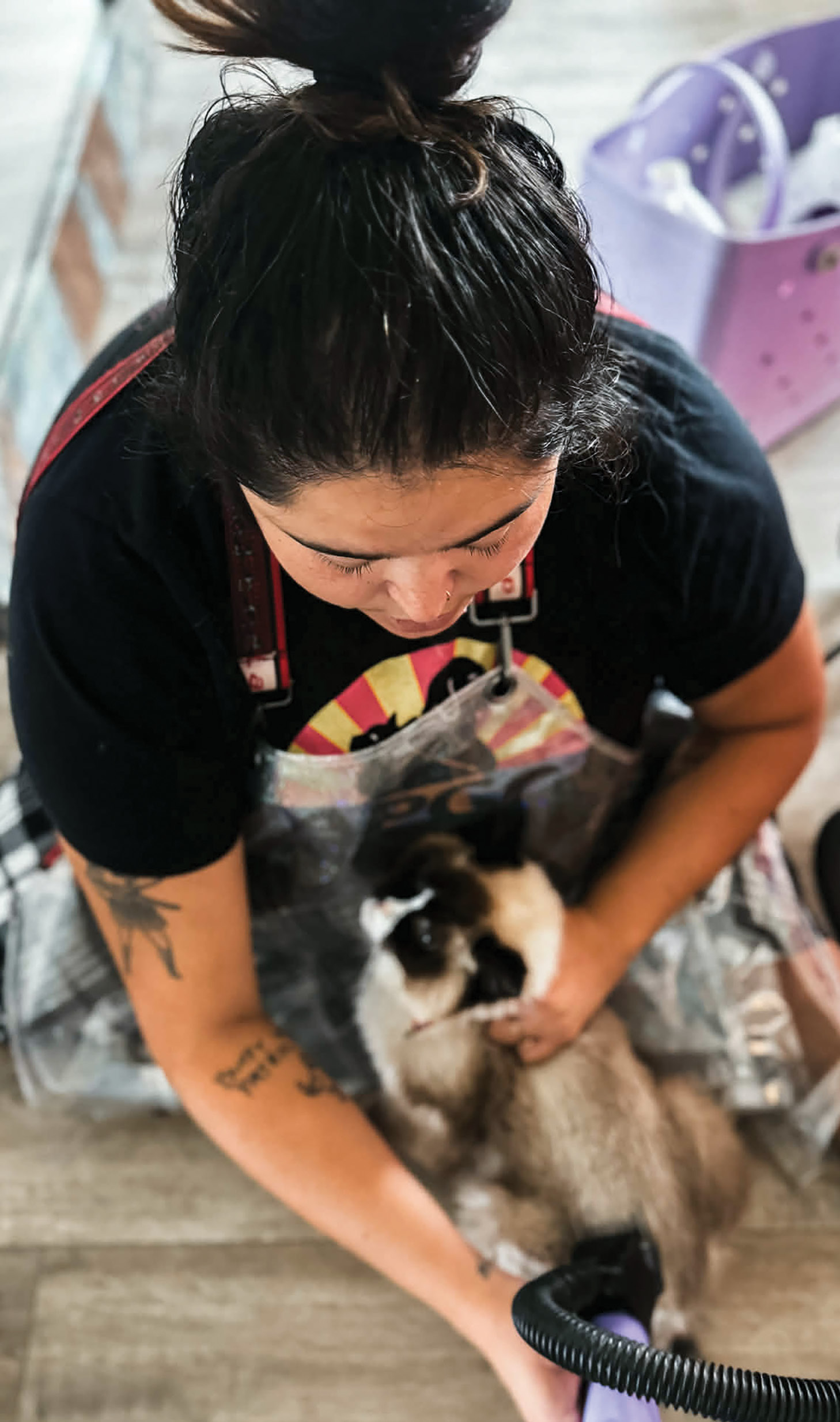
Some clients even go as far as designing or remodeling areas specifically for grooming, and she’s had people tell her they look for homes with washable spaces when they’re buying.
Working inside someone else’s home comes with its own challenges, however.
“Odor and cleanliness is probably my biggest ick,” Mercedes admits.
There is also the reality of being in a person’s private environment and learning how to filter what you notice, whether that is clutter or personal situations you would never encounter in a salon setting. And sometimes the challenge is not about time or difficulty, but energy.
“Certain appointments can be emotionally draining, which is something many groomers do not fully understand until they experience it themselves,” Mercedes notes.
Despite those challenges, the connection she builds with her clients is one of the biggest advantages of house-call grooming.
“Nothing beats the relationship, trust, communication, and connection that you make working in this type of environment,” shares Mercedes.
With the owner being present, they see exactly how their cat responds and become part of the process. That naturally shifts the conversation and it becomes less about the finished groom and more about how the cat is tolerating the experience.
It also opens the door for better education, helping owners understand that grooming is not just about appearance but about hygiene and preventative care as well.
Safety is a major consideration when working alone in clients’ homes, and it is something Mercedes takes seriously. She carries two phones—one for clients and one that shares her location—and approaches each day with that awareness in mind. And just as important as safety is learning how to set and maintain boundaries.
“The hardest lesson I’ve had to learn is to stop explaining myself,” says Mercedes.
Over time, she realized that over-explaining decisions often invites more pushback rather than resolving it. Now, she trusts her instincts. If something feels off or she dreads going back to a client’s home, she simply does not rebook. And if necessary, she is willing to end an appointment and refer the client elsewhere.
Mercedes’ personal approach to grooming is often described as holistic, but she is quick to clarify what that actually means.
“When people hear the word ‘holistic,’ they think of crystals, essential oils—all of that,” she explains. “But it means looking at the whole picture and understanding how behavior, stress, environment, and physical health all work together.”
“What we know about anxious cats is their tolerance is directly linked to changes in their environment,” she notes.
Grooming cats at home removes a significant layer of stress before the groom even begins. They are not dealing with transport, unfamiliar smells or a new environment, and that alone can increase their ability to tolerate the grooming process.
When it comes to technique, Mercedes emphasizes adaptability over rigid systems.
“There is no single right way to work with cats,” she states.
Instead, Mercedes encourages groomers to develop a wide range of handling skills and approaches so they can adjust based on the individual cat in front of them. A big part of that shift is letting go of canine-based handling concepts and truly understanding how cats function physically and behaviorally.
For groomers thinking about adding house-call services, her advice is practical and direct: “Start with safety, build a system, and make sure someone always knows where you are,” Mercedes advises. “Beyond that, personality matters. If you genuinely love people as much as you love cats, you’re going to be successful.”
Just as importantly, though, she says is to treat it like a real business. Too many groomers are undercharging, skipping policies or hesitating to set boundaries because they feel less legitimate without a physical location. In reality, you are the business, and how you present and value yourself matters.
At the end of the day, everything Mercedes does comes back to one clear boundary: “If I think it will hurt the cat psychologically or physically, I won’t do it,” she expresses.
Mercedes knows what she is capable of as a groomer, but capability is not the same as responsibility. The question is not whether she can complete the groom, but whether she should. If the cat cannot tolerate the ideal result, then the priority shifts. Progress can be gradual or it may stop where the cat is comfortable.
And in true Mercedes fashion, she sums it up in a way that is hard to forget: “It’s a cat, not a car.”


 e’ll be better at home.”
If you do mobile or in-home grooming, you’ve likely heard that line more times that you can count—and sometimes it’s true.
Certain dogs really struggle in a busy salon; the noise, the barking and the constant movement can be too much for their nervous system. Put them in a quieter one-on-one environment, and they settle right in. But not all dogs…
Quiet Vs Calm
On the surface, mobile and in-home grooming seem like the perfect solution for anxious dogs—no loud salon, no barking and no chaos. But behavior isn’t about what looks calm; it’s about what feels safe to the dog. And for some dogs, a quiet environment doesn’t feel relaxed at all. It feels intense, it feels focused, and sometimes it feels like pressure.
We’ve all seen countless dogs come out of the bath, go into a kennel, curl up and fall sleep. That’s not random—that’s the nervous system resetting. That’s the dogs saying, “That was a lot. I need a minute before I can handle more.”
In mobile and in-home grooming, that reset is often missing. There’s no kennel, no pause and no stepping away. The grooming process is continuous. For some dogs, that constant one-on-one interaction becomes overwhelming, not calming.
In a salon, however, stimulation is spread out. In a van or a quiet room it’s concentrated. Some dogs thrive in that environment while others feel like they’re right in the middle of it with no way to process or disengage.
Mobile vans and small in-home setups can create somewhat of a behavioral bubble—everything is closer, more direct and feels more intense.
When Home Isn’t Actually Comfort
When grooming suddenly happens in that space with new sounds, equipment and handling, the dog’s brain may shift into a different role. Instead of relaxing, they become more aware, more reactive and less able to settle.
You might see increased alertness, difficulty standing still, more resistance to handling, and reactivity to movement or noise in the home. This isn’t because the dog is being difficult, but because the environment changes how they’re processing the situation.

Not every dog has an issue with mobile or in-home grooming. Some dogs do exceptionally well. But the ones who tend to struggle often have a few things in common:
- Sensitive or easily overstimulated temperaments
- Anxiety or hyper awareness
- Previous negative grooming experiences
- Difficulty regulating without breaks
- Territorial behavior in the home
These are often the dogs people expect to do their best in a quiet setting. But in reality, they may need more structure, more space and more opportunity to rest—not just less noise.
- Build in intentional pauses: Even without a kennel, give the dog a moment to reset. Step back, lower your energy and allow them to settle before moving on.
- Break up the groom: To do this, think in segments: bath, pause, dry, pause. Work in stages instead of one continuous process.
- Watch for early stress signals: Lip licking, turning away, stiffening or sudden sitting are early signs that a dog is reaching their limit.
- Adjust your starting intensity: The first few minutes matter. Introduce tools gradually instead of going in at full speed.
- Manage the environment: In-home groomers should reduce distractions, limit movement, ask owners to step away and choose a calm space.
- Stay aware of your own energy: Dogs pick up on energy quickly. Staying steady and controlled helps them to feel more regulated.
The truth is, there’s no one-size-fits-all answer. We’re not just working with coats; we’re working with behavior, with stress and with nervous systems. And the environment we put a dog in plays a huge role in how that behavior shows up.
Mobile and in-home grooming can be incredible options, but they’re not automatically easier. They’re just different. And when we understand that difference, we can start making better decisions not just for the groom, but for the dog. Because sometimes the thing a dog needs most isn’t a quieter space—it’s the right kind of support within that space.
Angela Bucci has been grooming since 2004, starting out as a weekend bather while studying to become an Applied Behavior Analysis (ABA) therapist. What began as a side job quickly became a passion when she realized her behavioral training gave her a unique edge with anxious and reactive pets. ABA has helped Angela understand and manage behavior compassionately, an approach that translates beautifully to dogs and to her specialization in calm, behavior-focused grooming. Today, she works with Groomit, an on-demand mobile grooming service that provides groomers with a van, flexible scheduling, and the ability to build their own business.


by Blake Hernandez
Photos provided by Blake Hernandez
 etro trims are some of the most practical poodle cuts that exist. They are highly stylized and yet offer those strategically placed shave patterns that allow for easier at-home maintenance as well as table time in the salon. Yes, they look great on poodles, but they can also be really fun base patterns for other breeds and mixes.

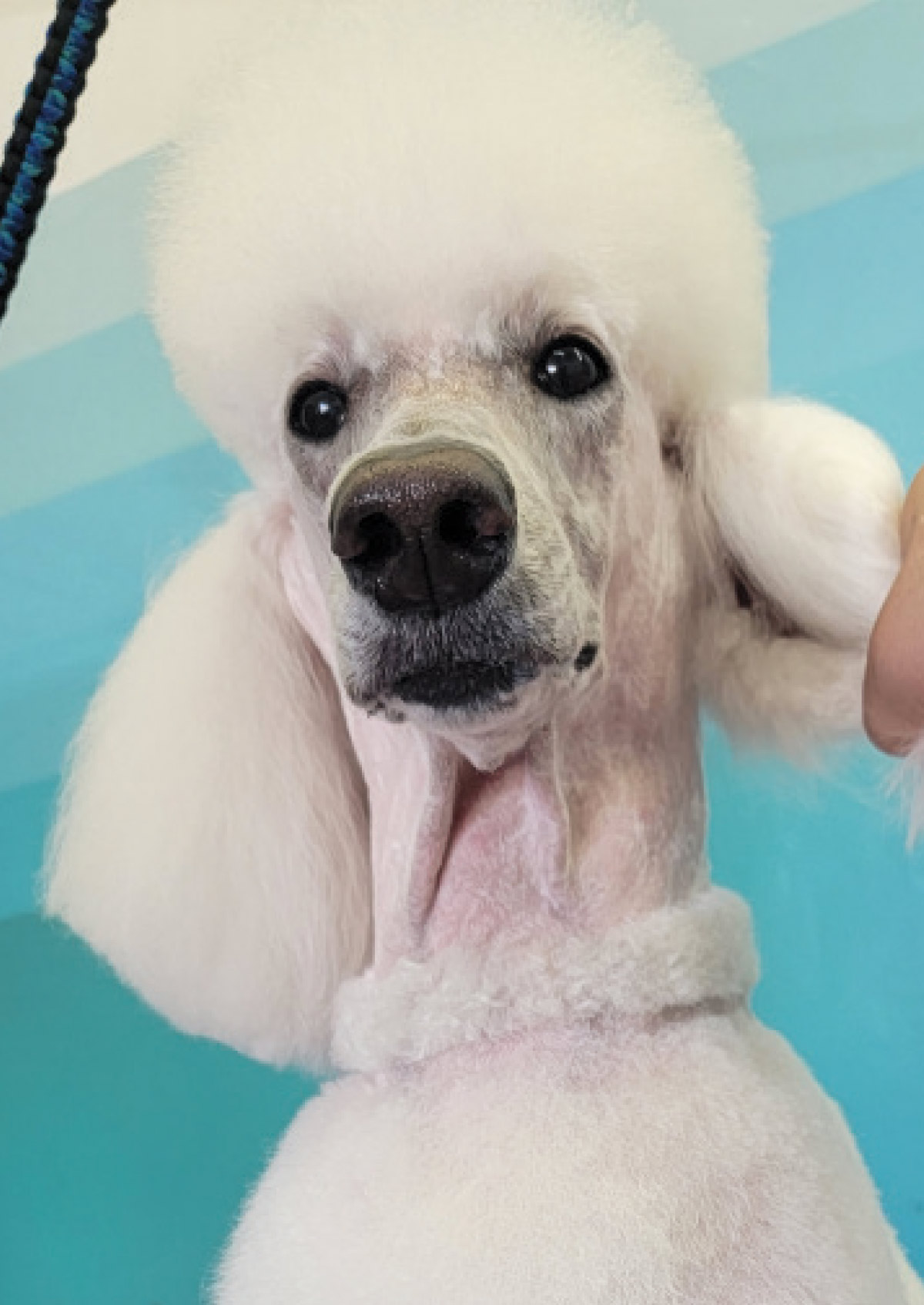

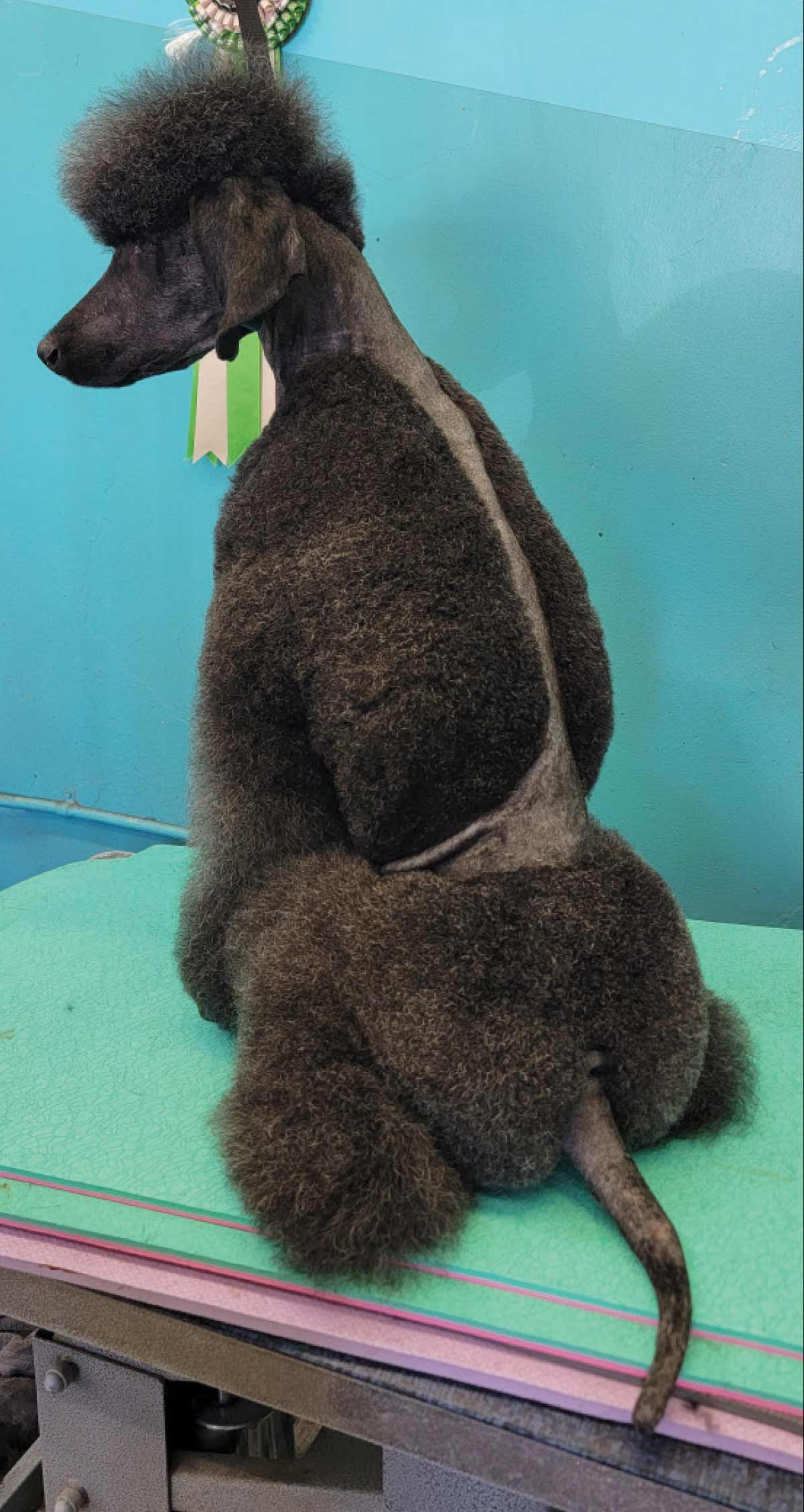
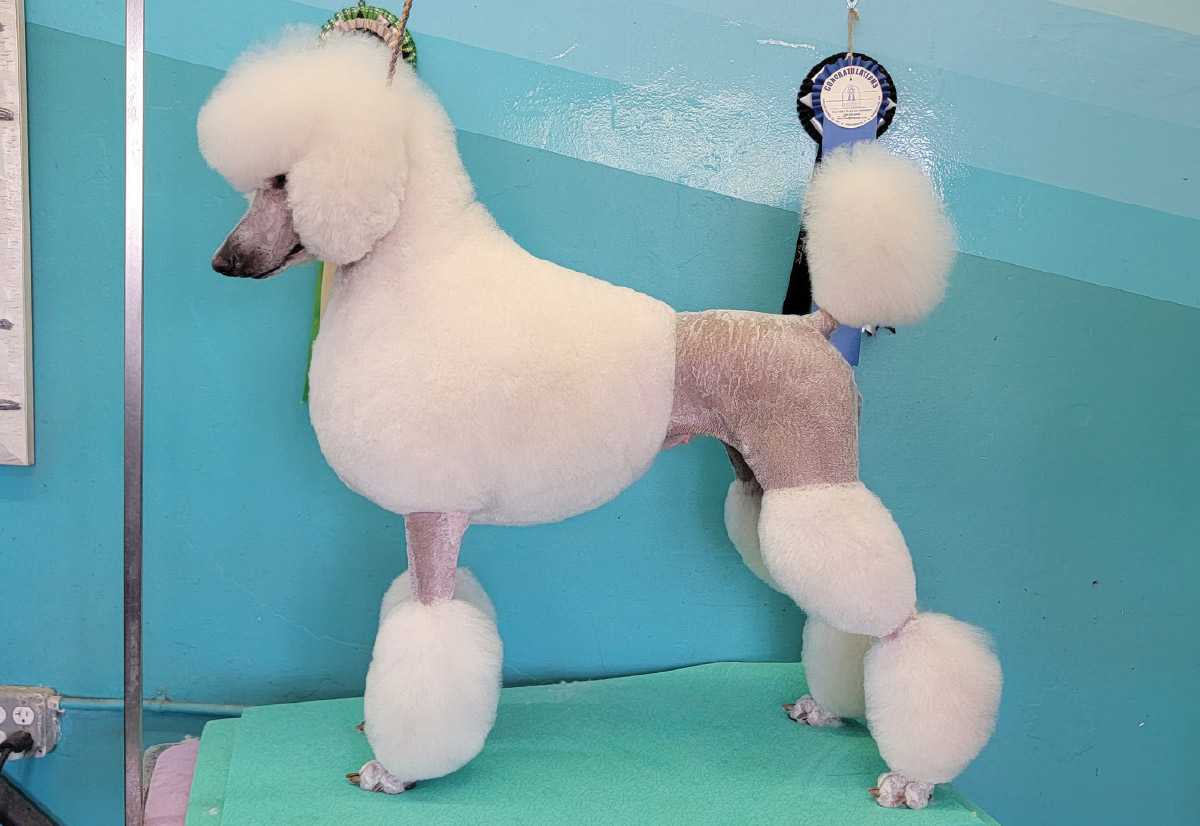




Retro trims are not just flashy and special; the intricate shave work means faster prep time. Clients will also notice the patterns growing out faster than they will recognize an all-over trim grown out. This results in more frequent appointments, which usually means better-behaved dogs and easier overhauls!



Call (717) 691-3388 ext 224 to place a Classified.
Rates: 25 words or less, $50.00.
Each additional word, $2.00 each.
Classified ads must be prepaid.
Call for issue deadlines.
Agency discounts do not apply.



Thanks for reading our July 2026 issue!