





Contents | January 2026
8

36

by Melissa Viera
ALSO INSIDE
todd@barkleigh.com
adam@barkleigh.com
gwen@barkleigh.com
rebecca@barkleigh.com
luke@barkleigh.com
laura@barkleigh.com
brandi@barkleigh.com
carlee@barkleigh.com
evan@barkleigh.com
allison@barkleigh.com
james@barkleigh.com
karin@barkleigh.com
christina@barkleigh.com
Daryl Conner
Lynn Paolillo
Amanda McGrath
Jennifer Bishop Jenkins
Blake Hernandez
ALSO INSIDE
ON THE COVER
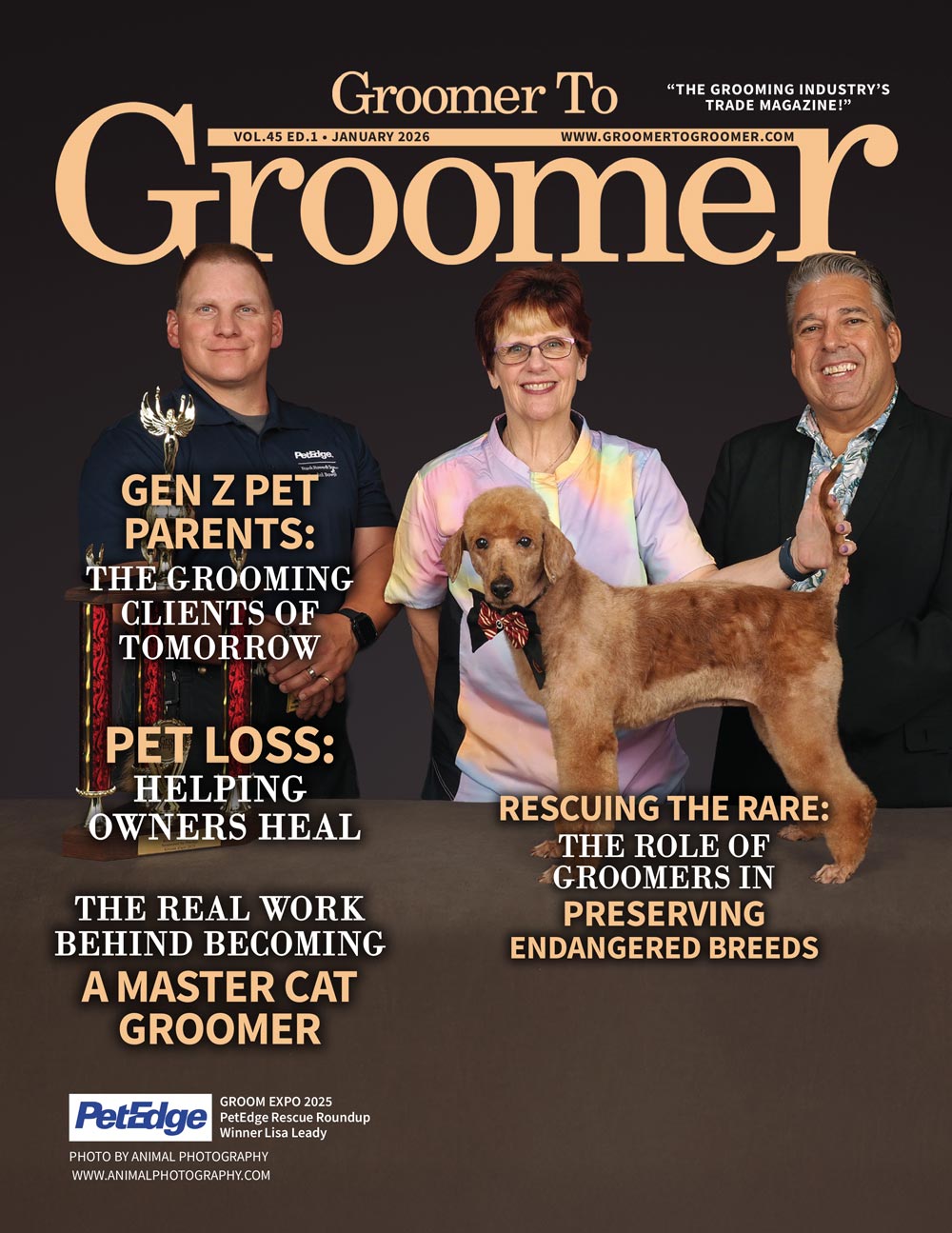
Rescue Roundup Winner
Lisa Leady
PHOTO BY ANIMAL PHOTOGRAPHY
WWW.ANIMALPHOTOGRAPHY.COM
- Andis2
- Animal Photography12
- Bandanas Unlimited46
- Barkleigh Store – Meow Wow! A Complete Guide to Feline Grooming45
- Barkleigh Store – The Pet Stylist Playbook51
- Best Shot Pet – 3 Step System22
- Best Shot Pet – Scentament Spa9
- Best Shot Pet – UltraMAX44
- Cosmos Bathing Systems39
- Direct Animal Products13
- Double K Industries3
- Electric Cleaner Company29
- Evolution Shears21
- Friedman Tax33
- Groom Curriculum — Upskill Fast Track47
- Groomer’s Choice4
- Groomsoft35
- Hanvey Engineering & Design11
- IV San Bernard | Pet Skin Academy14
- Laube55
- MetroVac15
- Mobile Grooming World41
- Odorcide49
- Paragon School of Pet Grooming19
- Paw Brothers | Ryan’s Pet Supply56
- PetLift31
- Puppy Playground30
- Quadruped Pet Care43
- Ryan’s Pet Supplies | Leading Edge Grooming AcademyDigital Only
- Stone Mountain Pet Products7
- SuperZooDigital Only
- Tidy Paws34
- Traini, Inc.23
- UGroom Conversions40
- Wag’n Tails53
Featured Spotlight Profile
Midmark




















 athleen Ruth (Donaghey) Salzberg, age 84, passed away on Wednesday, November 12, 2025, with her loving family by her side at her daughter’s home in Rehoboth, Massachusetts. Born in Boston, Massachusetts on December 17, 1940, she was the daughter of Joseph Patrick and Ruth Patricia (Armstrong) Donaghey.
Raised in Canton, Massachusetts, Kathy graduated from Canton High School with the class of 1957. After graduation she continued her education at Boston College, enrolling in one of their exclusive women’s collegiate programs to study journalism. She also volunteered as a member of the Peace Corps, educating people about civil rights during the Vietnam War. One warm summer evening in 1959 Kathy met a young man at a party on Green Harbor Beach in Marshfield, Massachusetts. Wedding bells soon rang, and Kathy married the love of her life, David Gerald Salzberg, on July 9, 1960, in Boston, Massachusetts. The young couple made their married home in Norwood, Massachusetts, welcoming their first of three children the following year.
As her children began to grow, Kathy put the skills she had learned at Boston College to use, accepting a position as a political correspondent at the Patriot Ledger for the Norwood area beginning in the early 1970’s. A woman in the newsroom was novel and Kathy worked hard to prove that she deserved to be there, not letting the adversity of her situation discourage her, but instead allowing it to empower her and inspire her to do her best. She remained with the newspaper until 1976, but her love of writing remained with her. The same year, the Salzberg family moved to nearby Walpole, Massachusetts where David owned a pet grooming business called The Village Groomer. Kathy joined her husband there, learning the ins and outs of the industry. She would become a master groomer and take over the business as David pursued other career interests. Eventually Kathy would be joined by their daughter Missi, working alongside each other until her retirement in 2011. Kathy never truly left journalism behind, as she began to perfect her trade she began to publish articles for the pet industry. She was a contributor to Dog Fancy and Cat Fancy, several industry magazines, as well as published multiple books and a novel. Her excellence in both the fields of grooming and journalism was recognized when she won the Pet Industry Journalist of the Year award twice.
In her retirement, Kathy moved to Eastham, Massachusetts. It had always been her dream to live there and she worked so hard to make it come true. She loved Cape Cod and enjoyed being so close to one of her favorite spots to visit, Provincetown.
Kathy was an extraordinary woman who, throughout her life, exemplified the values that she cherished so deeply; authenticity, kindness, inclusivity, acceptance, and justice among many others. She truly lived her values and, as matriarch of her family, instilled them in her children, teaching them compassion, how to be open-minded, and how to fight for those who could not fight for themselves. She was a woman ahead of her time and made the world a better place for all who knew her because of it.
Family was the most important aspect of Kathy’s life. She was a fun and active mother, gifting her children with wonderful memories of their childhood playing with her and tucking them into bed each night. While she had a quietness about her, people would be remiss to mistake that for weakness, as she was a strong, protective woman who’s children never once doubted if their mother would have their backs. She encouraged their interests and supported their decisions, proud of them and the adults they would one day become. Her love extended to her children’s in-laws, with Kathy welcoming them into her family with open arms. And when her children began having children of their own, she could not contain her happiness. Kathy thrived as a grandmother, always present and attentive, and in dressing up to take the kids trick or treating. She made regular visits to her grandchildren across the country, taking time while there for get togethers with her in-laws.
In her free time, Kathy enjoyed writing, sending beautifully written cards and letters to her family members and friends. She loved animals, especially dogs, and had a passion for rescue. Date nights were concerts at the Indian Ranch and long rides together on David’s Harley. At home, Kathy enjoyed the title of “Scrabble World Champion”, decimating everyone’s scores with her expanded vocabulary. A true New Englander, Kathy was a diehard Red Sox fan, thankful to see them break the curse and become the champions she knew they were. Faith was also very important to Kathy. A family of blended faiths, she chose to raise her children in the Universalist Unitarian Church so that they would have exposure to a variety of belief systems and practices. She was proud to give this opportunity to her children and served as the religious education director for the Medfield UU for multiple years. She also made sure to take plenty of trips with her family to Green Harbor Beach, visiting the place where it all began.
Beloved wife of the late David Gerald Salzberg.
Loving mother of David G. Salzberg Jr. and his wife Aline (Pham) of Chatsworth, California, Peter B. Salzberg and his wife Julianne (Collins) of Franklin, and Melissa “Missi” R. Salzberg and her wife Tracy (Fanis) of Rehoboth.
Cherished grandmother of Quinn, Kaitlin, Dylan, Allison, Cara, and Evangeline; and great grandmother of Vincent, Callum, Dominic, and Camille.
Sister of Martha Martin of New Haven, Connecticut, Barbara Costa of Niantic, Connecticut, Joanne Rienzie of Brockton, Michael Donaghey of Hartford, Connecticut, the late Mary Patricia “Patty” Donaghey, and the late Frances Griffin.
Kathy is also survived by her Godson Adam Rienzie of Lowell, as well as many nieces, nephews, extended relatives and friends.
Relatives and friends are kindly invited to attend Kathleen’s Life Celebration on Tuesday, November 18th, 2025, from 4:00 pm – 7:00 pm in the James H. Delaney & Son Funeral Home, 48 Common Street, Walpole.
A Mass of Christian Burial will be celebrated on Wednesday, November 19th, 2025, in Saint Mary Parish, 1 Church Square, Franklin, at 11:00 AM. Interment will occur privately at Terrace Hill Cemetery in Walpole.


 very groomer has had that moment, mid-dog, mid-shed, mid-existential crisis, when you wish your slicker brush had a built-in vacuum or your dryer could somehow detangle on its own. We live in a world of self-driving cars and robot vacuums, yet most of us are still untangling cords like it’s 1999.
Manufacturers have started to dabble in hybrid thinking, though. We’ve seen ergonomic grips you can slide onto brushes and combs, and even dryer hoses designed with comfort handles to save wrists and shoulders. A few fluff-drying units have taken things further, hanging comfortably around the neck for hands-free use. One even uses a laser pointer for direction control, and another includes an ultraviolet feature for viewing skin issues beneath the coat.
We’re getting closer, but most of these tools still feel like early prototypes. They’re fun glimpses of progress, but not yet the true hybrid revolution groomers have been waiting for.
I reached out to other groomers to see what hybrid tools they were dreaming about. The response was…silence, which honestly said a lot. Maybe we’re all too busy juggling dryers, scissors, rakes and reality to daydream about what could be. I decided to make my own list—part wishful thinking, part professional venting and part Sci-Fi pitch deck, so here it is…
- The Smart Dryer: It senses coat density and adjusts air pressure and heat automatically, gentle on thin coats, powerful for double coats and maybe even quiet enough to keep everyone’s nerves intact.
- The Modular Brush System: An all-in-one brush system complete with interchangeable brush heads that connect to a single ergonomic handle, as long as they stay lightweight and don’t turn into a juggling act.
- The Sensory-Safe Dryer Shield: We already have Happy Hoodies, ear protection and a few filtered nozzles that reduce sound, but imagine something universal—a quieting shield or attachment that fits most dryers and dampens both decibels and airflow shock.
- The Blade Buddy 2.0: A smart clipper that monitors blade temperature and adjusts speed based on coat density. It could even alert you before hitting a skin tag or sensitive area, a true safeguard for both pet and pro.
- The Adaptive Guard Comb System: Magnetic guard combs were a good start, but anyone who’s watched one pop off mid-clip knows they’re not quite there yet. Imagine a single adjustable comb built into the clipper body. It slides smoothly to set different lengths, staying secure and streamlined without adding bulk.
- The Integrated Mat Mapper: A clipper equipped with a built-in scanning function—whether thermal, ultrasonic or camera based—that helps visualize what’s under mats before you clip. One motion, two layers of awareness, it trims and informs at the same time.
- The Dual-Action Nail Tool: A nail clipper and dremel hybrid that lets you trim and smooth in one pass—no switching tools, no extra cords, no wrestling match.
If we can dream it, maybe someday we can plug it in. Ridiculous? Maybe. Necessary? Absolutely!
There’s also cost and scale to consider. True R&D takes investment, and our industry is made up largely of small companies and passionate artisans. But we’re also an industry of tinkerers. Groomers have been hacking and customizing tools forever. That creative spark is proof that hybrid innovation isn’t just possible, it’s overdue.
Someday we might unbox a “Hybrid Groomer Pro 3000,” a single-unit, silent, self-cleaning, cord-free device that brushes, dries, clips and praises us softly for doing our best. Until then, we’ll keep inventing in the margins, duct-taping dryer hoses, repurposing human tools and dreaming of a day when our gear evolves as quickly as our skills. Because behind every great groomer is an even greater pile of gadgets we wished worked together.


Photos provided by Misty Gieczys
 significant new trend is emerging in the contest ring for grooming competitions: greater access to and focus on rare dog breeds. In a world that seems to be consumed by everything “doodled,” it is encouraging to see professional groomers taking the time to learn the specific maintenance requirements of these distinctive dogs. This effort is crucial, as many of these rare breeds are currently on the endangered list.
Hand stripping is a specialized, meticulous process involving the pulling of both the harsh topcoat and the softer undercoat. This technique achieves a bright, vibrant color in the coat while also offering practical benefits. The coat becomes weather resistant, allowing the dog to go out, get dirty, dry off quickly and simply be brushed clean. Furthermore, incorporating stripping or carding on non-show dogs can help pull out dead coat and prevent issues like the “Schnauzer bumps” caused by their sebaceous glands becoming clogged and forming a pimple.
Groomers who are seeking out and mastering this specialized skill are not only helping to preserve breed standards, but are also tapping into a lucrative market opportunity. You can add this to your shop as a premium service because not everyone offers it. Being able to advertise that you are the only one in your area capable of performing this specialized grooming can be a significant professional advantage and a source of additional income.

– Christina Meuse
Photo by Animal Photography

– Holly Baker
The personal drive to revive these rare breeds is also strong with competitor Christina Meuse, who shares her motivation: “I loved the idea of a Sealyham since I learned what they were early in my career. I had my heart set on a breed that no one ever sees. I hope more people are inspired to look up a breed they haven’t seen before.”
The sheer spectacle of these dogs is enough to inspire a career pivot, as groomer Holly Baker notes: “It took me 19 years into my career to attend a grooming show. It was a wowing experiencing to see all the different breeds on stage, but seeing more rare breeds left me in awe.
“It was inspiring to see other pet groomers who had access to these breeds and knew how to groom them,” adds Holly. “It felt like they were grooming unicorns, and instead of feeling I would never groom one, I was inspired to chase the knowledge.
“I made friends with other competitors who started to introduce me to others who had unique breeds that would allow me groom their pets,” she continues. “That’s how I was introduced to the Dandie Dinmonts. Another groomer provided me instruction, and then I fell completely in love with the dog and breed.”
Competitor Stephanie Wilson highlights the reality of this choice: “I started competing with Australian Terriers after retiring my Wire Fox Terrier. Having a rare breed in the ring can be both a blessing and a curse. On one hand, you have a standout entry in a sea of similar breeds. On the other hand, you have a much more difficult time finding rental dogs if you need one.”
The commitment needed to raise and groom these dogs is substantial. Robby Hartley, who shows and bred Australian Terriers, embodies the goal of this movement. His ability to bridge the gap between the show world and the grooming contest world is exactly what is needed in breeders and exhibitors to help bring quality dogs into the contest ring.
Robby provides insight into the supply side: “One of the best parts about supplying people with my breed is that they get seen more often. They’re pretty easy to learn, but the hardest part is the growing process and knowing how much to leave on them because each one grows at a different speed, and they naturally grow slower than a lot of the other wire-coated breeds.”

-Stephanie Wilson
Photo by Animal Photography

– Robby Hartley
It’s encouraging to see that clients themselves are actually going out, getting some of these rare breeds and educating themselves on how to maintain the coats. They are constantly looking for groomers who are skilled and able to work on these specialized coats.
To learn hand stripping, you can attend seminars either at an expo or ones hosted by a dedicated breeder or handler. You can also take one-on-one classes from educators, open-level competitors or people who actively show the breed to gain specific, hands-on knowledge. Alternatively, you can go to a dog show and ask the exhibitors if they could teach you more about grooming their breed.
A powerful aspect of owning one of these rare breeds is that if you are already maintaining them for grooming competitions, why not also show them? This is another way to grow as a groomer, and it directly increases the numbers of these breeds in the show world.
Our commitment as groomers is changing the way breeds are being viewed. It behooves us all to work together, get our clients on board and to teach them about how to maintain these dogs. That is how we rebuild these rare breeds and aids in ensuring they do not go extinct.


 common statement I often hear in the grooming industry is, “I have been grooming for 20(+) years.” But what is the takeaway from that? Does that mean you know everything there is to know? Are you up to date on the newest and latest? Or does it mean you have been doing this so long that you don’t want to change? Is that 20 years of learning or one year repeated 20 times?
The point being, no matter how long we have been doing our given profession, things change. The real question is, are we changing with it or are we stuck in our old ways?
I always say it is a good day when I learn something new. But where do we go to learn? Are we attending trade shows, going to lectures, taking certifications courses and reading articles? If so, are those only within our industry, or are we looking at what other industries are doing and learning from them?
It is really easy to rely on the same people teaching the same thing over and over, but that is not growth. You may feel like it reinforces your thought process, but in reality, the best learning is when you are challenged to think differently or try something new. To be truly progressive, you need to be in a constant state of change.
When I started in business as a veterinarian, advertising was frowned upon. Only the aggressive businesspeople would take out a phonebook ad. Today, only a small percentage of us even remember phone books. I thought I was doing well when I started mastering Myspace, only to have it quickly replaced with Facebook. Before I could learn that well, we had LinkedIn, YouTube, Instagram, Twitter, Snapchat, Telegram and TikTok taking over.
Years ago, I was serving on a committee with one of the big veterinary product lines that was trying to get into social media, and they came out with a five-year social media plan. They couldn’t understand when we told them that nothing in their plan would likely even exist in five years.
Marketing happens to be one of the fastest-growing areas, but understanding logistics and efficiency (i.e., planning and optimization of procedures) is another important aspect of business. Instead of just focusing on saving a few dollars on shampoo and conditioner like we have in the past, we could explore different application techniques to reduce waste and save money.
For example, rather than having multiple groomers work 8-5, try opening early and staying open later to accommodate your clients who work during the day. You could adjust the schedule so that different groomers come in at 7 a.m., 11 a.m. and 3 p.m.. Your fixed cost wouldn’t change, but your income will.
What about your computer system? Is it up to date with new trends? Does it just handle appointments and payments, or does it do things like tracking the time each groom takes? Most salons guess on the time it takes to complete a groom, which often means each groomer could take on more pets if they knew exactly how long each one truly takes. That is how the big companies make the profit they do.
For example, Boeing has a slow conveyor that moves the plane along for production, and they know exactly how long every step of the process takes (approximately three months from start to finish). They have shifts 24 hours a day and even have engineers and teams to ensure parts and tools are at the correct locations at the exact times they are needed. Start to finish, that conveyor NEVER stops, and if it does, it costs the business millions of dollars.
While building a plane isn’t exactly the same as grooming a dog, the point is that having the proper routine in place is critical to our efficiency. And our computer system can play a significant role in that by tracking each step. What are the things that mess up your daily schedule or slow you down? Can they be changed or eliminated? Is there a better computer program to help you? Could AI play a part?
How about your technique? What if you could significantly reduce your groom time on de-shedding big dogs like Great Pyrenees by dropping all the hair in the tub and eliminating your clean-up? How many extra dogs could you do? How much could you increase your income?
What if we increased the quality of the grooming experience? Clients are looking for value, not necessarily price. Offering a better experience will allow you to charge more and attract better clients. But what does that look like? Good customer service; well-dressed staff (you are judged on your weakest link); a facility that is clean, smells good, attractive and well-kept (paint, floors, tables, etc.); grooming products that are for the health of the pet, not just for cleaning and, of course, a great groom. Clients’ expectations are different today than they were 20 years ago.
Running a grooming business is not easy. Being able to keep up with the constant changes in marketing, business and grooming trends is even harder. But just like the old dog in the pack, if you want to survive, you have to keep up with the rest. Continuing to grow in what we do is actually what keeps us young, so keep teaching this old dog new tricks!
Dr. Cliff Faver graduated with a BS in Biology/BA in Chemistry before getting a Veterinary degree in 1987. He is the past owner of Animal Health Services in Cave Creek, Arizona and now the US distributor for Iv San Bernard products, teaches the ISB Pet Aesthetician Certification program, and speaks internationally on hair and skin. His passion is to merge groomers and veterinarians to aid in helping and healing pets. He is also a member of AVMA, AAHA, AZVMA, Board member with Burbank Kennel Club, and has served on Novartis Lead Committee, Hill’s International Global Veterinary Board, and a Veterinary Management Group.

 s professional groomers, we spend years building relationships—and not just with our clients, but with their beloved pets, too. We often watch them grow from playful puppies and curious kittens to cherished seniors. So when a client calls to tell you their pet has passed away, it’s not just their loss, but ours as well.
Over the years, I’ve had many clients share the news of their pet’s passing. No matter how often it happens, it never gets easier. But I’ve learned that the way we respond in those moments can mean a great deal to grieving families. Our words and gestures, when genuine and compassionate, can bring lasting comfort.
I’ve had pet parents call me to schedule a final comfort groom for their precious friend when they knew the end was near. Those appointments are always difficult for me, but they mean the world to families who want their pet to leave the world feeling clean, comfortable and loved.
Others have called me from their veterinarian’s office tearfully telling me that they had to say goodbye to their cherished companion. Even in their deep grief, they tell me that I was such an important part of their pet’s life that they had to let me know. Of course, whenever this happens, I stop whatever I am doing and take the time to talk with them.
If I receive a voicemail or a text about a pet’s passing, I return the call at the end of the day. That allows me to have more time to speak with the client and also gives me a chance to process the sad news, as I really do become close to my pet clients and feel their loss deeply.
Often clients need to talk through their grief. They may share every detail of their pet’s last days and their passing, seeking reassurance that they did everything they possibly could have done for their beloved pet. Listening patiently and responding with compassion can help them begin to heal. Sometimes just hearing you say, “You gave them a wonderful life,” can mean everything.
When I learn of a pet’s passing, I acknowledge the family’s loss with a sympathy card and often a condolence gift. A handwritten card really stands out in today’s digital world and gives the pet parent something to keep that shows their pet was important and loved by others.

I am so sorry to hear that dear little Katie is no longer with us. She was one of the most gentle, loving, and sweet souls I have had the honor to care for. I will miss the wonderful visits we had when she came for her appointments.
Katie was a very lucky doggie—she had YOU to love her and to care for her every want and need. YOU made every day special for her. Thank you for allowing me to share in her life and her love.
With Love,
Aunt Kathy

One client framed the poem I sent about their dog, Hercules, and they keep it along with his picture in their living room over the sofa he loved to lie on. They say it puts a smile on their face every time they look at it.
Most of my clients have been coming to me for their pet’s entire life—some of them for longer than that, as I also cared for pets they had in the past. For many of those longtime clients, I also do something to honor their pet in addition to the card and poem. Here are a few of those gestures that you could also implement:


As their groomer, you had a unique relationship with the pet and your understanding words and thoughts can bring tremendous comfort at a time it is really needed. Honor their pet’s life and memory, share in their grief and assure them that their beloved companion will always be remembered.

 et grooming professionals have come a long way in mindfully integrating basic hair-care science principles into their daily bathing and prepping. But like with everything else, change is a constant. The following outlines three noteworthy shampoo trends and/or innovations that are headed to—or have arrived at—a salon near you!
Unlike older silicones, modern copolymers are designed to provide enhanced conditioning, detangling, and shine without buildup or skin and coat issues. Water-insoluble silicones like Dimethicone were once widely used but had a high potential for buildup, trapping dirt and residue, which weighed down the hair and sometimes led to skin irritation over time.
Here are some additional notable benefits of using next-generation hair-care silicone copolymers:
- They make drying time far faster and more efficient, enabling your dryer to act more like a brush.
- For double-coated breeds, they add “slip” to the coat, making it easier to manage and remove shedding undercoat.
- They help release tangles and mats, making the grooming process less stressful for both the pet and the groomer, especially for long coats and doodles.
- They protect the hair’s cuticles and seal in essential moisture, adding shine and luster.
- They protect the coat from thermal damage caused by heat drying, UV damage, and physical damage from the rigors of brushing and combing.
- They repel dirt, grime and urine to keep the coat cleaner longer between washes.
For example, some plant-based ingredients are touted as more “natural” alternatives to silicone in attempt to provide similar conditioning, detangling and shine benefits at a more reasonable cost. However, the truth is, silicone copolymers have consistently demonstrated superior performance in detangling, shine and extended manageability in established efficacy testing.
Products containing next-generation silicone copolymers are often cited by professional groomers as the most effective tools for safely removing shedding undercoats and difficult tangles with reduced physical effort and less coat damage. While some plant-based alternatives improve comb-ability, groomers resoundingly note how they do not measure up to the performance and pace of silicone copolymer development.
If you haven’t embraced the next generation of silicone copolymers, you’re still probably working way too hard!
Focus has shifted to safer fragrance ingredients for animals, and scent companies are developing new pet-specific fragrances and grooming aids to ensure products are not only effective, but also perceived as pleasant by the animals themselves, in addition to being safe for their sensitive systems.

A healthy skin microbiome entails the diverse ecosystem of beneficial microorganisms (bacteria, fungi and even mites) naturally residing on both human and animal skin. Skin is the largest organ hosting a micro-community of trillions of organisms that serve a critical role in maintaining skin health as well as providing the body’s first line of physical defense and immunity.
Marketers link microbiome health to common issues like dandruff, dryness, irritation and even hair loss, which makes the claims highly relevant to groomers, often interpreting microbiome-friendly to mean gentler and less disruptive to our pet’s natural ecosystem. But the fact is, skin biome science is nothing new. Advertisers are merely spinning things from another perspective. Since the global market for microbiome human cosmetic products is experiencing significant growth, pet product marketers understandably want to follow suit. All this allows brands to position their products’ perception as more innovative and effective by adding ingredients like prebiotics, probiotics and postbiotics.
It’s important to note how the science of skin microbiome is still evolving, and some argue that its marketing claims have outpaced actual chemistry, understanding and practical applications for pet shampoo. There is also a lack of regulation consistency on what constitutes a microbiome-friendly product, which leads to ambiguity and potential “greenwashing,” where a regular product is simply labeled with the buzzword. This, along with the many loopholes and lack of regulations pertaining to pet shampoos compared to more restricted human shampoo products, must also be acknowledged.
Also consider how every pet shampoo requires the use of preservatives, given they are mostly contrived of water. Water, after all, is the breeding ground for bacteria growth, and the broad-spectrum preservatives employed in a shampoo’s mixture are designed to kill microorganisms, thus postponing premature spoilage. When a pet shampoo contains both a preservative and probiotics (living microorganisms), the preservative likely kills the probiotics before providing any significant benefit. In other words, preservatives may render probiotics dead from the start.
Probiotic shampoos may need more time for innovation and development given where skin and hair chemistry is today, and are probably not the best choice for supporting a dog’s healthy skin microbiome. Instead, try turning to the many dietary applications of probiotics, prebiotics and postbiotics for substantiated proven results. That’s not to say a probiotic pet shampoo won’t clean and leave a pleasing fragrance afterwards, or is harmful in any way, though. What matters most is whether you like the results enough to continue using them.
3. Pet-Friendly Fragrance & Malodor Innovations
Concerns for harsh chemicals and certain known irritants have led to more manufacturers relying upon hypoallergenic fragrance options specifically engineered to minimize the risk of allergic reactions and skin irritation. This is achieved by excluding common fragrance allergens as mandated by EU regulations, using purified natural isolates or less aggravating synthetic versions, and limiting specific component dosages and/or the fragrances’ total volume load in topical rinse-off and leave-on products.
Some fragrance companies have developed additives designed to engulf and disperse malodors using cyclodextrin technology, among others, without overwhelmingly masking with pungent scents. Shampoo manufacturers now call out these proprietary technology brands by name on their packaging and in their advertising, like the Symrise NeoFresh® system1, a technology platform for managing and neutralizing malodors, and Belle Aire’s Ordenone®2, a proprietary, concentrated deodorizing agent that works by encapsulating and neutralizing malodor molecules rather than masking them.
There you have it. Whether these new innovations and trends have already taken over the way you wash pets or have sent you down a rabbit hole of research, it is up to you to decide whether to embrace them or not.
- Neofresh® is a registered tradename and proprietary technology of Symrise (Teterboro, New Jersey USA). https://www.symrise.com/scent-and-care/
- Ordenone® is a registered tradename and proprietary technology of Belle Aire Creations (Libertyville, IL USA). https://belleairecreations.com/our-expertise/total-malodor-management-experience/
Dave Campanella is an entertaining seminar speaker, popular podcast guest, industry columnist and educator. He is Best Shot Pet Products sales and marketing director with over 30 years of pet industry wisdom. He and his wife Tracy (NCMG) co-owned a full-service pet salon and self-wash in Ohio prior to relocating with Best Shot to Central Kentucky 20 years ago. Together the Campanellas enjoy exhibiting at grooming shows, being industry ambassadors, and breeding AKC registered Kerry Blue Terrier Champions under the Goodfellas prefix.

www.FITSgroom.com


Wire Coated Breeds Sponsored by Groomer’s Mart


Creative Sponsored by Wag’n Tails


www.animalphotography.com


by Amanda McGrath
 ou’ve probably noticed a new type of pet owner walking through your salon doors. They have their phones out, ask about shampoo ingredients and want to book their appointments online. Meet Gen Z—the future of your client base.
- The Greatest Generation:
Born 1901–1924 - The Silent Generation:
Born 1928–1945 - Baby Boomers:
Born 1946–1964 - Generation X:
Born 1965–1980 - Millennials (or Generation Y):
Born 1981–1996 - Generation Z:
Born 1997–2012 - Generation Alpha:
Born 2013–present
Right now, Gen Z’s are roughly between the ages of 12 and 29. Many are just entering pet ownership, caring for the first dog or cat they’ve owned without their parents. They grew up in a digital-first, value-driven world. Clients in this age group are often the most informed, connected and vocal generation of customers.
According to one survey, 48% of Gen Z respondents said they consider their pets equivalent to human children.1 Many view their pets as “starter children” or are putting off having children altogether and opting for pet ownership instead.
This is important to take note of, as the shift in how owners of different generations view their pets will be a driving force that shapes the future of the grooming and pet industry as a whole. Gone are the days when clients drop their pets off mindlessly and don’t want to have a good understanding of exactly what will happen with them in your care. In my opinion, this is a great shift and will help to elevate our entire industry.
Many of them will research extensively online before booking. During this research, they’ll look for groomers who show their process: Is the workspace clean? Are they calm when handling pets? Do they use clear communication?
As grooming salon owners, we can market in ways that highlight all of this. Some examples include:
- Posting videos of the entire grooming process or filming a “Day in the Life” of your salon.
- Listing the products you use, along with their ingredients, and why you chose them on your website and social media.
- Displaying certifications and posting about how you’re continuing to learn and improve your craft.
Above all, be authentic in everything you share. It doesn’t need to be perfectly scripted, but it does need to be real.
In addition, digital convenience is essential for Gen Z. They expect online booking, digital reminders and mobile-friendly communication. Most prefer texting or messaging over phone calls. They also value speed and accessibility. If booking with you is harder than ordering DoorDash, you’ll lose them before they ever step foot in your salon.
Many younger clients are drawn to transparency about products, especially those that are cruelty-free, eco-friendly or community-minded. If your products fit those categories, make sure to highlight that in your posts or on your website.
Gen Z owners are more likely to pay premium prices for brands that reflect their beliefs. When developing your marketing strategy, look outside the grooming industry for inspiration. Think of skincare brands, hair salons and coffee shops, many of which do a great job connecting with customers across generations. Browse their socials and websites to see which posts are getting the most engagement.
Checklist for Adapting Your Marketing to Attract Gen Z Clients
- Audit your digital presence: Is your website modern, mobile-friendly and easy to use?
- Refresh your branding: Is it authentic, relatable and consistent?
- Be upfront about products and policies: Do clients understand why you use them?
- Offer payment flexibility: Can owners use Venmo, Apple Pay and other digital methods?
- Add a personal touch: Would new clients know who you are and what you stand for?
Gen Z often craves connection and a sense of community. They don’t just want a service; they want to feel like they’re part of something. As for grooming salons, we have the advantage of the cutest subject matter when it comes to creating marketing content. (Think of how hard all of this would be if we were in the used car business!) It’s easy to create pet photo walls or “Pet of the Month” contests that make clients feel connected, and not just to your salon and staff, but to each other.
If you want to specialize in certain breeds, consider hosting breed-specific community events. Some fun ideas include:
- “Tacos & Terriers” with a local Mexican food truck.
- “Pastries & Poodles” partnering with a bakery near you.
- “Westie Wednesday Night Social” with a yappy hour at a local brewery.
Events like these help clients connect with you personally and with others who share a love for the same breed. Remember, clients of this generation buy from people, not faceless businesses.
As grooming salons, it’s wise to take note of this trend. By slightly shifting our marketing efforts and paying attention to what’s important to this rising generation, we can stay ahead of the curve. Understanding Gen Z’s mindset now will help you build a business that’s not only current, but future-proof.
The next generation of pet parents is here, and they’re ready to connect with groomers who are authentic, share their values and treat their pets like family.
- Paw-rental differences: How each generation views their pets. (2025, May). Talker Research. https://talkerresearch.com/paw-rental-differences-how-each-generation-views-their-pets/
- 2025 State of the Industry Report. (2025, March). American Pet Products Association. https://americanpetproducts.org/news/the-american-pet-products-association-appa-releases-2025-state-of-the-industry-report



 ax season is here once again, and as a self-employed pet groomer or salon owner, knowing how to protect your income from Uncle Sam is essential to maximizing your profits. Understanding how to properly report your business activity, leverage deductions and take advantage of tax credits—especially with the major changes introduced by the One Big Beautiful Bill (the Bill)—can significantly reduce what you owe.
Whether you file independently or work with a tax professional, this guide aims to help you navigate the 2025 tax season with clarity and confidence.
- Payments from grooming services
- Tips
- Cash transactions
- Electronic payments processed through Square, Cash App, PayPal, etc.
- Income reported on a W-2 or 1099 tax form
Even if you don’t receive a tax form, the IRS requires you to report every dollar earned. Unreported income can trigger audits, penalties, or difficulty qualifying for loans when expanding your business or trying to purchase large assets like a home or vehicle.
- Grooming Equipment & Supplies: Clippers, shears, shampoos, brushes, dryers, tables and other tools essential for grooming.
- Rent & Utilities: Salon lease payments, booth rental fees, phone expenses, etc.
- Advertising & Marketing: Business cards, social media ads, website hosting and printed materials.
- Continuing Education: Grooming-specific courses, certifications and industry seminars.
- Business Travel: Costs incurred to attend out-of-town industry expos, trade shows or continuing education events.
- Vehicle Expenses: Mobile grooming vehicle costs (fuel, depreciation, maintenance, etc.) or mileage when driving to the salon, for supply runs or business travel.
- Home Office Deduction: If you perform administrative tasks, such as managing appointments, bookkeeping or marketing from home, you may qualify. This will also help maximize your vehicle deductions.
- Merchant & Bank Fees: Bank and credit card fees, processing fees from Square, Stripe, PayPal, etc.
- Insurance Premiums: Professional liability and other business insurance. Health insurance premiums may also be deductible, but not as a business expense.
- Retirement Contributions: Employer contributions into a Solo 401(k) or SEP IRA can reduce your business income while helping you plan for the future. Contributions to a traditional IRA may also be deductible, but not as a business expense.
- Permanently Increased Standard Deduction: The Bill makes the higher standard deduction permanent and eliminates personal exemptions for most taxpayers. For 2025, the standard deduction is $15,750 for single filers and $31,500 for married couples.
- QBI Deduction (20%) Made Permanent: Self-employed pet groomers and S Corp shareholders can continue to claim the 20% Qualified Business Income deduction without fear of expiration.
- No Income Tax on Tips: The Bill creates a temporary deduction for qualified tips, claimed on Schedule 1-A. All tips must still be reported as income, but up to $25,000 of eligible W-2 or 1099-reported tips (cash tips do not qualify) may be deducted for income-tax purposes. The deduction applies only for tax years 2025–2028 and may be limited or disallowed at higher income levels. Most importantly, it does not reduce self-employment tax, you’ll still owe tax on all your tips.
- No Tax on Car Loan Interest: If you bought and financed a new vehicle with a gross weight rating under 14,000 pounds in 2025, you may be able to deduct up to $10,000 in interest on your personal car loan thanks to the Bill. The catch? The “final assembly” of the vehicle must have occurred in the United States, there are income limitations that may disqualify you for the deduction and it is temporary, set to expire after the 2028 tax year.
- New Trump Accounts & $1,000 Pilot Contribution: A new tax-advantaged savings account for kids created in the Bill, parents can contribute up to $5,000 annually, though contributions are not tax-deductible. Funds cannot be accessed until the child turns 18, and some rules remain unclear pending further guidance. Most importantly, children born in 2025 may qualify for a $1,000 federal baby bonus, expected to be deposited into the account in 2026. To receive it, you must elect to do so on Form 4547 when filing your 2025 Form 1040.
- Early Expiration of the Clean Energy Vehicle & Home Improvement Credits: The Used, New, and Commercial Clean Vehicle Credits now expire early, ending September 30, 2025 (originally set to expire in 2032 or later). No credit is allowed unless an eligible vehicle was purchased before October 1, 2025. The Energy Efficient Home Improvement Credit and Residential Clean Energy Credit are also cancelled effective December 31, 2025, meaning they may still be claimed on 2025 returns for prior-year improvements but are eliminated for 2026 and later.
- Major 1099-K Reporting Changes: Beginning in 2025, payment processors no longer must issue 1099-K’s until total gross payments exceed $20,000 and there are more than 200 transactions for the year.
- Retirement Contribution Limits: The IRA contribution limit is $7,000 ($8,000 for individuals aged 50+), while the SEP IRA and Solo 401(k) limit is $70,000.
- 100% Bonus Depreciation Restored Permanently: First-year bonus depreciation for business assets is now back to 100%—and it’s permanent! This could be used whenever you purchase grooming equipment over $2,500, such as tables, tubs, computers, laptops, tablets, even your mobile grooming van.
If you’re a self-employed pet groomer, you’re responsible for the full 15.3% self-employment tax (Social Security and Medicare), which is in addition to your regular income taxes, so be sure to plan ahead. Proper bookkeeping and staying on top of your quarterly estimated payments can prevent an unpleasant surprise at tax time.
If you own a grooming business through an LLC, confirm every year with the state that your business registration is active and up to date. And if your income is substantial, making an S Corp election could help you shield a portion of your income from that nasty 15.3% self-employment tax. However, always consult a tax professional to determine if this is the right strategy for you, otherwise it could end up costing you more than it saves you.
Friedman & Friedman Accounting & Tax Advisors, PLLC (aka Friedman Tax) is a family-owned accounting and tax-advisory firm dedicated exclusively to tattoo artists, pet groomers, body piercers, hair stylists, barbers and salon/shop owners. Founded and operated by two CPA brothers, the “Tattoo Tax Guys,” they bring deep experience in complex tax and accounting work, a passion for helping creative entrepreneurs, and a strong focus on exceptional client service. They offer full-service tax preparation and bookkeeping, LLC formation, strategic tax planning, back-tax cleanup, and consulting, all tailored to the unique needs of artists, stylists and pet grooming professionals.


 ven for clients who stick to a six-week grooming schedule, professional grooming alone isn’t always enough to keep a dog’s coat healthy and mat-free. Life happens between appointments—dogs go swimming, roll in the grass, wear harnesses that rub, and their coats and nails don’t stop growing.
Some groomers are noticing that more dog owners are taking an active role in maintaining their pets between salon visits. But that’s not always the case…
While pet industry trends and observations hint that owners are more likely to recognize what it takes to care for their dogs in recent years than in the past, groomers still have an important educational role.
As a groomer, you’ve probably encountered the dog owner who believes they don’t have to brush their dog because the dog was supposed to be low-maintenance. Or there is the puppy owner who calls for information, explaining that they will call back to book when their puppy needs a haircut, but then they wait too long.
These misconceptions can be frustrating for groomers to encounter. And while talking with clients about what to do doesn’t always yield the results you hope for, many clients will appreciate your tips and make lasting changes because of them.
The grooming industry continues to grow, and according to one article, part of the reason is the current trend of pet humanization.1 When owners treat their pets like family, they seek more than just the basics.
Still, education on coat-care needs is lacking. One report found that pet owners face gaps in knowledge, tools, and access to care for their pets’ coats, highlighting the importance of increasing client knowledge about grooming for veterinarians and animal welfare professionals.2
Dog groomers have the opportunity to talk with clients directly about coat care—even before problems arise. For many groomers, educating their clients is an essential part of their role. Much like grooming takes practice, learning techniques for having meaningful conversations with clients is a skill, too.
It can help to be aware of how client education relates to your business and role as a groomer. You might begin noticing when clients respond positively to your feedback when you start paying attention to it. This is a rewarding part of working closely with pet owners.
“Educated clients mean happier dogs, better grooms, and less stressful visits,” says Vicki Doyle, groomer, consultant and owner of Groomed by Vicki located in England.
Vickie is also the owner of a shampoo line, which she launched amid an increase in at-home pet grooming, especially during the pandemic.


For Vickie, education might involve demonstrating brushing and combing techniques or talking to owners about reducing anxiety and preparing their dogs for the groomers. Education isn’t just about coat care; it also involves considering the dog’s behavior.
“I explain that grooming isn’t just a bath and a haircut,” she shares. “I give my clients tips on handling paws, brushing calmly at home, and getting their dog used to clippers (by having an electric toothbrush buzzing nearby) and a hairdryer too!”
For Nadia Bongelli, lead groomer at Doggieland Toronto and member of GroomTeam Canada, exposing puppies to the grooming process as soon as possible is an essential part of setting them up for success. She explains that new puppy owners often reach out, unsure when to start grooming their pup, and her suggestion is, don’t wait.
In addition to discussing the importance of puppy grooming, Nadia also talks with clients about the right tools for their dog’s coat type.
“I will ask a client to bring in their at-home tools and show me what they are using,” she explains. “More often than not, the tools they have are decent, but not exactly what I would use. It’s helpful to keep an inventory of my favorite brushes, combs, and sprays on hand.”
The relationship you build with your clients by sharing your time and expertise with them can make your business stand out. Like all aspects of business, you also have to take into consideration what education means for your business. You can’t spend a considerable chunk of time demonstrating brushing techniques for every client. It’s up to groomers and businesses to determine the best process for their salons.
It can be helpful to have a set of brushes available at the front desk for clients to see, along with any handouts or resources you want to provide. Some groomers even host in-person sessions or sell online courses to demonstrate basic grooming techniques.
Letting your clients know what you expect between appointments right from the beginning is essential. Some dog owners aren’t aware of what their dog requires. As a groomer, you can help guide and support them, which often results in more frequent bookings.
Whether or not you’ve noticed any trends in how involved owners are in the grooming process, it’s never too late to start thinking about ways you can have a positive impact that your clients will appreciate.
- Maciel, E. (2024, October). How can pet grooming continue to boom? Global Pets. https://globalpetindustry.com/article/how-can-pet-grooming-continue-to-boom/
- McDonald, S., Sweeney, J., Niestat, L., Doherty, C. (2022, February). Grooming-Related Concerns Among Companion Animals. Frontiers in Veterinary Science. https://www.frontiersin.org/journals/veterinary-science/articles/10.3389/fvets.2022.827348/full


 ake a moment to remember back (if you are as old as me) or imagine back to a time long gone when there was no internet, no cell phones, no social media, no grooming trade shows or competitions, no state associations, few grooming schools, and really no way for us to talk to each other, teach each other or learn from each other. All reading material was printed in books and all human conversations happened on landline phones or in person. That is the grooming industry I entered in the early-mid 1980s.
Most groomers worked for cash, and many did not report their business income as legally required. Referrals often came from our local veterinarian. We used horribly poisonous flea dips, hot oil treatments and had other ill-informed practices that we thankfully have outgrown.
At a small table in the corner at the first All American Grooming Show I attended in the mid-1980s, sat Sally Liddick and Gwen Shelly. They were selling “Groom-O-Grams” and their other early publications. Sally was a Pennsylvania groomer with a lot of clients who kept asking her the same questions all the time. So rather than constantly repeat her explanations to them, starting in the late 1970s, Sally had been printing up Groom-O-Grams just for her clients.
By 1984 Sally approached her lifelong friend and fellow Pennsylvanian Gwen Shelly to help her in the growing business. They had been friends for decades and had known each other since first grade in elementary school. Both now adults, married and neighbors, Gwen teamed up with Sally to handle the growing demands of her business. They got advertisers and subscribers and were off and running, eventually helping groomers with other printed materials such as kennel clip cards and file cards for client recordkeeping.
Gwen said that early on the business interfered so much with Sally’s grooming business that Sally was going to give it all up. But she had one advertiser in her earliest Groom-O-Grams that was thrilled about the reach that it gave their business in an industry that had almost no means of sharing information. It was the advertisers, Gwen reported, that pressed Sally not to give up the publication.

Gwen shared that it was not easy to build the business at first, especially as a women-owned businesses. Even though most groomers were women, national business owners almost never were. And some printers did not even want to work with them because of this.
Sally was a very forward thinker and did not give up. She wanted to also help move the grooming industry to be more independent and business-like, so their company needed a name. Gwen told me the story of Sally looking out the window at a lovely nearby tree and admiring its bark. She thought of naming the company “Barkley,” but when she looked it up, she saw that name was taken. So, she changed the spelling of the final part of the name and Barkleigh Productions was established as a company.
By the time that Sally Liddick passed in 2012, she had lived to see her vision of a nationwide grooming community realized, where professionalism, good business practices, education and sharing were everywhere in our industry. Sally’s name lives on though, as it’s often heard in the “Sally Breaks” that take place during grooming contests. The judging was so long and tedious in the early days of competition that dogs were often standing on the tables for hours. Sally insisted that the dogs needed a break to go outside, and so Sally Breaks were instituted.
So from me and all other groomers, we offer a heartfelt thank you to Sally and Gwen, and all who worked to build a real community in this industry we love, for bringing groomers together through inspiring trade shows and education, and through this world-class magazine, page by page.


 hear it all the time: “You make it look so easy”—especially when one of my clients or students watches a calm, clean lion cut come together on a cat that, just minutes before, looked like an overgrown Muppet with an attitude problem. And while it might look easy, the truth is far from it.
Mastery isn’t magic, it’s repetition. It’s knowing your tools. It’s problem-solving with each cat during every appointment. And most importantly, it’s the result of doing the work over and over again until your hands move with intention instead of hesitation.
I recently wrapped up one of my two-week cat grooming pop-up schools, and every day I’m reminded of just how much there is to learn when you first step into this world—and how much of that learning is quiet, subtle and humbling.
And I get it, I’ve had years of practice. My clippers are balanced in my hand at just the right angle. I know how to read body language without second-guessing. I know what kind of resistance means “go slower” and what kind means “wrap this up.” But none of that came naturally. It came from experience. And more often than not, it came from trial and error, scratches and sweat, frustration and breakthrough.
That’s what allows you to adapt. It’s the difference between following a recipe and actually cooking, and the difference between duplicating a groom and becoming a confident cat groomer.
It doesn’t matter where I’m grooming, I see it every day in my own cat grooming salon, in workshops and in private training sessions. One cat needs a firm, confident hold to feel safe, and another panics if you don’t give them a towel to dig into. One tolerates the dryer if you keep the airflow wide and flat, and another needs a break halfway through or they’ll mentally check out.
Learning to notice those differences is half the battle. Learning to adjust in real time? That’s the beginning of mastery.
Grooming cats the first few times can be a lot of trial and error. You’ll find out what works and what doesn’t—which can be the difference between a successful groom with little to no escalating or aggressive behaviors and a total meltdown with a cat going home half shaved.

Here’s the truth: You can watch a hundred videos, read every article and follow the best accounts online, but none of it will give you clipper confidence until you do it, over and over again. But fumbling with a cat you met for the first time is a sure way to get in over your head, compared to working with an expert who has lined up cats that fit your experience level and the goals you are trying to accomplish.
In the pop-up schools, each student grooms roughly 27-35 cats over the course of 10 days. And while the first few are slow, clumsy and awkward, by the end of the second week you can see their posture shift, their hands move with purpose and their voice calm the cat instead of startling it.
There are no shortcuts—you just have to get in there. You have to figure out how your body moves, how your tools feel and how the cats respond. And the fastest way to get there isn’t trying to tackle everything all at once or by yourself.
Each cat teaches a lesson, and having another experienced cat groomer in the room doesn’t just mean they are there to assist you, but also to increase the amount of “brain power” available for problem-solving.
The future of the grooming industry isn’t going to be about doing more cats, faster. It’s going to be about doing better work with more intention and creating positive, long-term grooming experiences for every cat in our care. That starts with recognizing that mastery isn’t a destination, it’s a practice.


Groomed by Tricia Burgs


 ommonly known as westies, West Highland White Terriers are a top-ten breed in many salons. Even if you aren’t a purebred enthusiast, these spunky dogs with a round-face groom likely aren’t going anywhere—and they usually come in pairs!

Fig. 2) Going with the lay of the coat, gently fall off the ribs to begin your transition into the dog’s furnished pattern.


Fig. 4) Use a shorter length than you used on the jacket to do the flat, short area on the throat. This helps create separation between the head and neck.


Fig. 6) Use a curved scissor to shape the feet. For a more natural finish, you could soften them with a straight or curved thinner.


Fig. 8) Use a blender in the outside corner of the eyes to really open them up.


Even if you’re not getting many purebred West Highland White Terriers, there are tons of grooms that look cute with a carrot tail or a round head. Have fun adding a little westie spice to your grooming style!
Fig. 10) Without flattening the cheek too much, connect the outside of your circle up to the point of the ear. One of this dog’s modifications is that they do not get tipped ears.
Even if you’re not getting many purebred West Highland White Terriers, there are tons of grooms that look cute with a carrot tail or a round head. Have fun adding a little westie spice to your grooming style!


Each additional word, $2.00 each. Classified ads must be prepaid.
Call for issue deadlines. Agency discounts do not apply.
Classified
Established grooming business with 4 self-serve dog wash stations and pet supplies for sale. Good location. Owner must retire. Sacrifice at $30,000. Call 410-913-8472


Thanks for reading our January 2026 issue!