







ALSO INSIDE
todd@barkleigh.com
adam@barkleigh.com
gwen@barkleigh.com
rebecca@barkleigh.com
luke@barkleigh.com
laura@barkleigh.com
brandi@barkleigh.com
carlee@barkleigh.com
evan@barkleigh.com
allison@barkleigh.com
james@barkleigh.com
karin@barkleigh.com
presley@barkleigh.com
Daryl Conner
Amanda McGrath
Dr. Cliff Faver
Blake Hernandez
Melissa Viera
THE SOCIAL HOUSE
- Andis2
- Best Shot Pet31
- Best Shot Pet43
- Best Shot Pet63
- Direct Animal Products25
- Double K Industries3
- Envirogroom | Special FX Premium Products61
- EQyss35
- EZ Groom Pro65
- Groomer’s Choice4
- Groomsoft17
- Groom Team USA47
- Heiniger37
- Laube66
- Mobile Grooming World68
- Odorcide33
- PetLift27
- Quadruped Pet Care23
- Stallergenes Greer53
- Thera-Clean55
- Wag’n Tails67
- Evolution Shears7
- IV San Bernard8
- Paragon School of Pet Grooming30
- Puppy Playground29
- Friedman Tax46
- PetBizInsurance.com56
- Stazko57
- Barkleigh Updates51
- Cosmos Bathing Systems49
- Pet Palette50
- Electric Cleaner Company15
- Happy Hoodie16
- Stone Mountain Pet Products16
- Animal Photography26
- Animals Ink41
- Midmark42
- Hanvey43
- Eau Du Bitches13
Featured Spotlight Profile
Midmark


































 s professional groomers, we’re experts at planning our days. We carefully schedule appointments, estimate grooming times, coordinate staff and make sure every pet receives the attention they deserve. Yet many of us never stop to intentionally plan the business itself.
Instead, we spend the year reacting to rising costs, staffing challenges, difficult clients and every other issue that comes up. By the time December rolls around, we’re exhausted, and before we know it, we’re doing it all over again. But successful businesses aren’t built by reacting—they’re built by reflecting, planning and making intentional decisions before the chaos begins.
That’s why every salon owner should schedule an annual business planning day—or even two. Close the salon for the day if you need to and go to your favorite coffee shop, sit on your back porch or find anywhere you can think without interruption. Bring your planner, financial reports, calendar, notebook, and maybe even a highlighter or two.
As groomers, we spend our careers helping pets look and feel their best. We owe ourselves the same level of care when it comes to our businesses. So before another year slips by, schedule the day to find a quiet place where you can think clearly, dream a little bigger, and honestly evaluate where you are and where you want to go. Because the most successful grooming salons aren’t built one appointment at a time—they’re built one intentional decision at a time.
by Misty Gieczys
Photos provided by Misty Gieczys
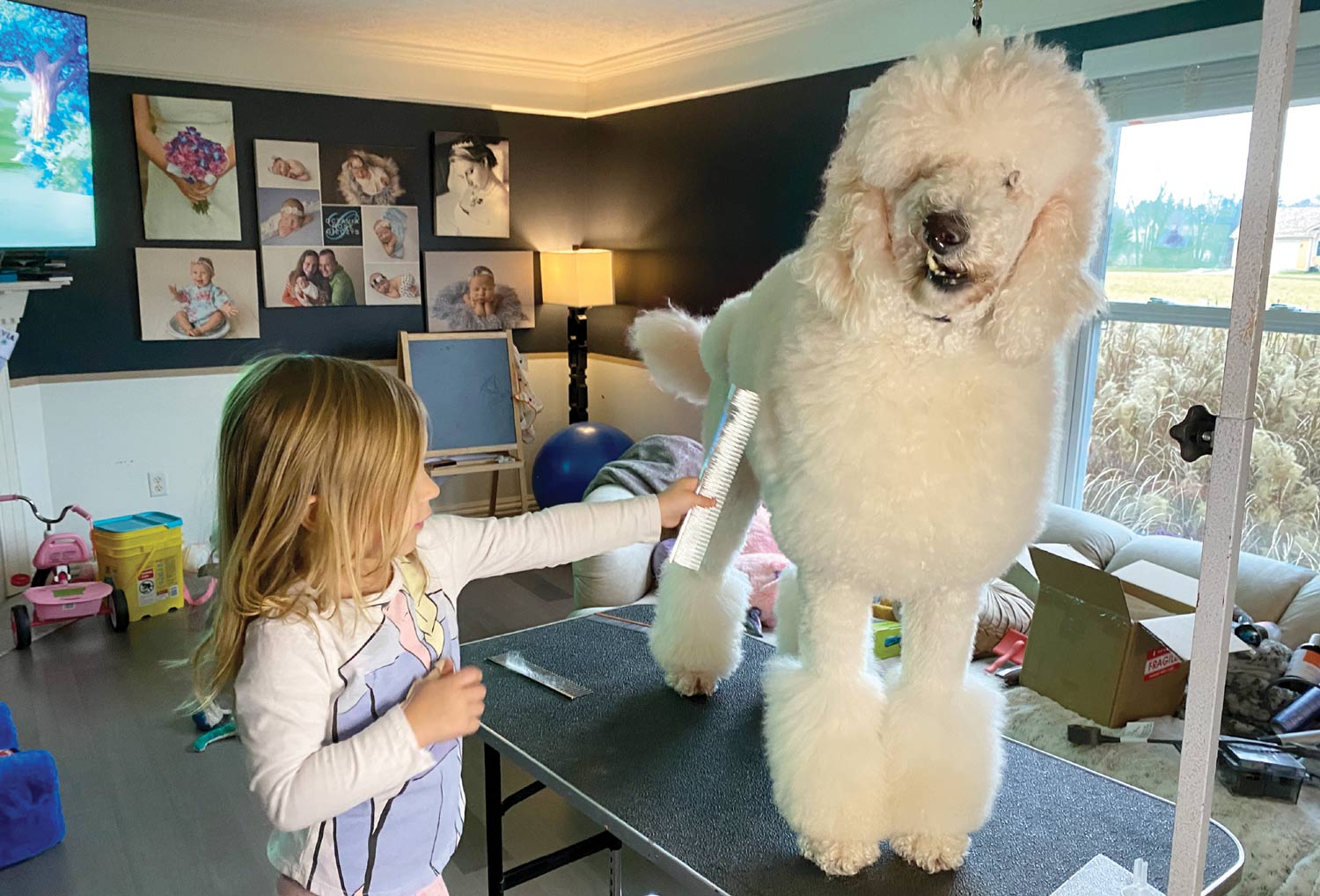
 hen we look for activities to build a child’s character, traditional team sports usually dominate the conversation. But there is a completely different arena where kids can develop deep responsibility, important life skills and a massive financial safety net for the future: the world of animal sports and early exposure to the pet care space.
For pet professionals, groomers and animal lovers, this isn’t just a hobby—it’s an open invitation to get our kids working, learning and saving right alongside us. From toddlers getting their feet wet with stuffed animals to teenagers stacking future retirement wealth, the animal world provides the ultimate blueprint for raising independent, resilient kids.
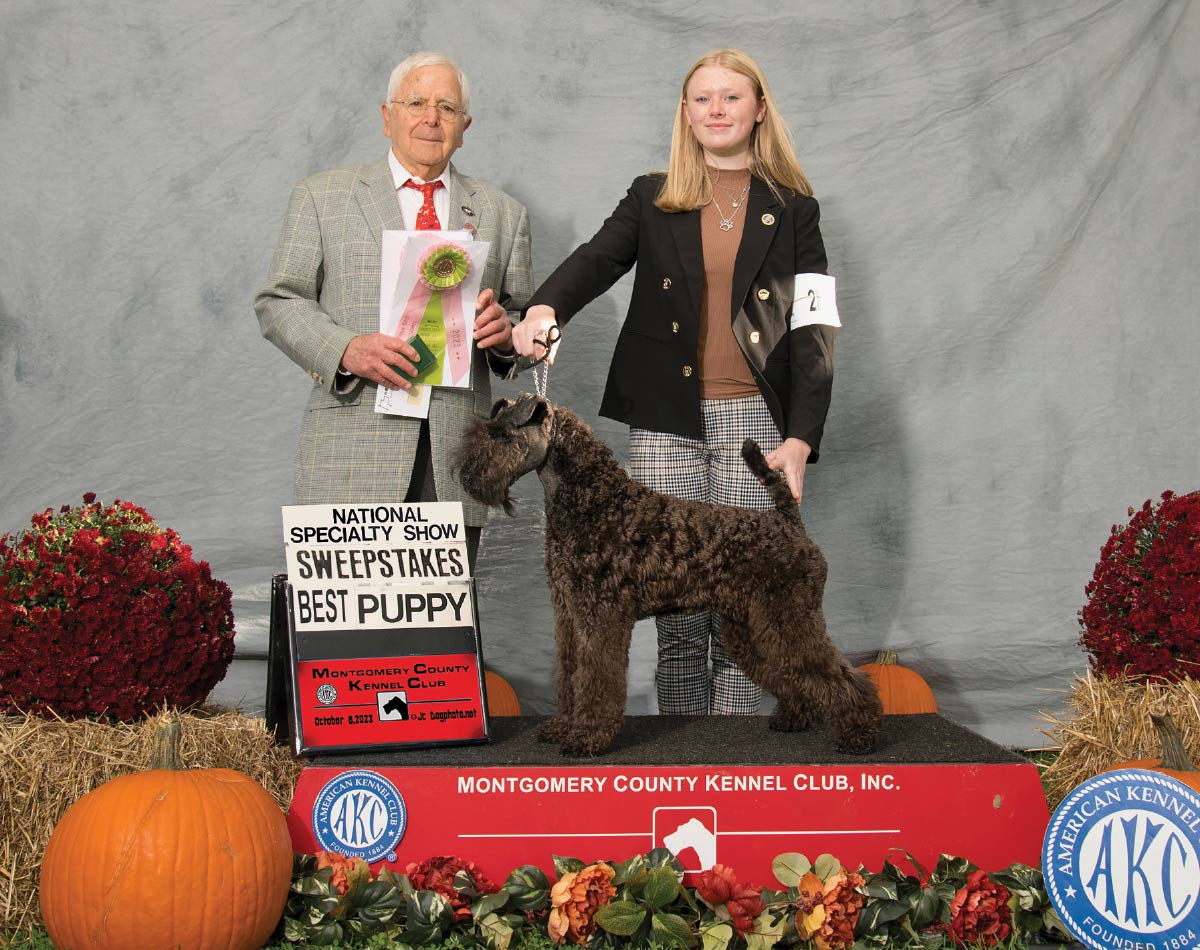
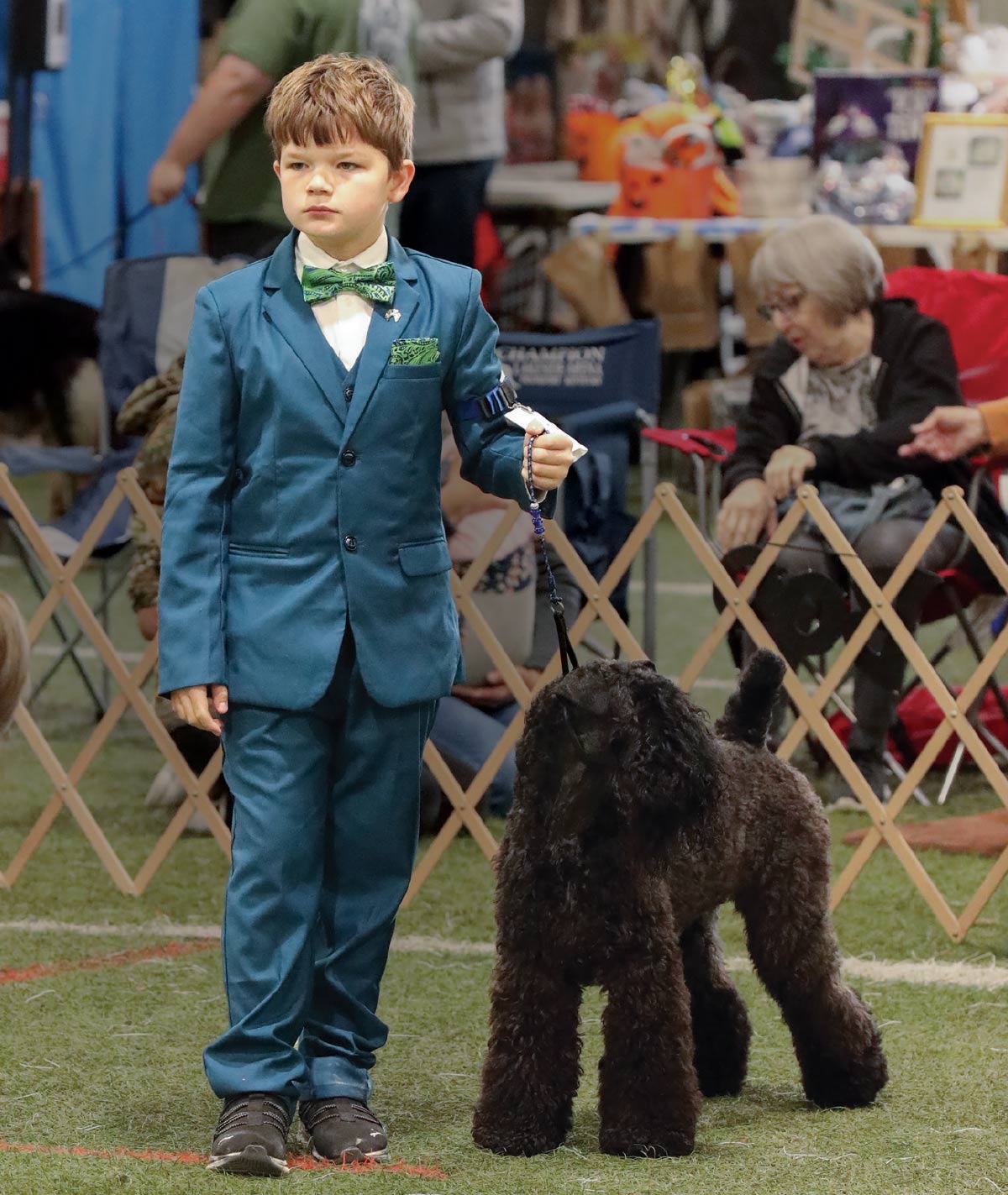
- Itty Bitties (Up to 4 years old): This adorable introduction is purely about fun. Instead of handling live animals, toddlers enter the ring proudly showcasing a stuffed dog.
- Pee Wee (Ages 5 to 8): This is a fun, non-competitive introduction to live dogs. Each child enters the ring one by one with a parent or responsible adult to learn basic handling skills in a supportive environment.
- Juniors (Ages 9 up to 18): This is where the real competition begins. Juniors are judged strictly on their handling abilities, etiquette, presentation and knowledge—not on the physical faults of the dog.
One of the biggest roadblocks for young handlers used to be the AKC’s strict ownership rule. To show a dog in Juniors, the child or an immediate family member had to officially own or co-own the animal. For families without a show-quality dog or the means to buy one, this barrier kept many talented kids on the sidelines.
Thankfully, the AKC permanently eliminated the ownership restriction for Junior showmanship. A Junior can now borrow any registered dog from a supportive mentor or breeder without changing the dog’s legal paperwork. This opens up the playing field endlessly, allowing kids from any background to dive headfirst into the sport.
If your family is completely new to the show world, the idea of jumping into a competitive ring or borrowing a purebred champion can feel intimidating. However, the community is eager to welcome fresh faces. Here is how parents can navigate the gateway into the sport:
- Locate Local All-Breed and Specialty Clubs. Every region has local AKC-affiliated clubs. By searching the AKC club directory online, you can find groups right in your backyard. Attend a local club meeting or an unbenched dog show. Introduce yourself to the club officers and let them know you have a young person eager to learn handling.
- Utilize Specialized Facebook Networks. There are highly active, moderated Facebook groups specifically dedicated to matching Junior Handlers with mentors and breeders (such as “AKC Junior Handlers Info” or breed-specific junior groups). Parents can post a short introduction about their child’s age, location and interest level.
- Source a “Kid-Proofed” Dog. When looking for a loaner dog, parents must prioritize temperament. Children have unique high-pitched voices, and their erratic behavior, sudden movements and quick bursts of energy can easily spook an unsocialized dog. Because of this, it is crucial to connect with local breeders and explicitly ask for a dog that has been intentionally raised, handled and socialized around kids.
- Provide a Support System. The most successful Juniors are the ones whose parents understand ring etiquette. In this sport, the parent’s job is to ensure the child is on time, looks presentable and has the supplies they need—but once the child steps into that ring, the parent steps back completely. Allowing the child to communicate directly with the judge and manage the dog independently is where the real magic happens.
- Fast CAT (Coursing Ability Test): In this sport, dogs sprint one at a time down a secure, fenced straightaway chasing a mechanized lure. It is an inclusive, entry-level sport open to both purebreds and mixed breeds alike. For kids, learning how to handle their dog at the starting line, safely release them, and use precise recall commands to catch them at full speed at the finish line is an incredible rush that builds massive bonds and teamwork.
- Barn Hunt: This sport tests a dog’s nose, speed, agility and surefootedness in a labyrinth of straw bales. Dogs must navigate tunnels, climb obstacles and use their scenting skills to locate live rats safely enclosed in protective, aerated tubes hidden in the straw. Kids learn scent theory, how to read their dog’s subtle behavioral indications when they find a hide and how to communicate effectively under a ticking clock.
Enrolling your child in local Fast CAT or Barn Hunt introduction classes gets them outdoors, keeps both the kid and the dog physically fit, and provides an instant community of active pet lovers.
- Free AKC Professional Handling Clinics: The AKC Registered Handlers Program regularly hosts completely free youth clinics at various dog shows across the country. Top-tier, professional adult handlers volunteer their time to give kids hands-on, one-on-one ring coaching.
- AKC Patch Program: Kids can also complete the AKC Patch Program, which is an interactive educational scavenger hunt designed for Boy Scouts, Girl Scouts and youth groups to earn an official iron-on dog show patch.
- Local Club Mentorship: Youth seminars and competitions put on by breed-specific specialty clubs are built to teach young people all about the unique history and care of the breed, walk them through hands-on handling techniques and let them test their skills in a real ring.
- Community and School Outreach: In a world dominated by tablets, social media and online algorithms, finding ways to genuinely connect with the youth means taking our passion directly to them. As business owners and industry leaders, we can step up by bringing educational days directly to local Girl Scout and Boy Scout troops or public school classrooms.
Topics challenge kids to think like future industry leaders. Juniors might write on prompts like, “How do we educate our community on responsible pet ownership?” while Seniors face high-level questions like, “If you were the president of a national breed club for a year, what three priorities would you implement to secure the future of the sport?”
Because these scholarship funds (and showmanship wins, which can bring in $2,000 to $8,000 a match) are securely held by the organizations and don’t pay out until the child reaches college age, a dedicated kid has nearly a decade to stack multiple awards. By the time they graduate high school, higher education becomes infinitely more obtainable through their own hard work.

This is true in grooming competitions as well. When a child enters a youth grooming competition, they are held to the exact same standards as the adults: the same rules, the same technical expectations and the exact same time clocks. However, providing compassionate mentorship preserves their confidence, ensures they walk away with a new skill and inspires them to keep coming back to compete.
One of the greatest silent crises facing the youth today is the addiction to instant gratification. Social media feeds, video games and streaming apps train young brains to expect immediate rewards with zero friction. If something gets hard, they can simply swipe away. Dog sports and grooming competitions are the ultimate, healthy antidote to this screen-induced vulnerability.
In the ring, there is no undo button. A child can spend months bathing, conditioning, training and practicing with a dog, only to walk into the ring and get passed over by the judge. Learning how to smile, look at the winner and say, “Congratulations, great job,” builds an elite level of mental armor. It teaches children that failure isn’t fatal; it’s just data. It forces them to look inward, analyze what they can improve and develop the grit required to try again. That resilience is a rare commodity in the modern world, and it guarantees they will outpace their peers in adulthood.
When a young teen works on a shop floor, they aren’t just trading time for dollars; they are getting a front-row seat to how a business actually operates. Furthermore, they learn face-to-face customer service. Learning how to greet a client politely, hold a door or safely accept a dog on a lead strips away the social anxiety that plagues so many modern teens. It teaches them that their labor has value and that professionalism matters.
Ultimately, whether a child sticks with animals forever or goes down a completely different career path, exposure to the pet industry provides something priceless: a tangible trade skill and an unbreakable foundation for life. There is immense power in having a practical trade skill to fall back on, even on top of a college degree.
The pet world doesn’t just build better handlers—it builds resilient, resourceful and financially savvy adults. So let’s open our shop doors, share our rings and invite the next generation into this incredible industry. By giving our kids a leash, a brush or a cleaning shift today, we aren’t just teaching them a trade—we are setting them up for a lifetime of success!



 ne of the greatest challenges in business is not finding customers—it’s finding and keeping the right people. Likewise, one of the most important decisions an employee makes is choosing the right place to work. Unfortunately, not every hiring decision is made in heaven…
Sometimes an employer hires the first warm body that walks through the door because they desperately need help. Other times an employee accepts the first job offered simply because they need a paycheck. Both situations often end the same way: with frustration, disappointment, and eventually someone quitting or being fired.
Successful employment relationships don’t happen by accident. They require both employers and employees to do their homework before taking the plunge and to continue investing in the relationship throughout employment. When both sides understand their responsibilities, the chances of building a successful, long-term partnership increase dramatically.
Every employee is an investment. You’ll spend hours training them, paying them and helping them grow. If they leave after a few months or create problems while they’re there, you’ve lost far more than wages; you’ve lost time, productivity and often team morale.
 ne of the greatest challenges in business is not finding customers—it’s finding and keeping the right people. Likewise, one of the most important decisions an employee makes is choosing the right place to work. Unfortunately, not every hiring decision is made in heaven…
Sometimes an employer hires the first warm body that walks through the door because they desperately need help. Other times an employee accepts the first job offered simply because they need a paycheck. Both situations often end the same way: with frustration, disappointment, and eventually someone quitting or being fired.
Successful employment relationships don’t happen by accident. They require both employers and employees to do their homework before taking the plunge and to continue investing in the relationship throughout employment. When both sides understand their responsibilities, the chances of building a successful, long-term partnership increase dramatically.
Every employee is an investment. You’ll spend hours training them, paying them and helping them grow. If they leave after a few months or create problems while they’re there, you’ve lost far more than wages; you’ve lost time, productivity and often team morale.
Pay attention to how applicants describe previous employers. Statements like, “They wouldn’t give me the hours I wanted.” or “Nobody liked me there.” may be true. However, if every former employer was the problem, it may indicate a lack of personal accountability.
One of my favorite interview questions to ask is, “What did you enjoy most about your last job?” followed by “What did you enjoy least?” Their answers often reveal what motivates them and how they handle challenges. Don’t just hear the words; listen to the attitude behind them.
Interviews should never be one-sided, though. As an employee, before accepting a position, research the business. Read reviews, visit their social media and look at the quality of their work. Do they appear organized? Do they use quality products? Do clients speak positively about them?
More importantly, learn about the culture. Ask questions such as:
- What do clients appreciate most about your salon?
- What challenges is the business currently facing?
- How do you work with neighboring salons or local veterinarians?
- What opportunities are available for continuing education?
If possible, meet some of the staff. You’re not only working for the owner; you’ll also spend every day working alongside your coworkers.
Finding a workplace whose ethics, values and culture match your own is often worth far more than a slightly higher paycheck. High pay rarely compensates for a toxic work environment.
One of the biggest mistakes employers make is assuming employees already know how to perform a task because they’ve worked somewhere else. Every salon has different standards. Never assume someone knows your bathing procedures, sanitation protocols, customer service expectations, cleaning routines or product usage. Even experienced groomers develop habits that may not match your standards.
If an employee has never been shown how you expect something done, whose failure is it when they perform it incorrectly? Train first. Correct later.
Employees also have responsibilities during training. If something isn’t clear, ask. Don’t guess. If you’re unsure how the owner wants a dog bathed, a kennel cleaned, a client greeted or a product used, ask them. Seeking clarification demonstrates professionalism, not weakness. Many jobs are lost because employees assume instead of asking.
For employees, this is where your value is determined. Some people continually look for ways to improve, while others simply do the minimum required. Employees who welcome feedback, take responsibility and continue learning become invaluable. Those who consistently choose the path of least resistance eventually force employers to ask whether the business would be better off without them.
Looking back over my career, some of the greatest lessons for both myself and former employees came after we decided to part ways. Several have later thanked me for the training they received, while others found workplaces that better suited their personalities and career goals.
Businesses rarely fail because one employee leaves, and employees rarely fail because they leave one job. Treat each other with respect, communicate honestly and leave professionally whenever possible. You never know when your paths will cross again.
Employment is far more than an exchange of labor for a paycheck. It is a partnership built on trust, communication, accountability and mutual respect. Employers have a responsibility to hire carefully, train thoroughly, communicate clearly and lead consistently. Employees have an equal responsibility to research prospective employers, work hard, continue learning, accept accountability and contribute positively to the workplace.
The best employment relationships don’t happen by chance. They happen because both employer and employee choose to invest in each other from the very beginning.
Dr. Cliff Faver graduated with a BS in Biology/BA in Chemistry before getting a Veterinary degree in 1987. He is the past owner of Animal Health Services in Cave Creek, Arizona and now the US distributor for Iv San Bernard products, teaches the ISB Pet Aesthetician Certification program, and speaks internationally on hair and skin. His passion is to merge groomers and veterinarians to aid in helping and healing pets. He is also a member of AVMA, AAHA, AZVMA, Board member with Burbank Kennel Club, and has served on Novartis Lead Committee, Hill’s International Global Veterinary Board, and a Veterinary Management Group.


by Chris Anthony
 used to joke that the hardest part of house-call grooming was backing down strange driveways. And while there may be some merit to that, maintaining professional boundaries and enforcing policies truly was much harder.
Making our policies and boundaries clear is challenging enough in a shop, but it can be even more difficult for house-call groomers when you are right there in the client’s home. So, what boundaries are important for us as house-call groomers? And how do we even tell the difference between boundaries and policies and procedures (P&P)?
First let’s address boundaries. One can fall down a rabbit hole trying to strictly differentiate between boundaries and P&P. But for small business owners (which most house-call groomers are), our written P&P are our way of setting firm boundaries and expectations in writing.
This goes for shops as well. Do you have firm closing times or require pickup ASAP because you work one on one? Put that in your P&P along with what happens if they are not adhered to. Do no-shows get under your skin more than anything? Put those no-show fees in there. Enforcing these policies may not feel easy, but nothing feels quite as good as standing up for yourself while still being the professional that you are.
Now that you’ve got your boundaries down in writing, how do we communicate them to our customers? If you are dealing with a new client, it’s fairly straightforward. You can either direct them to your website where they can download the form, e-sign and send back, or send them a copy via email or text to sign and send back to you before the first appointment.

But what if they won’t pay? Enforcing this in house-call is actually easier because you don’t have a shop for them to just show up at demanding a groom; you control whether or not you go to their house. If they never pay? Fantastic—you can replace them with a client who actually values you and your time. Just a calm statement of the facts and wishing them well is all that is needed if it looks like you are parting ways—no long drawn-out arguments.
Yes, there is such a thing as no-shows in house-call grooming. As annoying as no-shows can be in the salon setting, there is almost nothing more annoying than driving to a client’s house, unloading all your equipment and standing outside for 10 minutes while you realize no one is home. It’s even worse if you have a garage code and unload, set up and spend half an hour searching an empty house for a dog that’s at the shore with its family because they forgot their standing appointment.
Most of the actual boundary setting can be done in text or email communications, removing the need for perceived conflicts on the client’s “home turf.” If you ever feel pressured by a client in their home to do something you’re not comfortable with regarding either policy or grooming, you need to reevaluate whether that client is a good fit for you.
There are absolutely times when you don’t enforce your policies. Has there been a death or hospitalization? Is someone in the home sick and you really don’t want them to share? You are the only one who gets to decide when your rules get bent; you decide who is a good fit for your business. If you don’t feel comfortable with the client or in their home, no amount of policy enforcement can fix that.
The bottom line is that your boundaries and your P&P enable you to stay in business and run your business effectively. Not having a storefront or mobile unit does not make you somehow less of a professional or business owner.



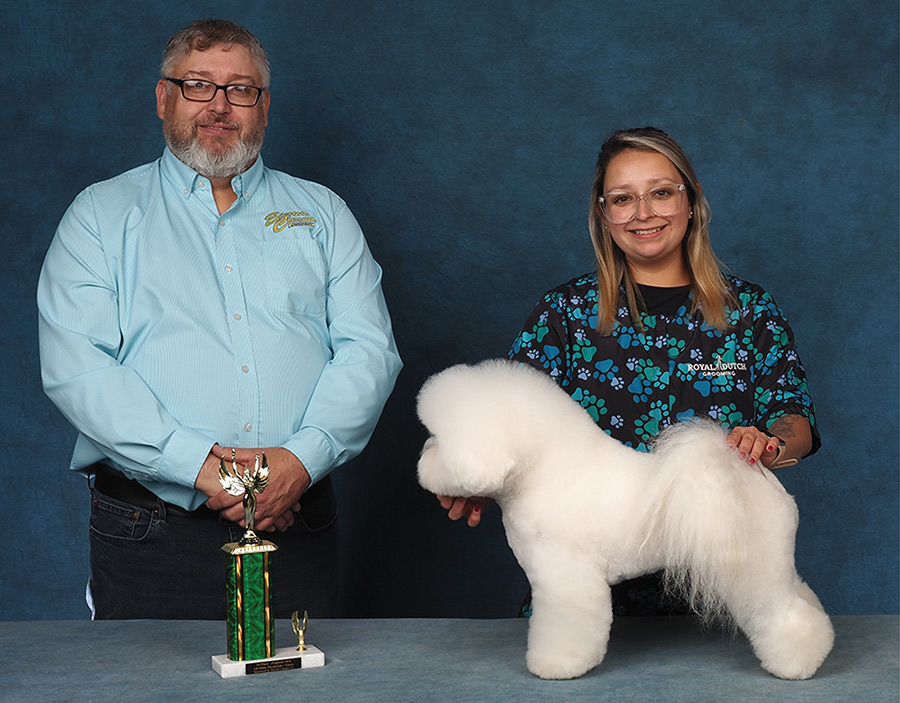

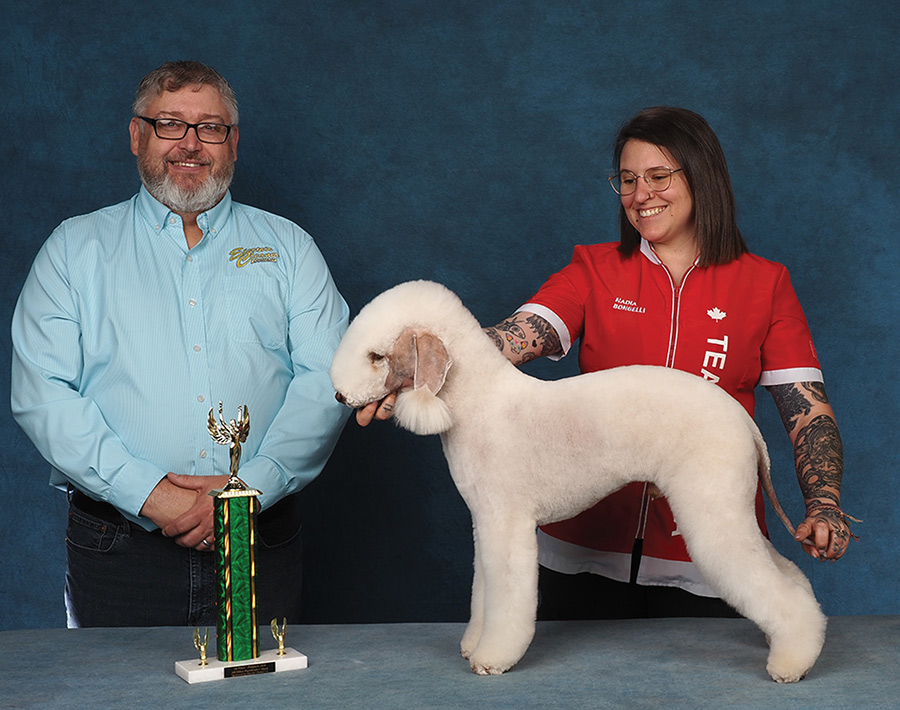


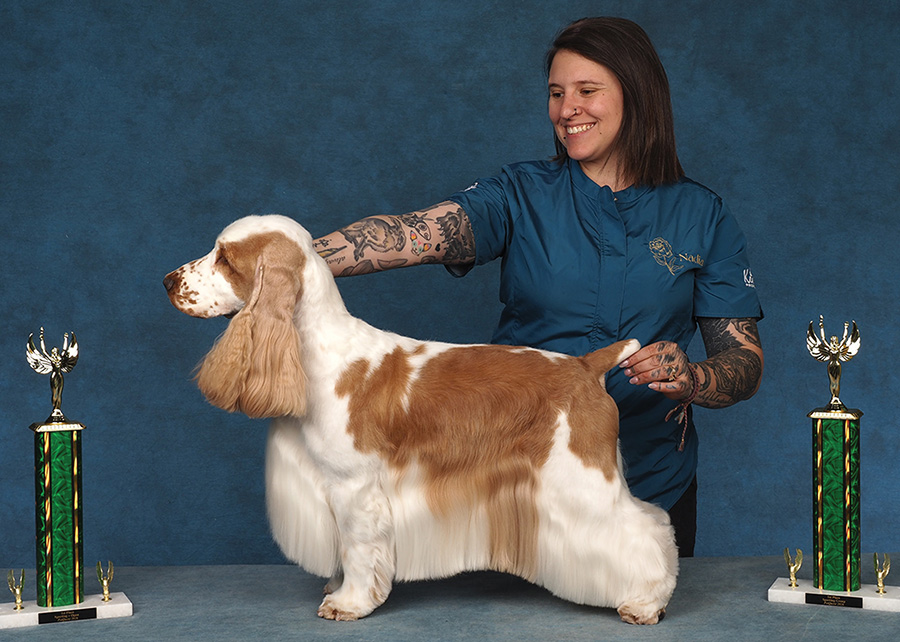
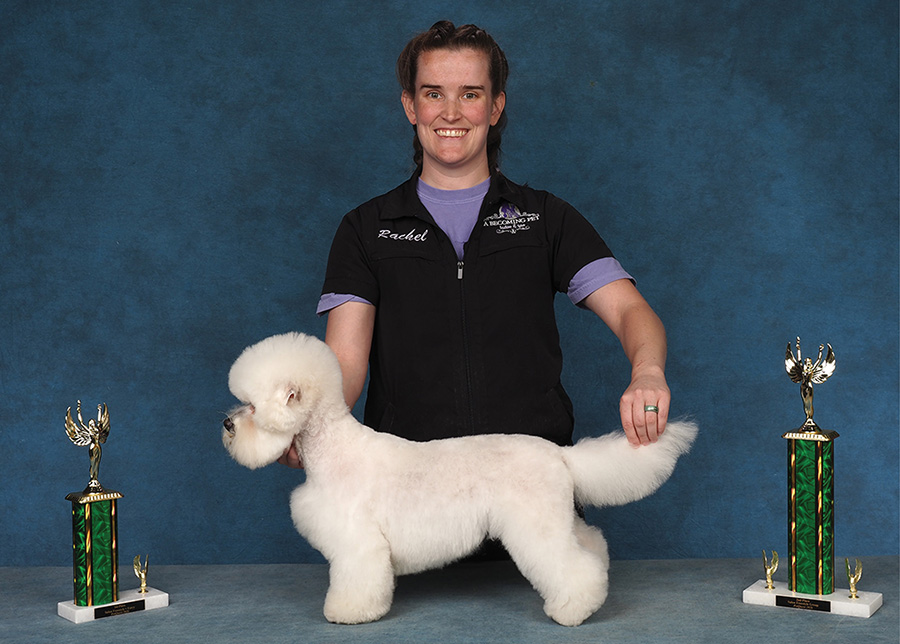
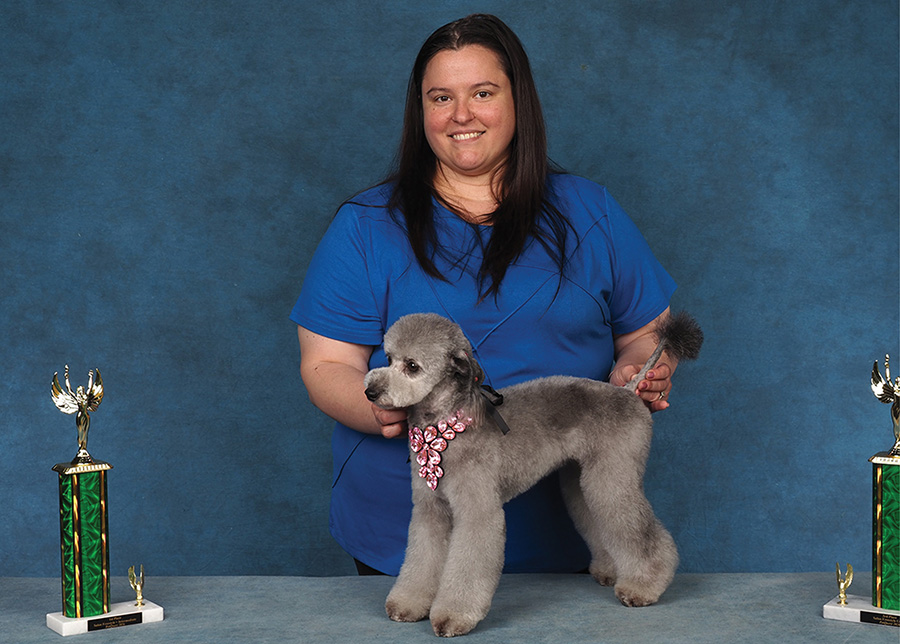

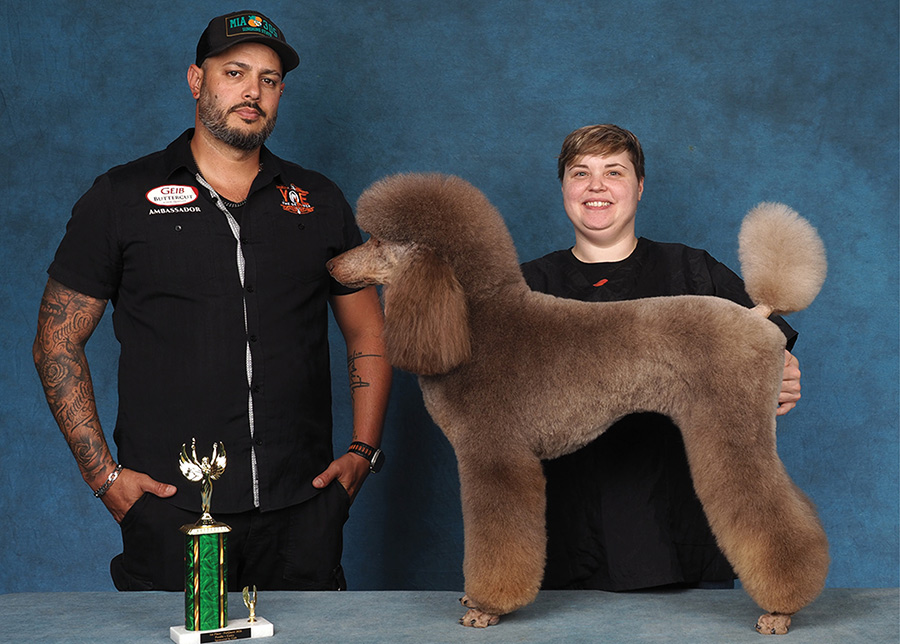
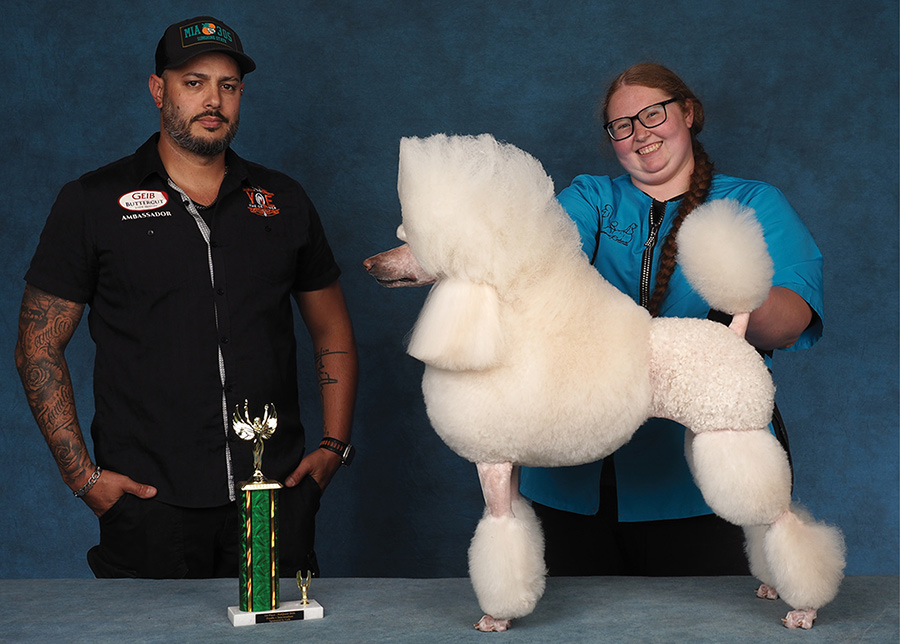


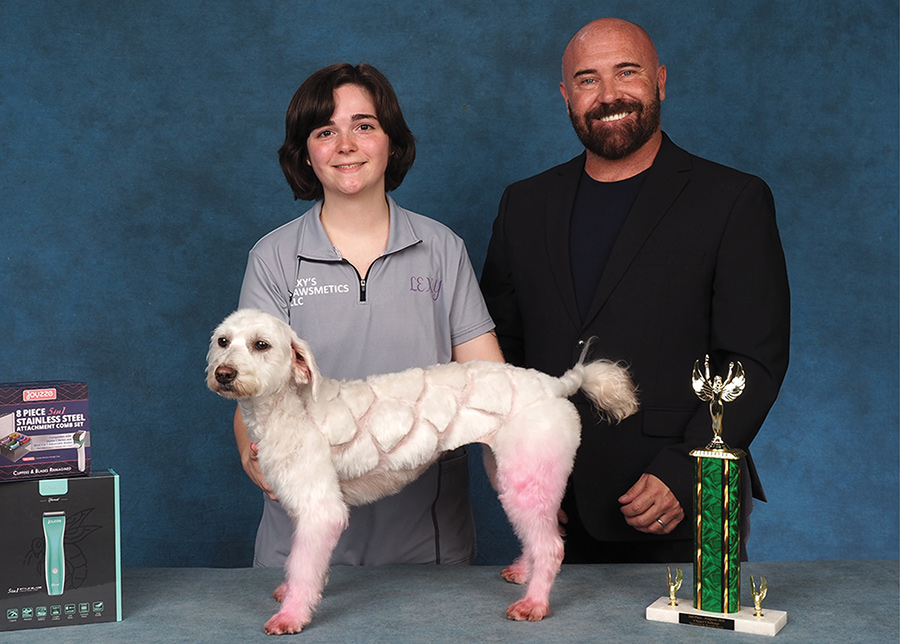









 hether you are buying an established grooming business or selling one, there are many details to address in such a process. The following is a checklist of tasks, processes and tips to consider for both buyers and sellers, though all may not apply to every situation.

Owning your own business or selling your existing business is an exciting venture, but it also carries great responsibility and duties. Expect there to be a learning curve on both ends, but developing a good relationship with the buyer/seller and abiding by all laws and ordinances can help you build a path to financial stability and independence.
The information provided in this article is for general informational and educational purposes only and does not constitute legal advice. The author is not a lawyer. For specific legal advice, please consult a licensed attorney in your jurisdiction.

by Keith Loria
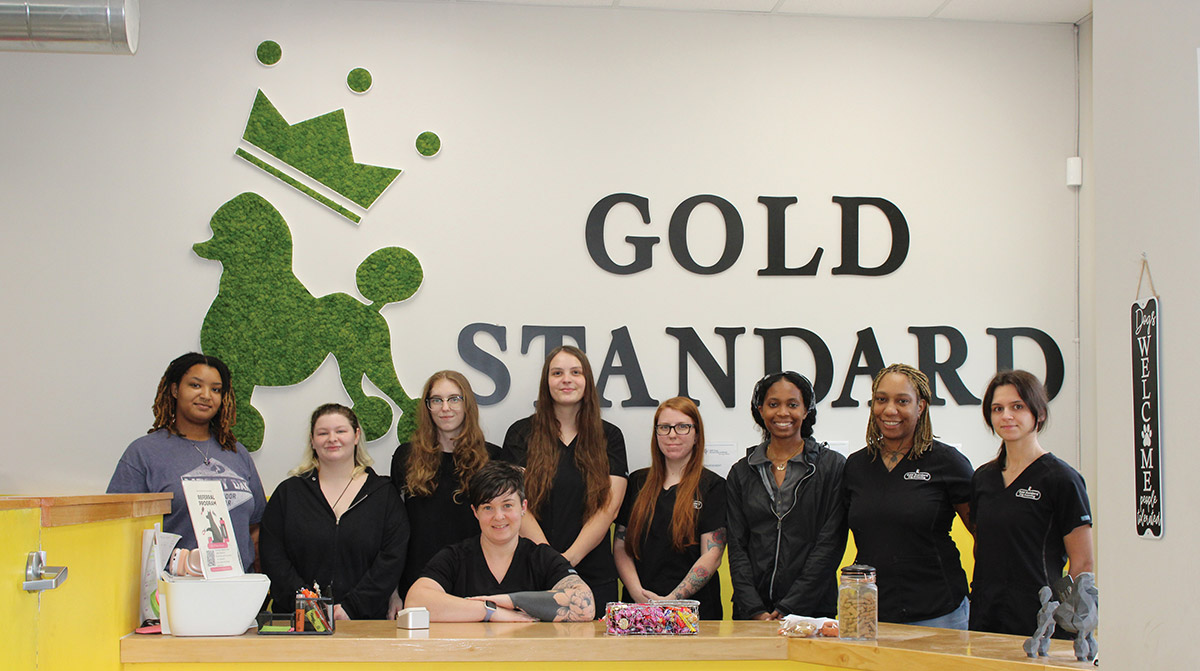
Photos prodvided by Gold Standard Dog Grooming
 hen Molly Forbes was 11 years old, she wanted a dog of her own. And when a local woman who bred AKC Australian Shepherds and also taught obedience and agility classes agreed to give Molly one of her show dogs, it came with a catch.
“She gave me one on the condition that I would learn how to train it, groom it, show it—all the things,” recalls Molly. “She was my mentor and my boss for a lot of years.”
Spanning more than two decades, Molly immersed herself in nearly every aspect of the dog world—from breeding and showing to training, grooming and veterinary care—all experiences that led to the creation of Gold Standard Dog Grooming in Charlotte, NC.
Unlike many groomers entering the profession today, Molly didn’t begin at a formal grooming school. Instead, she learned the old-fashioned way—through years of hands-on mentorship. Each summer she stayed with her mentor, traveling to dog shows and working alongside her while learning every aspect of caring for dogs.
“We would travel to dog shows and, obviously, when we were home, I was learning how to groom,” Molly shares. “It was just a long process over a lot of years.”
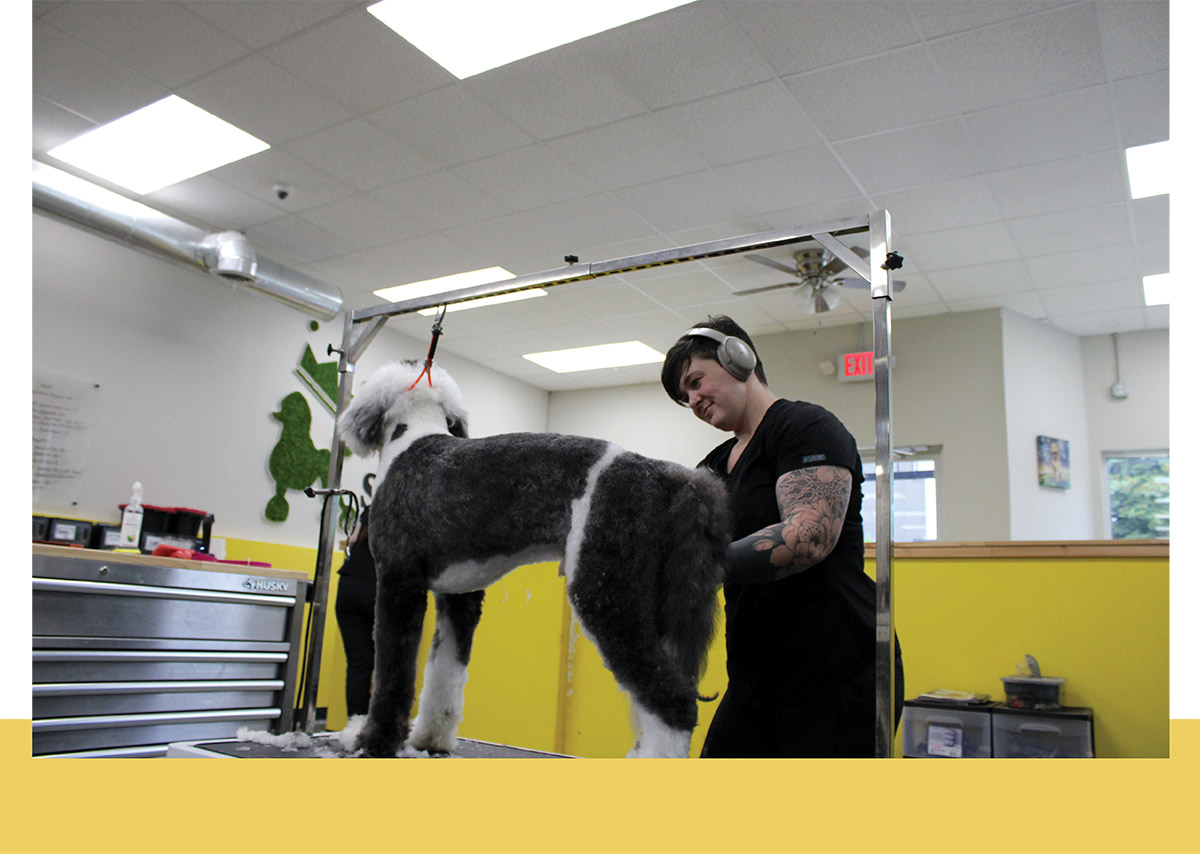
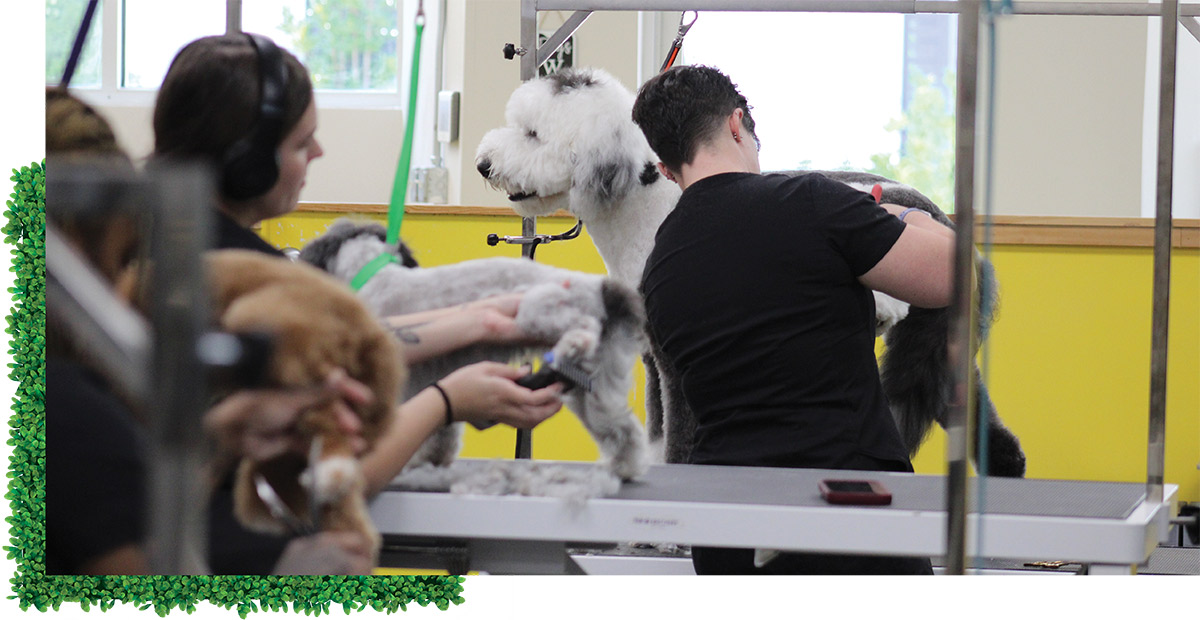

“I think it gives me a more realistic approach,” Molly says. “It allows me to read the dog’s body language a little bit easier than someone who maybe hasn’t been exposed to it. I have an easier time seeing problems before they happen.”
And that perspective carries over into every appointment. For Molly, a successful groom isn’t just about producing a beautiful finish—it’s also about understanding the dog standing on the table, recognizing stress signals and making the experience as positive as possible.
After years of grooming professionally in upstate New York, Molly and her husband, Mike, decided it was time for a change. The couple relocated to Charlotte in 2020 to be closer to family and enjoy a warmer climate, but Molly didn’t rush into opening a business.
“We spent a couple years just kind of learning the lay of the land of Charlotte, figuring out what neighborhood I wanted to end up in,” she explains.
By then, Molly had spent years working in different grooming environments and had developed a clear vision of what she wanted her own salon to look like.
“I’ve been in the business a long time,” Molly notes. “I’ve seen a lot of different ways of running a grooming shop and just felt that it was the right time. I had enough opinions about how I wanted things done and definitely enough knowledge and experience that I wanted to open my own shop.”
And so, Gold Standard Dog Grooming opened in 2022 with one guiding philosophy: quality over quantity. However, launching the business wasn’t quite as straightforward as Molly had planned. A zoning issue delayed renovations of the salon for nearly a year, leaving her with a difficult choice—wait for construction to finish or find another way to begin serving clients. Molly chose the latter.
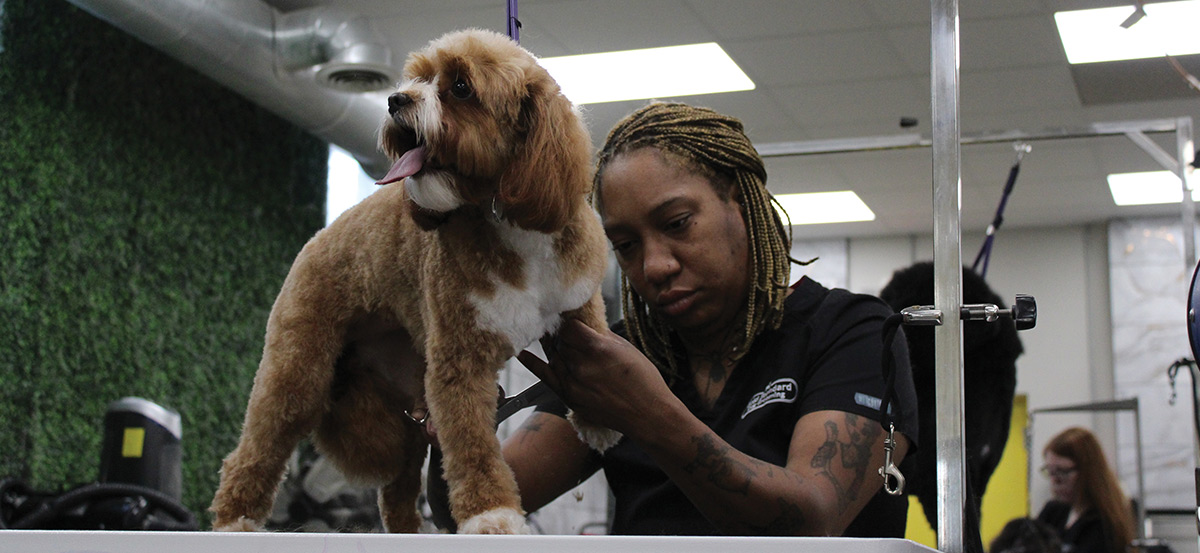
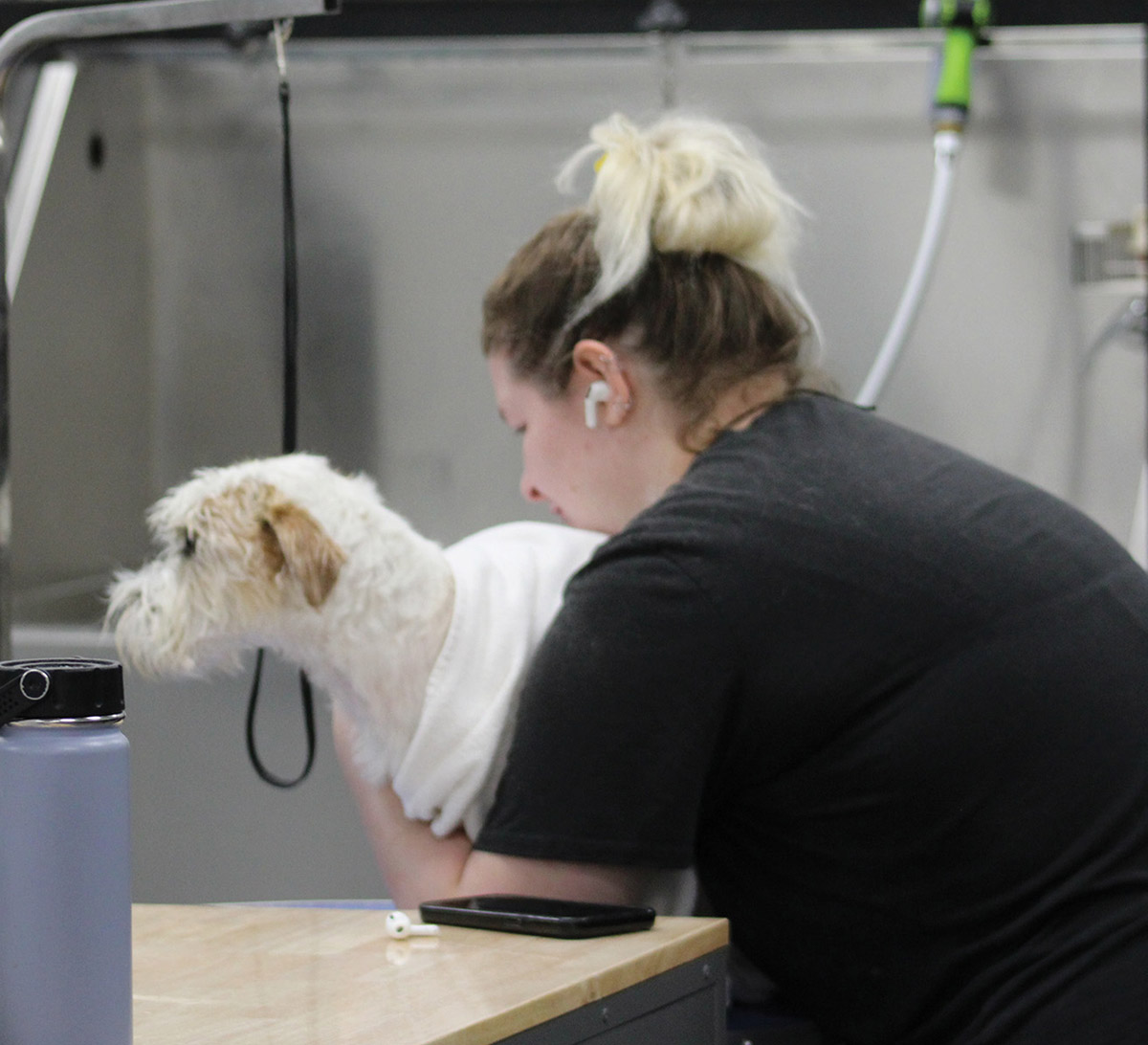

What could have been a frustrating setback turned into an effective way for Molly to introduce her new business to the community.
“The branding on the van helped,” she shares. “It started getting the name out there. It started getting the Google reviews coming in. It started building name recognition.”
Once the storefront finally opened, Molly didn’t invest heavily in traditional advertising. Instead, she focused on social media, neighborhood Facebook groups and building a reputation through customer referrals.
“People have to catch your name somewhere, then they Google you, there’s good reviews, and that brings them in. Then they tell people,” she notes.
As Gold Standard Dog Grooming grew, Molly discovered that hiring talented groomers was only part of the equation. Finding groomers who shared her philosophy proved to be the greater challenge.
“It’s tricky to find groomers that are the right fit,” Molly states. “Grooming competitions are important to me. Continued education is important to me. I want people that want to be really good at their craft.”
Today, the salon includes a receptionist, multiple bathers and four additional full-time groomers, creating a collaborative environment where everyone is willing to help each other when needed. Despite the growth, though, Molly hasn’t changed the philosophy she envisioned before opening the business.
“We don’t do high volume,” she explains. “I want quality over quantity. I want groomers that really want to do high-level haircuts.”
Another important foundation of Gold Standard Dog Grooming is communication. Over the years, Molly has found that many problems between groomers and pet owners have very little to do with the haircut itself. Instead, they often come down to expectations.


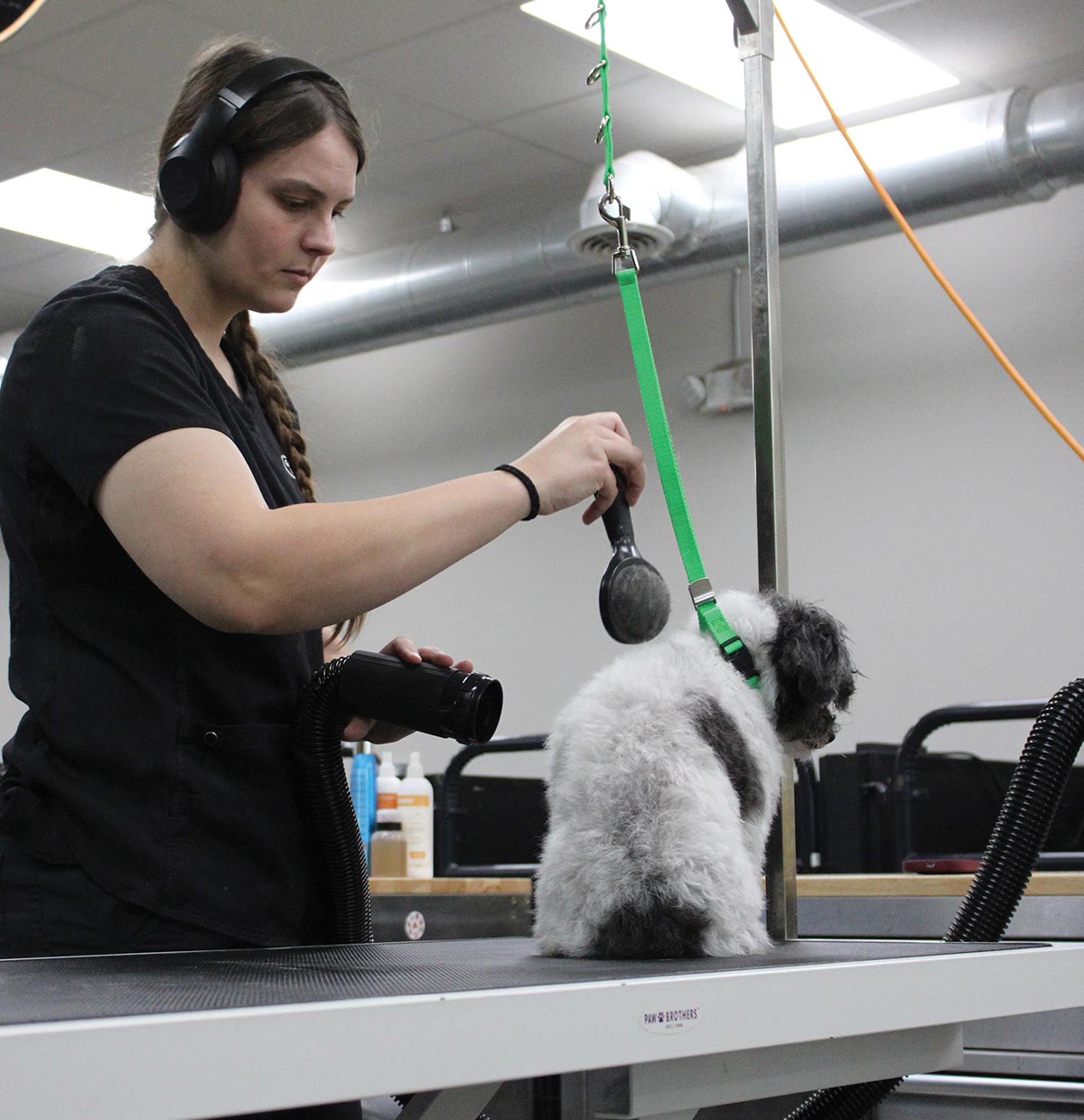
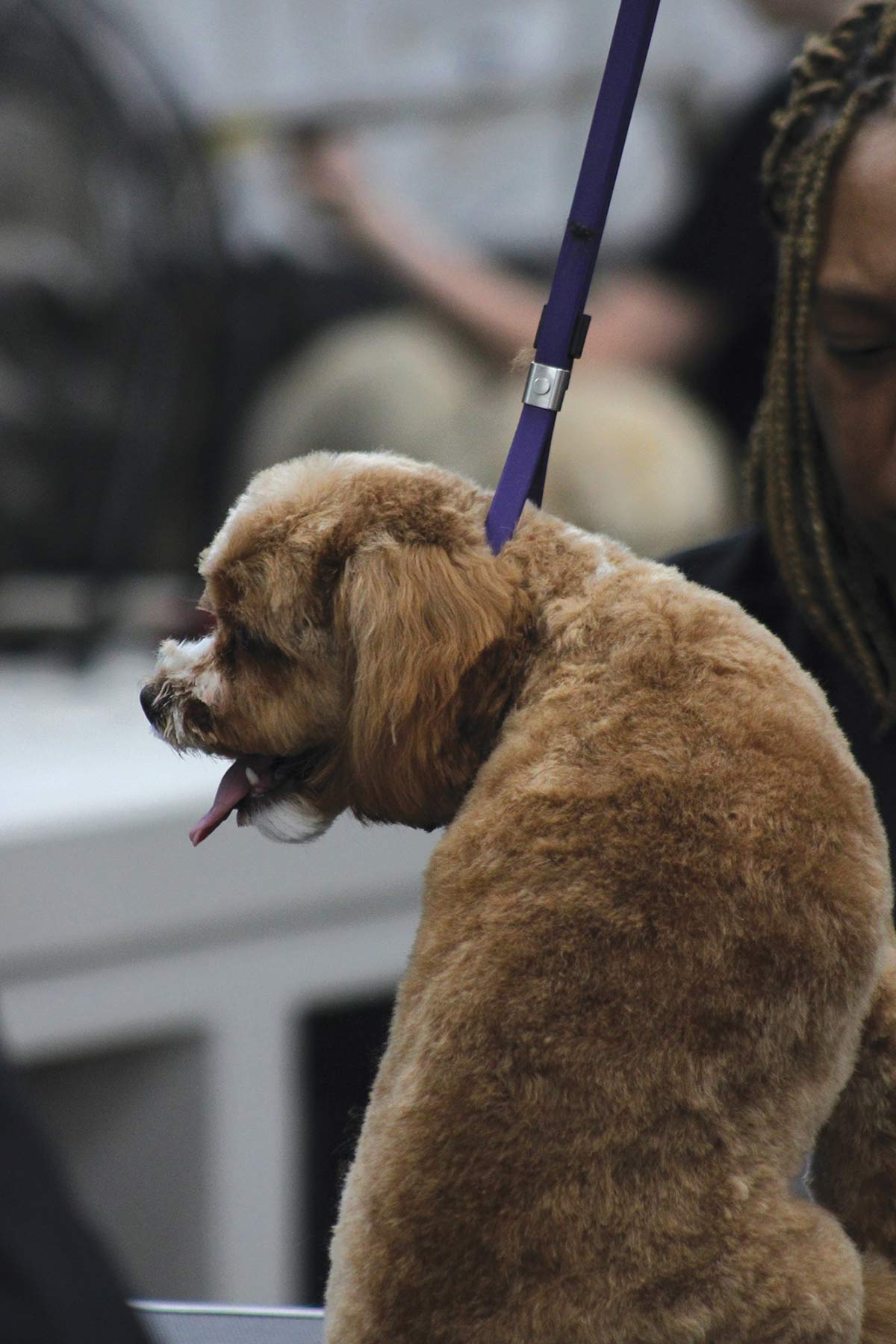
Whether a dog is nervous, matting requires a shorter trim than expected or something unexpected happens during the appointment, Molly wants clients informed every step of the way. That philosophy also applies when mistakes happen.
“We’re not perfect as groomers,” she admits. “If something happens, we’re going to talk to the owner about it and hopefully make it right for them. Our owners appreciate that.”
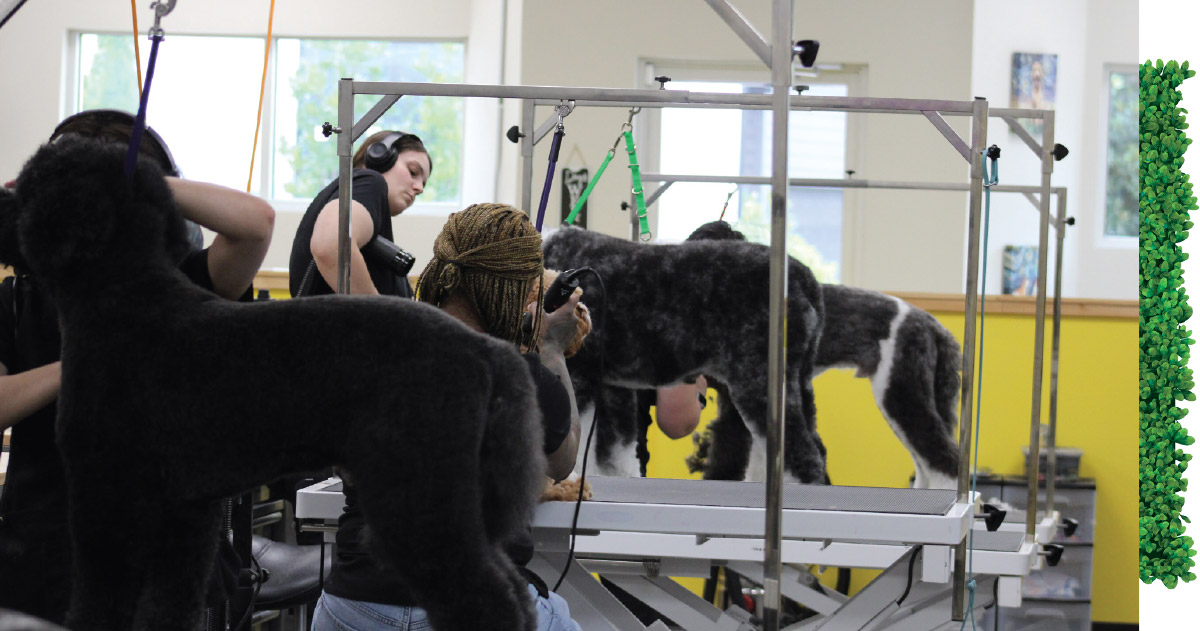
When you walk into Gold Standard Dog Grooming, one thing quickly becomes apparent—there are very few secrets. Rather than hiding the grooming area behind closed doors, Molly designed the salon so clients can see nearly everything that happens.
The 2,000-square-foot space features an open floor plan where dogs are bathed, dried and groomed in full view. And while the open design can be noisier than a traditional salon, she believes the transparency gives clients peace of mind.
“They know we’re not mishandling the dogs in a back room,” shares Molly. “You can see everything.”
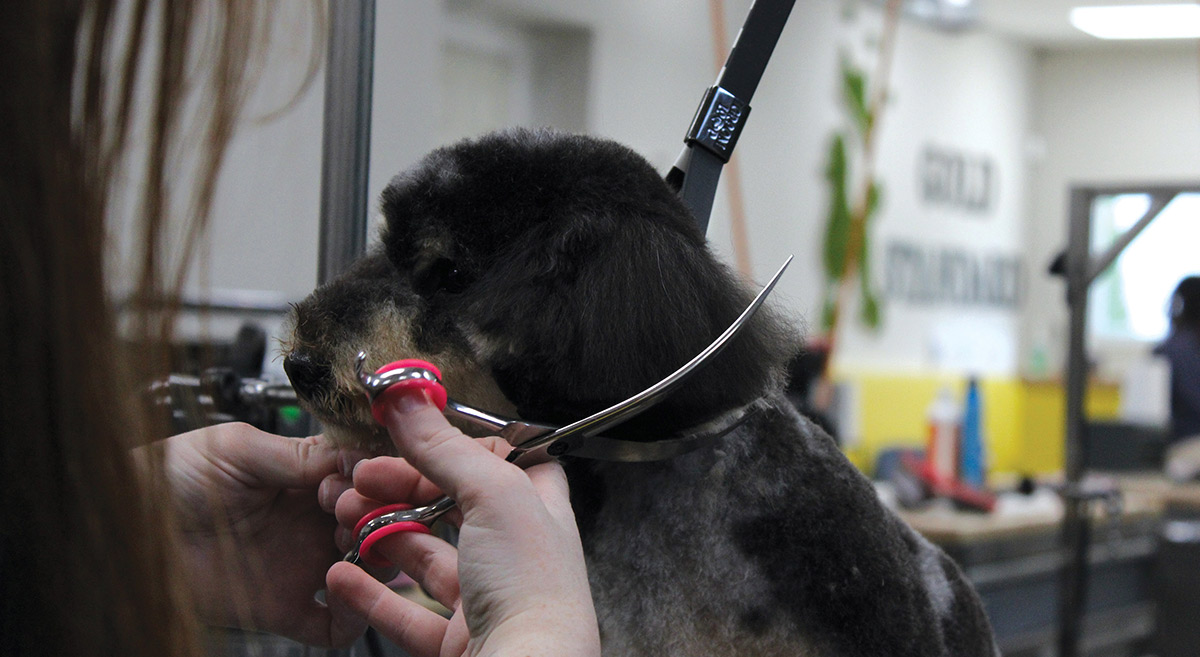

“We educate first,” she explains. “If they want their wire-coated dog clipped, that’s their choice. At the end of the day, the owner is the one who lives with the pet.
“I would love every terrier that came in the door to get hand stripped,” continues Molly, “but that’s just not realistic.”
Today, Gold Standard Dog Grooming is fully staffed, and Molly is beginning to explore opening a second location. But for now she’s enjoying being able to spend more time pursuing one of her favorite parts of the profession—grooming competitions.
“The shop is at a point where I can now step away a little bit,” she explains. “It frees me up to go to more grooming competitions, which is how I find growth as a groomer.”
Another goal of Molly’s is to host more educational seminars at the salon to educate her groomers, but also other groomers in the area. As someone whose own career began with a mentor willing to share her knowledge, Molly hopes to do the same for others.
Regardless of where her career takes her, one thing will remain unchanged for Molly and Gold Standard Dog Grooming: quality will always prevail over quantity.

 ay you decide to play a game with a group of friends that you have never played (e.g., cards, video game, board game, etc.). What do your friends do?
- They tell you it is easy to pick up, so just play along.
- They tell you the rules and start the game.
- They do a few “dry runs” and teach you how to play as you go along.
If they are true friends, they do a few dry runs, explaining the rules and the best tactics before starting an official game. But what does this have to do with leadership training?
Think about the last time you or someone in your salon was promoted to a lead, assistant manager or manager position. Was it more of a “tag, you’re it” situation, or did someone explain the role and key skills required for the success of the newly promoted individual and the future of business? Let’s answer the basic questions of why, what, how and when.

New managers are in the process of changing from being a team member (an individual contributing to the goals set forth by the owner) to being a leader responsible for delegating, giving feedback, managing performance, solving conflict and a whole host of other responsibilities. A different skillset is needed—some of which they may still need to gain.
Team members are also in the process of change; changing from viewing the person as one of “us” to one of “them”—one who has the power to make or break the team. We have all heard the saying that an employee doesn’t leave a job; they leave a manager. Surveys say that over 57% of employees quit because of a manager, and another 32% seriously consider quitting because of their manager.1
With all the talk about employee turnover, quiet quitting, difficulties attracting new hires and problem managers, it is easy to see why a new manager must be trained. Training by trial and error (i.e., the game is easy; just jump in and play along) may not be the best method and can set the new manager up to fail.

In addition the obvious skills that managers must possess (i.e., delegation, prioritizing tasks, giving feedback, resolving conflict, managing employee performance, setting goals, etc.), the following skills are also needed:
- Understanding the laws, regulations and rules
- Recognizing what motivates people
- Familiarity with the employee handbook
- Communication and interpersonal skills
- Understanding learning styles
- Creating psychological safety
The list may seem daunting, but with an organized plan, the new manager can be adequately prepared to deal with what comes along during their time on the floor.

Consider using the following to train a new manager (and anyone on the management team, for that matter):
- Manager’s Handbook: Just like you have an employee handbook, a manager’s handbook can provide resources, templates for documents and “how-to” instructions.
- Monthly Check-Ins: Discuss issues and talk about best practices.
- Daily Huddle: Get management on the same page for appointments, special situations, etc.
- Debriefing Sessions: After one of those “special” situations, sit down and debrief—talk about what worked well, what didn’t and what to do in the future.
- Mentorship: Be it with an experienced manager on the team or someone outside the salon, they should have someone to turn to who understands their role.
- Classroom & eLearning: Take advantage of conferences, webinars and other industry resources.
- Upside-Down Training: Start with a scenario and work through how to apply knowledge and make decisions.
Remember, people learn in different ways, and your manager is no different. For some, reading pages in a handbook is not the best method, and perhaps a case study would be better. For others, they may prefer to read the information first. Take the time to find out the new manager’s learning style before you start the actual training session.


The goal is to deliver the right training at the right time. For example, the new manager is faced with an employee problem. Conducting a quick five-minute session is valuable when it targets the issue at hand, therefore enhancing learning and building skills much quicker than a session on the topic five months from now. However, there is a benefit to training on issues and then getting into the details when the situation calls for it.
All of this training culminates in being held accountable. Training lets the manager know expectations for job performance. They understand their role and duties, and they know how they will be evaluated. You can’t promote someone, not train them, and then penalize them for not performing well.
This brings us back to playing that new game with friends. If your friends fail to teach you the game, you may become frustrated, give up and quit, or maybe get kicked off the team if you lose too many times. But if you were taught the rules and techniques of the game, apply what you learned and strive to score higher in the next round, you’ll experience personal and team success. The same goes for the game of business. A well-trained manager is necessary for business, personal and team success.
- Miles, M. (2022, August) Five must-haves for a new manager training program. BetterUp. https://www.betterup.com/blog/new-manager-training

 very spring, four longtime groomer friends—Harper, Zoey, Finn and Layla—meet for an annual dinner where talk inevitably shifts from poodles to profits and taxes. Each groomer makes about $100,000 a year in net profit, but each has structured their business differently.
Harper, Zoey and Finn all work independently; Zoey and Finn as mobile groomers, while Harper works in a salon. They originally chose to operate as sole proprietors—the default setup for any groomer who starts taking on clients. After all, it’s the simplest and cheapest way to start a grooming business; there’s no entity to register, no separate tax filing and little, if any, paperwork.
In the eyes of the law and the IRS, the three groomers and their businesses were one and the same. And as Layla liked to point out, the idea that you need an LLC or corporation to start writing off expenses is a myth. A sole proprietor can still deduct every legitimate business cost—from shampoo, clippers and equipment to vehicle mileage, a home office and even retirement contributions—right on their personal return.
Most groomers manage that risk with a solid liability insurance policy as a first line of defense. But insurance only goes so far. A serious claim that exceeds the policy limits (or an unpaid business debt) can still reach a groomer’s personal savings, and even their home.
Layla, on the other hand, had a reason to be more careful. Early in her career, an anxious shepherd mix twisted on the table and her clipper created the smallest of nicks. Layla felt the cold drop in her stomach as she pictured the owner’s face at pickup—and the lawsuit that luckily never came. As a homeowner with a car and savings to protect, she formed a single-member LLC not long after.
It wasn’t a magic shield, either. It wouldn’t protect her from her own negligence, and when she later explored a business loan, the bank still wanted her personal guarantee. What it did do was keep her personal assets out of reach of the everyday liabilities of running a salon, and for a homeowner, that peace of mind was worth the upkeep: formation costs and an annual fee to keep the LLC in good standing, which vary by state.
At that year’s dinner, Harper, Zoey and Finn were venting about how much they owed—roughly $30,000 each, once they factored in both income tax and the 15.3% self-employment tax. They assumed Layla had it better thanks to her LLC, but to their surprise, she paid nearly the same amount.
A single-member LLC is what’s known as a disregarded entity: invisible to the IRS, so its income drops straight onto the owner’s personal return. The LLC had changed Layla’s legal exposure, not her tax bill, so she still had to file a Schedule C and pay self-employment tax just like the others. The only way to actually change how her profits are taxed is to make a separate election with the IRS—a decision entirely distinct from forming an LLC.
That dual role is where the savings come from, and where the rules get strict. As an S corporation owner, Layla had to put herself on payroll and pay herself a “reasonable” salary—roughly what she’d have to pay someone else to do her job. This isn’t a number she could just make up, though. If you pay yourself too little so you can save taxes, the IRS can step in, reclassify your profits as wages and pile on penalties.
Layla landed on a defensible $50,000, which still got hit with the same payroll taxes that make up the 15.3% she was always paying. But the other $50,000 (the profit left over after her salary) passed through to her as a distribution that self-employment tax simply doesn’t touch. That one move shielded roughly $7,650 a year (15.3% of $50,000) from a tax her friends were still paying.
However, being her own employee meant setting up a real payroll: actual paychecks, tax withholdings and the filings that come with them. She also had to set up an Accountable Plan, a simple but powerful tool that let the business reimburse her, tax-free, for the share of her home, car and cell phone used for work. Done correctly, it created business deductions that never became taxable income to her personally.
Now, for all its upside, the S corporation wasn’t free. Hiring a payroll provider, preparing and filing a separate business return (Form 1120-S), and the meticulous bookkeeping an S corporation demands all meant higher costs. The savings only made sense because her profits had grown high enough to where the tax savings far exceeded those added costs. Below a certain income, the math simply doesn’t work.
The next year, Zoey and Harper decided to open a pet spa together. They formed a multi-member LLC, and on their attorney’s advice, they didn’t stop at the basic paperwork. They sat down and hammered out a real partnership agreement, documenting who contributed what, how profits would be split and, less comfortably, what would happen if one of them ever wanted out or passed away.
Side by side at their two stations, Zoey and Harper’s appointment book filled, and so did their shared business bank account. But success brought a challenge of its own. The two friends soon found they had very different ideas about what to do with all that cash. Zoey wanted to plow the profits back into the business, and Harper wanted to take the cash home as a partner distribution. There was no clean right answer, just two owners with different but valid priorities.
When tax season arrived, they discovered partnerships come with their own March tax deadline. Their salon had to file its own return, a Form 1065. The partnership itself paid no tax; instead, it issued a form (Schedule K-1) reporting each partner’s share of the profit, which then flowed into their individual returns. The catch was, Zoey and Harper couldn’t file their own individual returns until the partnership return was finished.
There were new terms to learn, too. Because Zoey and Harper wanted to ensure they received at least 50% of the money for the grooming work they personally did, profit or no profit, the partnership used what’s called a guaranteed payment. Think of it as a partner’s version of a salary: it gets paid regardless of how the business performs that year. They also had to track each partner’s capital account, a running tally of what each put into and pulled out of the business.
Even after all that, the bottom line was the same. A multi-member LLC, by default, is taxed as a partnership: the profits pass straight through to the owners, who pay income tax and the same 15.3% self-employment tax on their share. The new partnership structure gave them liability protection and a clean framework for running a business together, but it didn’t shrink their tax bill by a single dollar. Just like their sole-proprietor days, they each still owed around $30,000.
Another year later, at the same restaurant, the talk drifted the way it always did. Only this time, no one was guessing. Four friends who started in the same place had each taken a different road, and they laid those roads out plainly:
- Sole Proprietorships: Simple and low-cost but offer no personal asset protection.
- Single-Member LLCs: Add legal protection but do not reduce taxes unless paired with an S Corp election.
- Multi-Member LLCs: Provide structure and liability protection for partnerships but bring complex compliance and offer no inherent tax savings.
- S Corporations: Can significantly reduce self-employment taxes but require payroll, meticulous bookkeeping and separate tax filings.
As they wrapped up their night, they all raised their glasses in a toast to clean cuts, clean books and keeping more of what they earn.
Jason Friedman is co-founder of Friedman & Friedman Accounting & Tax Advisors (aka “Friedman Tax”), a family-owned accounting and tax-advisory firm dedicated exclusively to tattoo artists, pet groomers, body piercers, hair stylists, barbers, and salon/shop owners. Founded and operated by two CPA brothers, the “Tattoo Tax Guys,” they bring deep experience in complex tax and accounting work, a passion for helping creative entrepreneurs, and a strong focus on exceptional client service. They offer full-service tax preparation and bookkeeping, LLC formation, strategic tax planning, back-tax cleanup, and consulting, all tailored to the unique needs of artists, stylists and pet grooming professionals.



 s groomers, we all know just how much work goes into learning the skills needed to do our job. We spend years learning and honing our craft to safely and efficiently groom pets to each individual client’s expectation. However, as an industry, we are still fighting to have our jobs taken seriously by the public.
What many see as a temporary job or “just a hobby,” we see as a genuine career path that we have dedicated ourselves to. Though it has taken time, we are finally making strides in being seen as legitimate businesses and tradespeople—but we still have a long way to go.
As we continue to work towards being more respected as professionals, the expectation of and need for employee benefits has increased. Individuals and families seeking benefits such as health care and retirement savings often end up leaving their workplace to go where these are offered, even if they are happy at their current place of employment.
As employers, offering a benefits package is not only a way to keep top talent at your salon; it is also a way to show respect and appreciation for your team, and increase your total compensation package without raising commission rates.

For years, we have normalized health insurance only being possible if you work in a corporate environment, which is no longer true. There are so many options out there for businesses of all sizes to offer health insurance to its employees if you know where to look.
Depending on how much you have available to spend each month on insurance, you can even choose to offer partial or full coverage to your employees. Many health insurance companies offer group rates to small businesses, and they are often cheaper than going through the marketplace.
A health insurance broker can be a great resource for finding a plan that will fit in your business’s budget. They have the contacts and resources available to compare multiple companies at once, saving you time and frustration.
Another great place to look for affordable health insurance is your payroll company. Many are partnered with insurance brokers who are able to offer multiple plan options that fit your budget.
If all else fails, you can also offer a Health Insurance Stipend for employees. This would be a flat dollar amount that you reimburse them each month to cover their own private insurance plans that they have enrolled in.
Another popular option in this space is offering a Health and Wellness Stipend. This could include paying for a gym membership, regular massages, acupuncture, mental health appointments or even a healthy food subscription service. These are all great add-ons to offering health insurance.
Even if your state does not have these requirements, paid time off is still a great way to reward your employees for their hard work. Some business owners choose to pay a flat rate for this, while others choose to calculate the average hourly wage their employees earn. Both work great, as long as they follow your local laws and guidelines.
Another benefit which is gaining popularity is more flexibility with unpaid time off. Many salon owners are not setting a maximum number of unpaid days off their employees take, as long as they are requested with reasonable time and do not disrupt the schedule. This lets your employees know that you care about their personal life as well as their spent time in your business.

There are many ways you can offer continuing education to your team, but some may include:
- Offering subscriptions to courses or websites with grooming videos and tutorials
- Hiring high-level groomers to teach seminars at your salon
- Bringing in a CPR/First Aid certifier or paying for them to take an in-person course
- Covering certification fees or hosting a certification course at your salon
- Paying for admission to grooming trade shows and seminars
- Reimbursing grooming contest entry fees
- Providing model dogs for employees to practice breed trims on
- Attending local dog shows
Business owners should consult with a tax professional before choosing a retirement benefit, as they can have important tax implications.
These are just a few examples of popular employee benefits, but they can absolutely be tailored to what your employees really want and need. Feel free to get creative, and let’s all start thinking of more ways that we can reward and compensate our employees that are so vital to our grooming businesses.


 ne of the most common questions I hear from cat groomers is, “What should I charge?” And it’s usually followed by a list of prices from competitors, a screenshot from a Facebook group or a discussion about what dog groomers are charging in their area. Unfortunately, none of those things actually answer the question.
Pricing is one of the most confusing topics in the grooming industry, as groomers tend to fall into the trap of “emotional pricing.” Ask 10 groomers what to charge and you’ll often hear the same response: “Charge what you’re worth.” And while that sounds encouraging, it isn’t particularly helpful. What exactly is your worth? How do you calculate it? Does your worth go up on days when you’re feeling confident and down on days when you’re struggling?
The reality is that your business cannot survive on motivational quotes—it has to work on paper first. One of the biggest mistakes groomers make is treating pricing as a “feeling” instead of a business decision. But before we address confidence, we need to answer a much more important question: Can your business actually support itself?
Groomers also often underprice themselves because they just opened, are emotionally attached to their clients, imagine what they personally would be willing to pay, worry about offending someone, feel guilty charging more or charge a lot higher for a “happy price” when they don’t want to do something. The business doesn’t care about any of these things. Your insurance company doesn’t accept guilt as payment and neither does your landlord, utility company, software provider, accountant, equipment supplier or the IRS. The numbers either work or they don’t.
For example, let’s say a groomer determines they can comfortably complete a certain number of appointments each day, working a schedule that they actually want to maintain long-term. Once they know that number, they can calculate approximately how many appointments they expect to perform each month and each year. Now we’re working with something tangible.
Instead of asking, “What should I charge?” we’re asking, “What revenue does this business need to generate from those appointments?” That is a much easier question to answer.
- Rent or mortgage expenses
- Insurance
- Utilities
- Software & app subscriptions
- Credit card processing fees
- Laundry
- Continuing education & professional memberships
- Taxes
- Equipment repairs & replacement
- Marketing (ads, business cards, etc.)
- Office supplies
- Business savings
And don’t forget about your own compensation. Far too many groomers account for every bottle of shampoo and every dryer filter but completely overlook the fact that they need to pay themselves.
Once you’ve determined your annual business expenses and the income you want the business to provide, you can calculate the total revenue required to support those goals. From there, it’s simply a matter of dividing that number by the number of appointments your schedule can realistically support. Now you have a baseline—not an emotional number or a competitor’s number—you have your number.
A client doesn’t know how long it should take to groom their cat. They don’t know whether a bath and blow-dry takes 45 minutes or two hours, and they don’t know whether a lion cut takes one hour, three hours or an entire afternoon. They only know they want a clean, comfortable cat.
Time is certainly one factor in grooming profitability, but it isn’t the only factor. A groomer with an efficient setup, specialized equipment and years of experience may complete the same service significantly faster than a groomer who is just starting out. Should the more efficient groomer earn less simply because they developed better systems? I don’t think so.
Efficiency has value. The goal should be creating a pricing structure that supports the business regardless of whether a particular appointment takes slightly more or less time than average.
That doesn’t mean every cat costs the same, though. It means creating a structure that is straightforward and predictable. Many cat groomers naturally separate services into broad categories such as shorthaired, longhaired and haircut appointments. Add-on services can then be layered on top when appropriate. Clients understand that. But, more importantly, they can budget for it.
Most importantly, you don’t feel pressured to “sell” something every time a client walks through the door. Many groomers are uncomfortable with upselling, as we got into this profession to work with animals, not feel “sleazy” in sales. When your pricing structure is built properly from the beginning, you can recommend add-ons based on what will genuinely benefit the cat instead of what the business needs to survive.
For cats requiring severe mat removal, I increased the price of the initial lion cut and included a second follow-up bath and blow-dry appointment within eight weeks. Many clients view this as a complimentary groom, but the real goal is bridging the gap between crisis management and preventative maintenance.
When I see the cat again before the coat has a chance to become matted, I can evaluate how quickly the hair is growing back, what grooming services the cat tolerated well and what maintenance schedule is most appropriate moving forward. More importantly, the owner gets to experience grooming when there isn’t a problem to solve. The appointment is easier, less stressful and more comfortable for everyone involved. Instead of discussing how to fix matting, we’re discussing how to prevent it.
By encouraging follow-up visits and helping owners see the difference between preventative maintenance and emergency grooming, we create healthier habits for both the cat and the client. The result is often a more predictable schedule, better coat condition, safer appointments and stronger client retention. Everybody wins.
The best pricing decisions are rarely emotional ones—they’re mathematical ones. Do the math first, then build a pricing structure that supports both your business and the cats you serve. Because when the numbers work on paper, everything else becomes much easier.



by Blake Hernandez
Groomed by Sarah Yagi
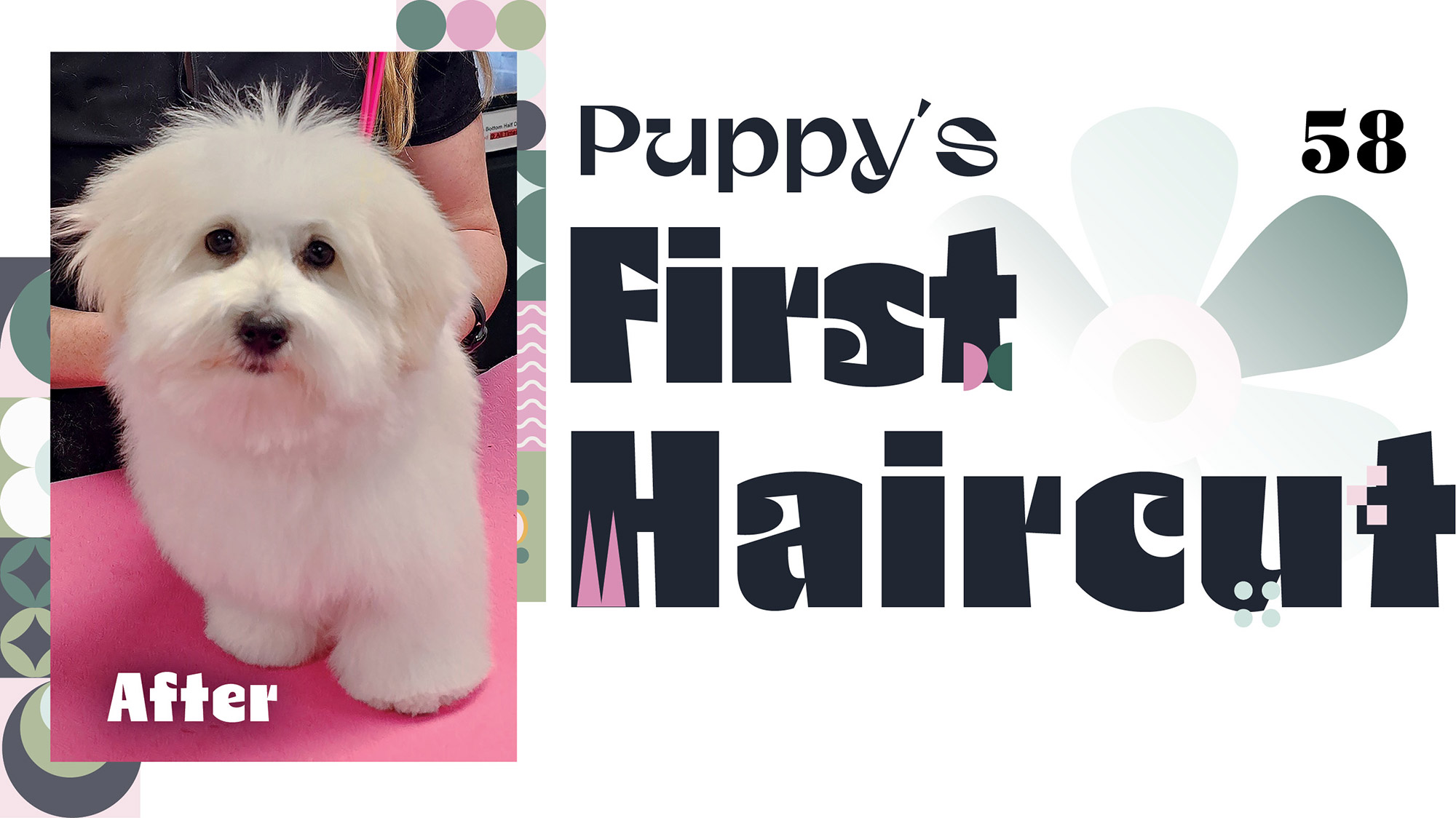
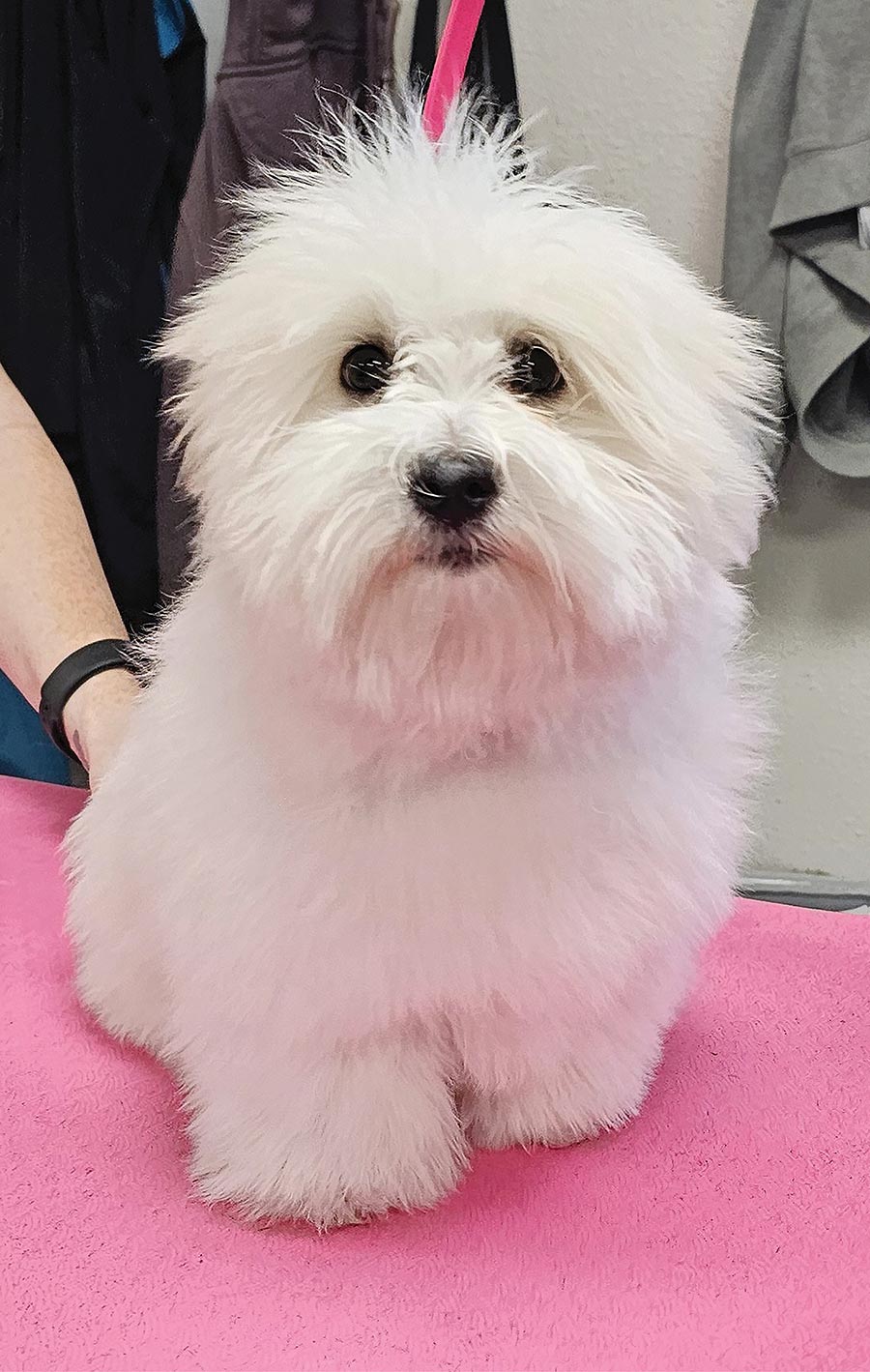
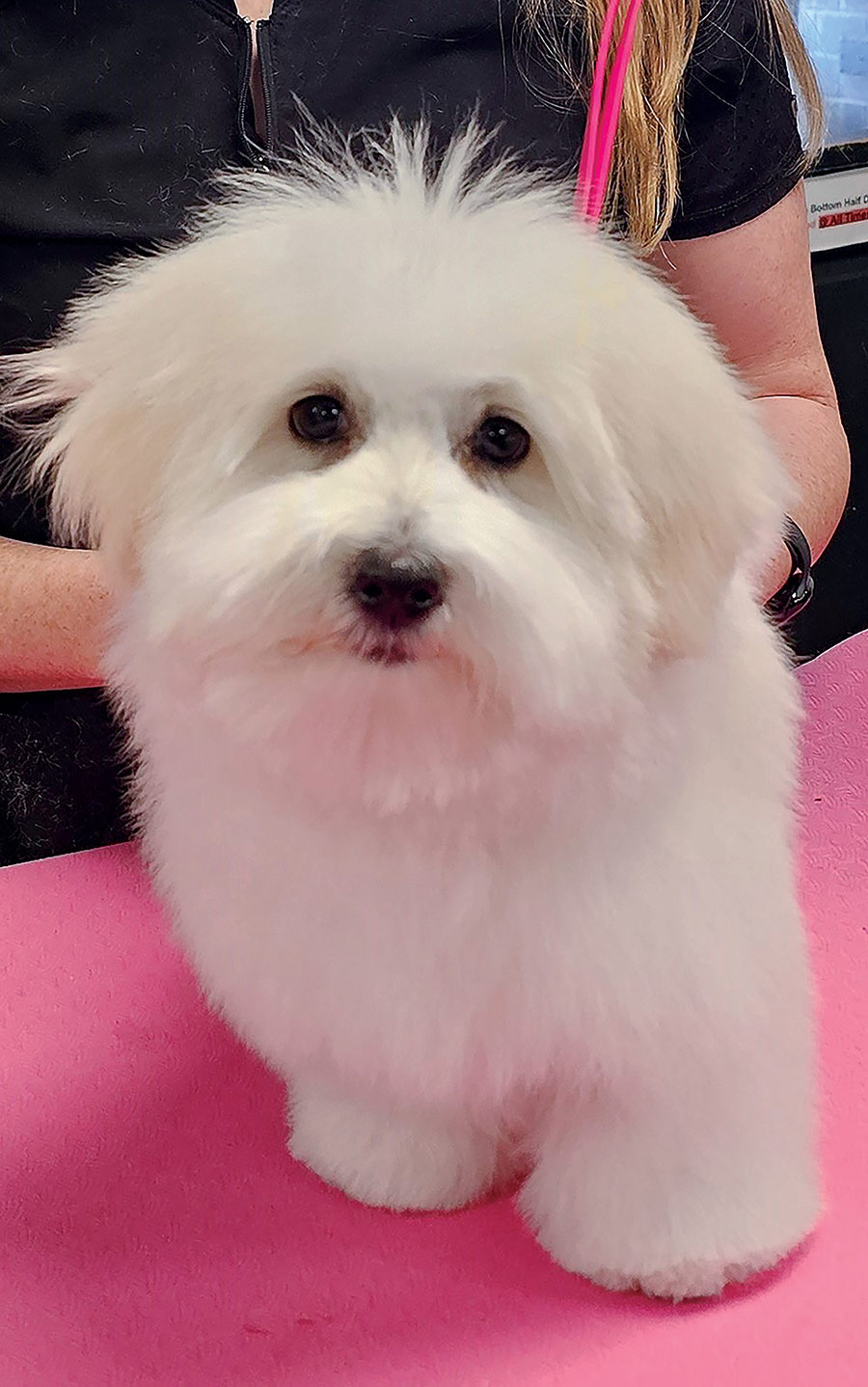
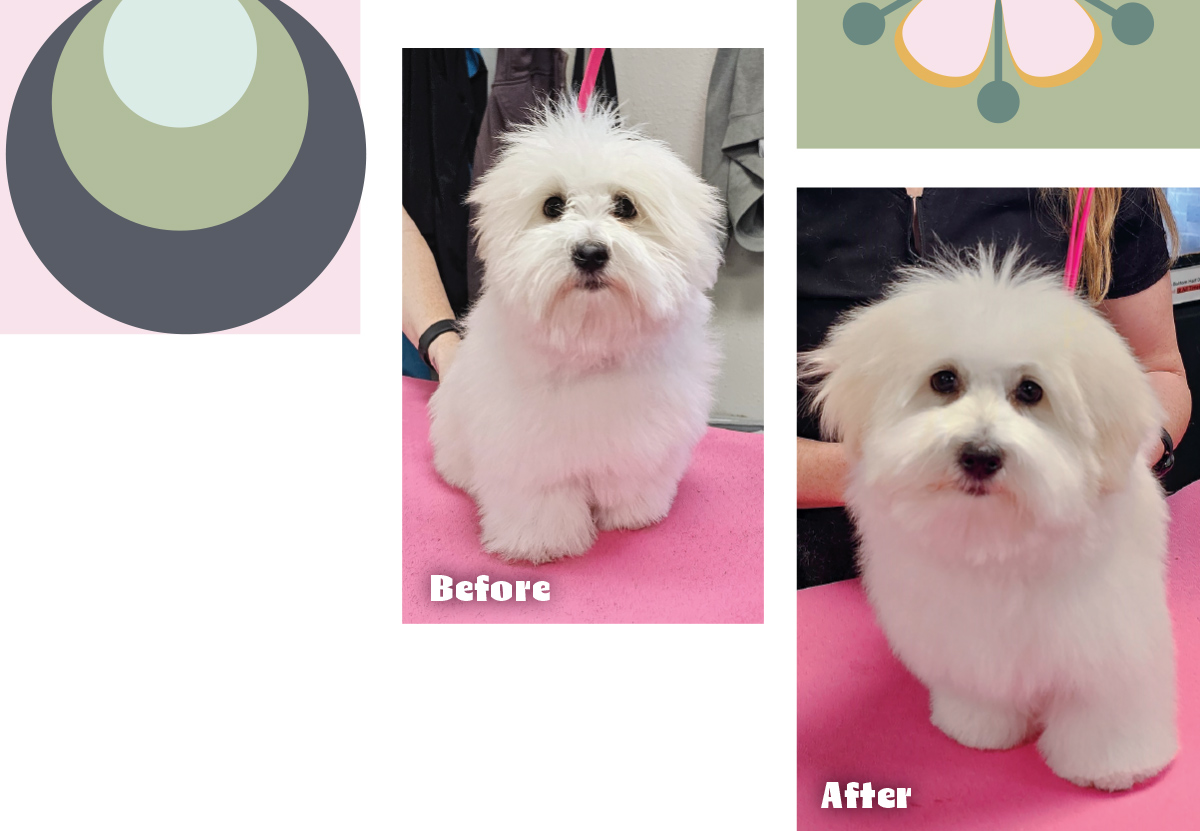
 hile there will always be new puppies coming through our salons, it is important to know that each situation can be different, and we owe it to these young dogs to teach them the routine and make them confident while still meeting our grooming clients’ requests.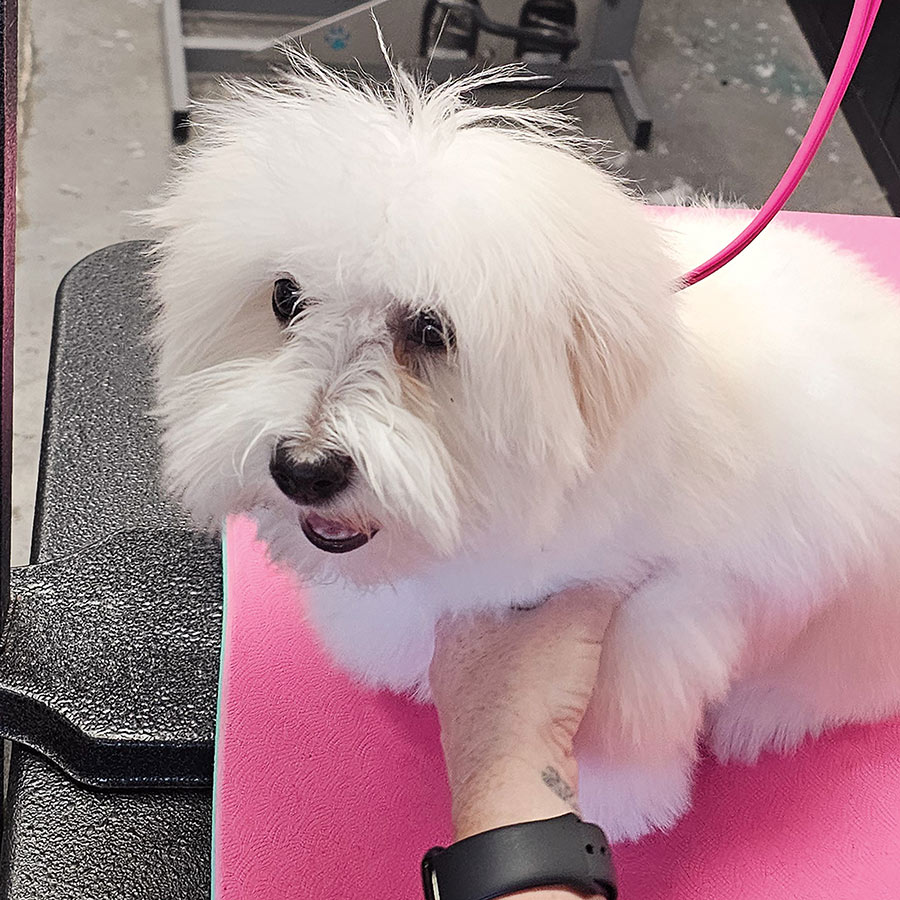
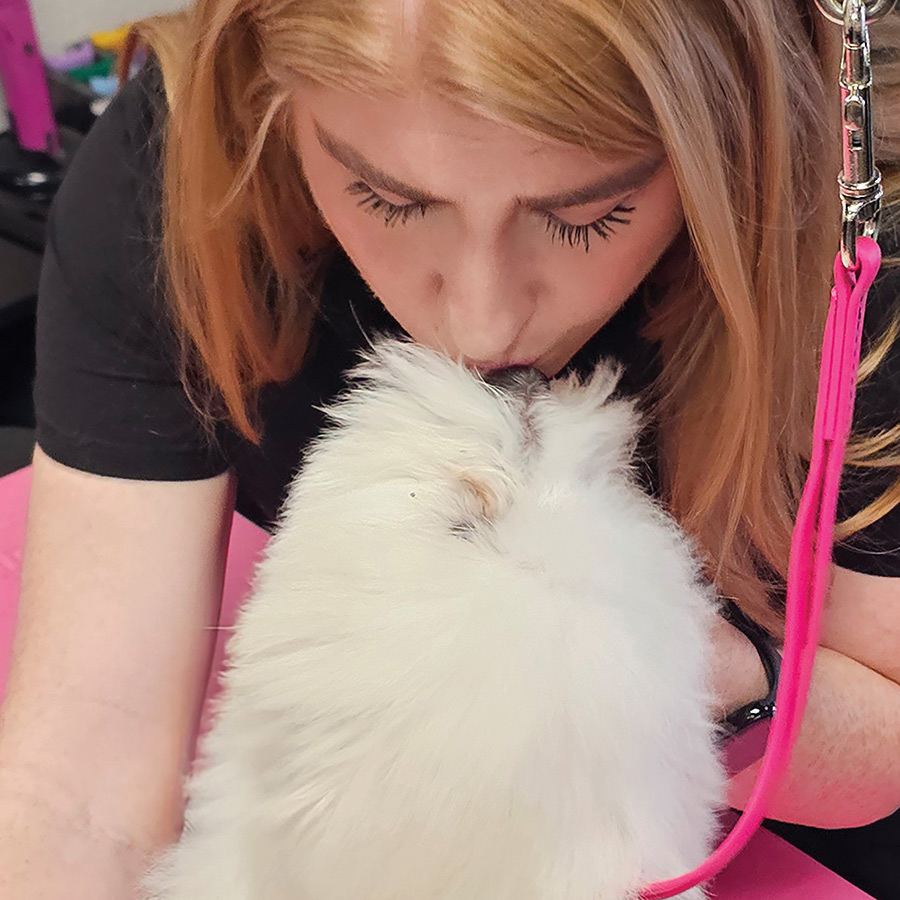
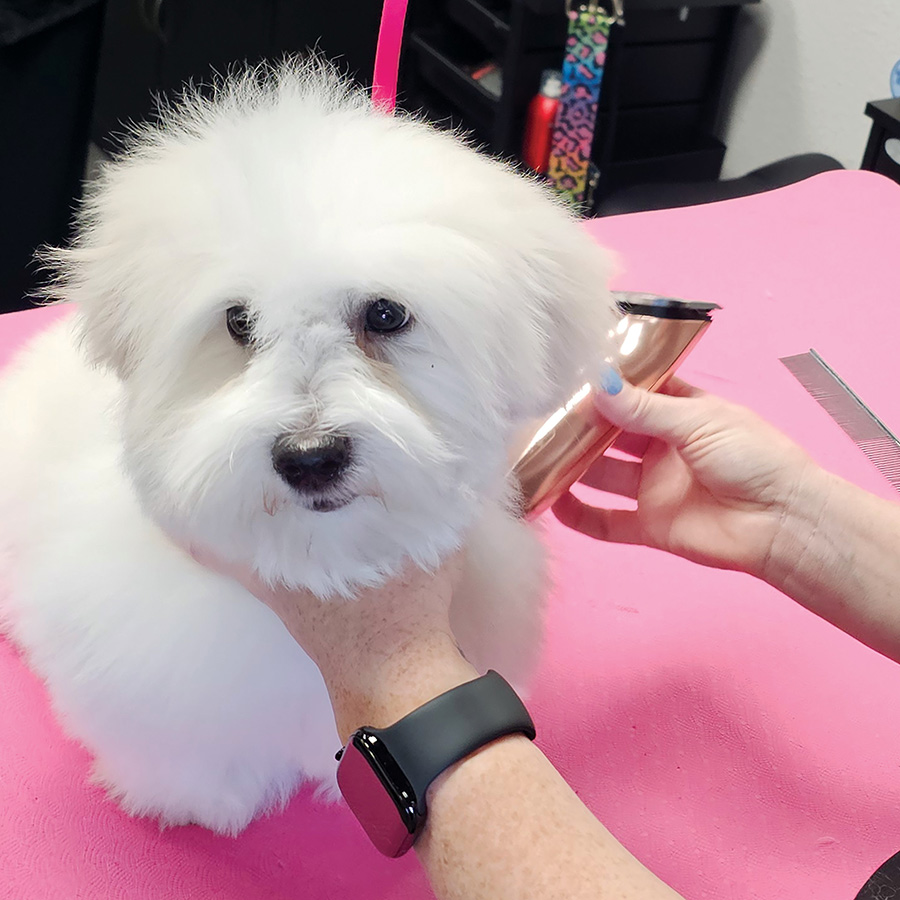
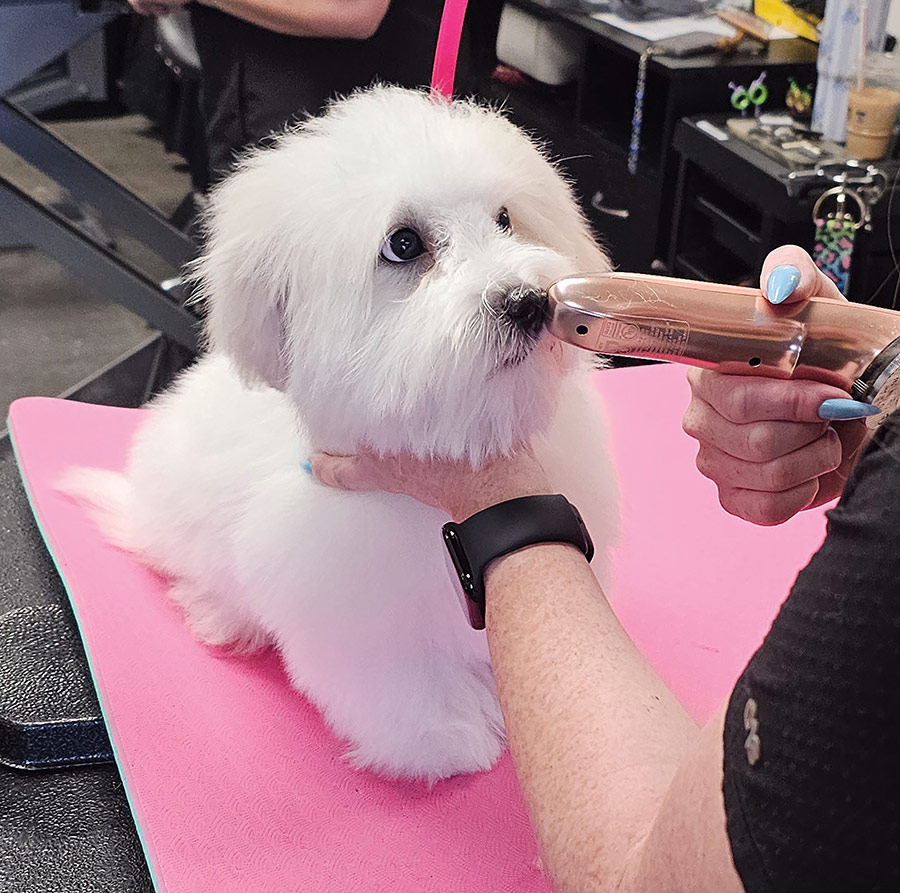
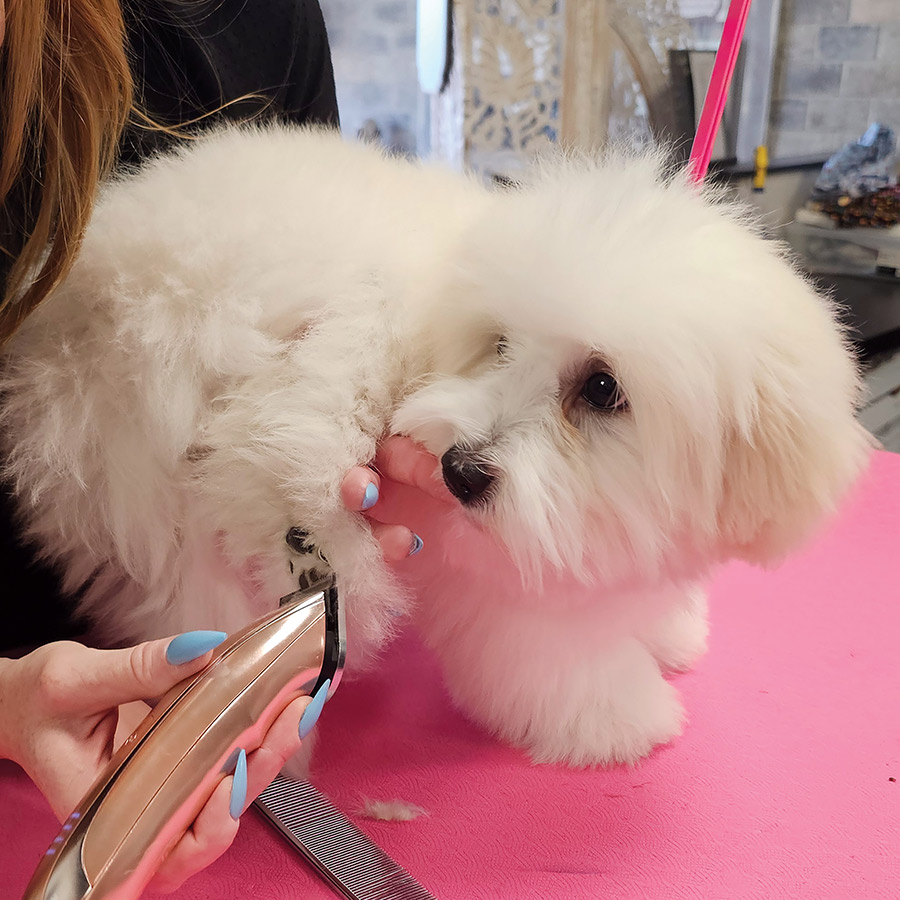
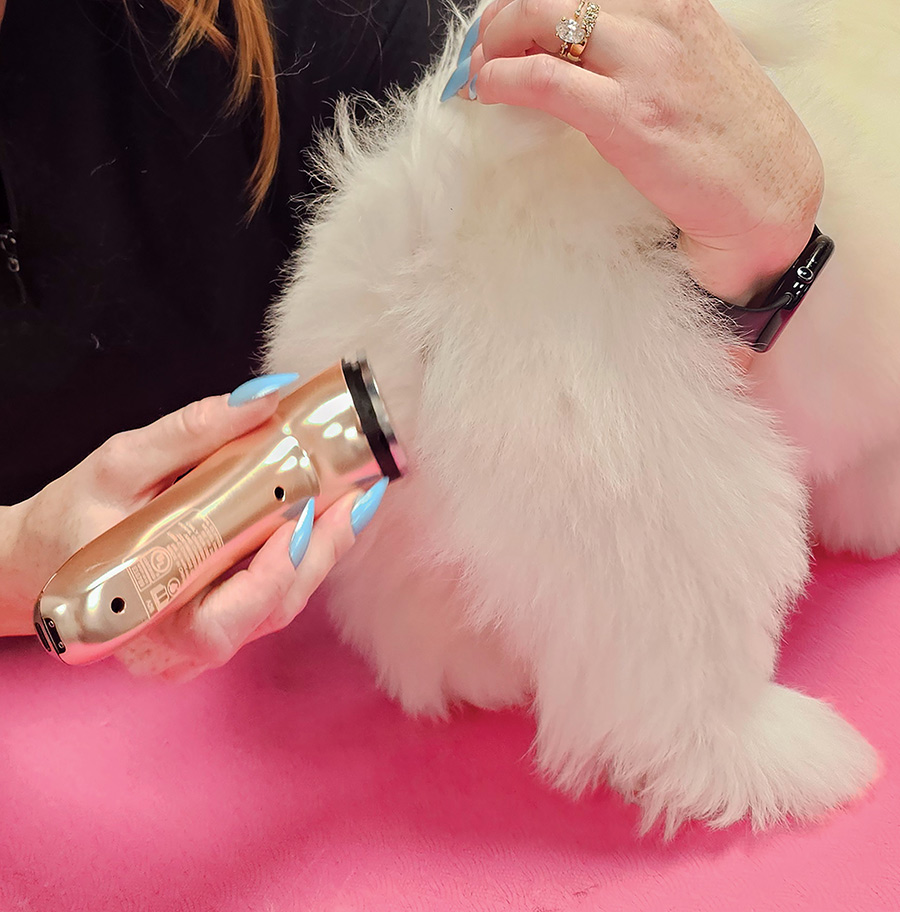
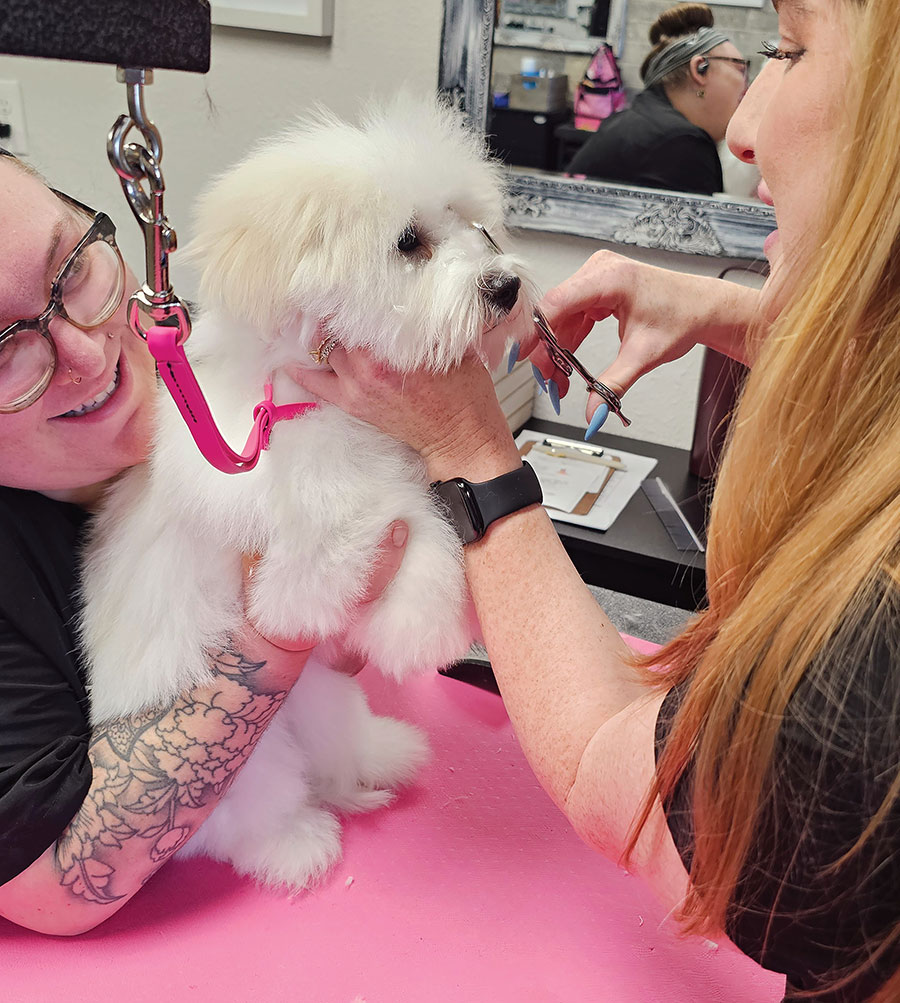
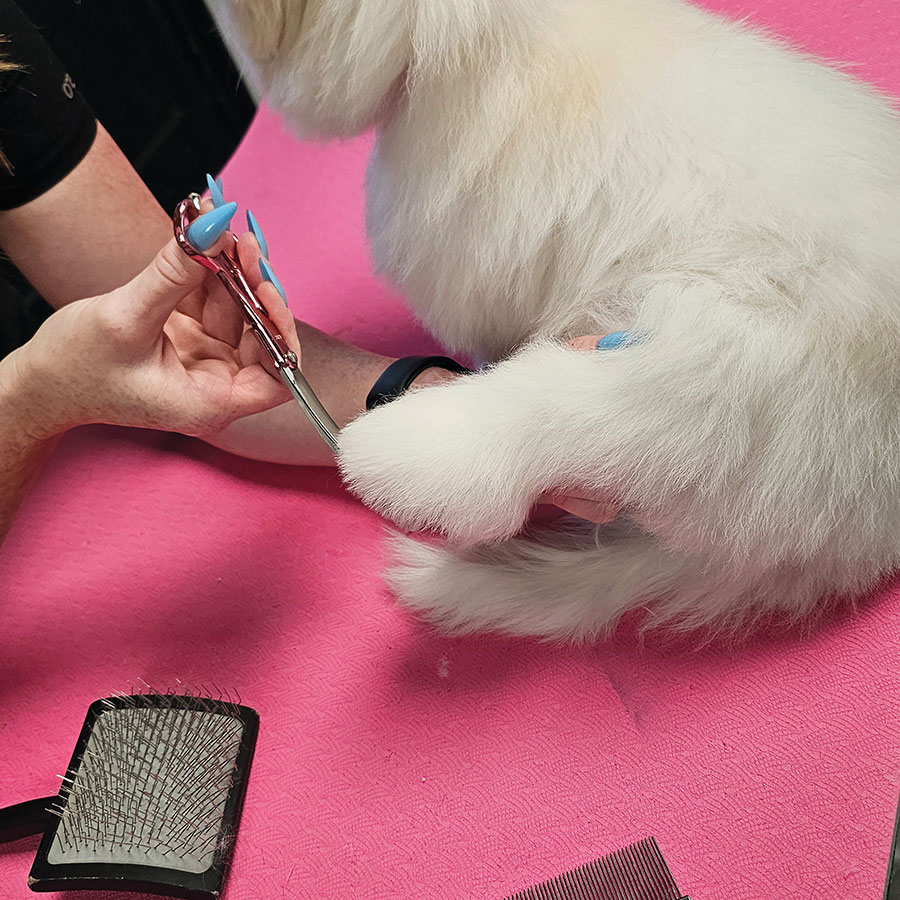
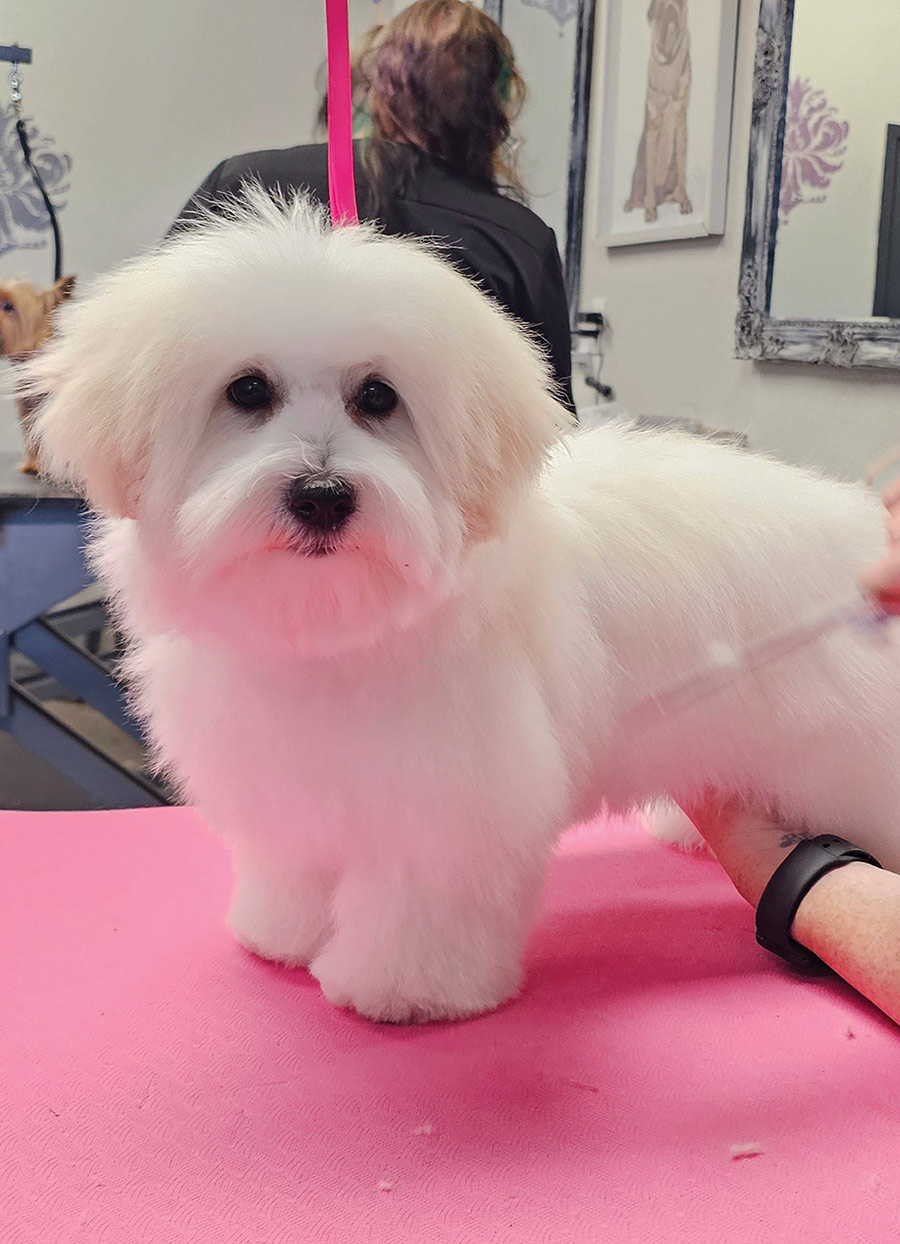
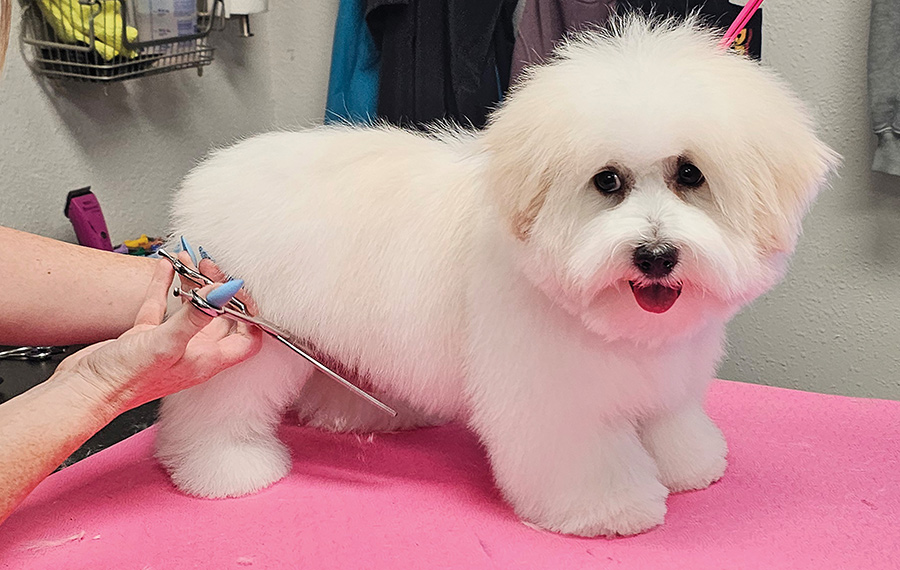
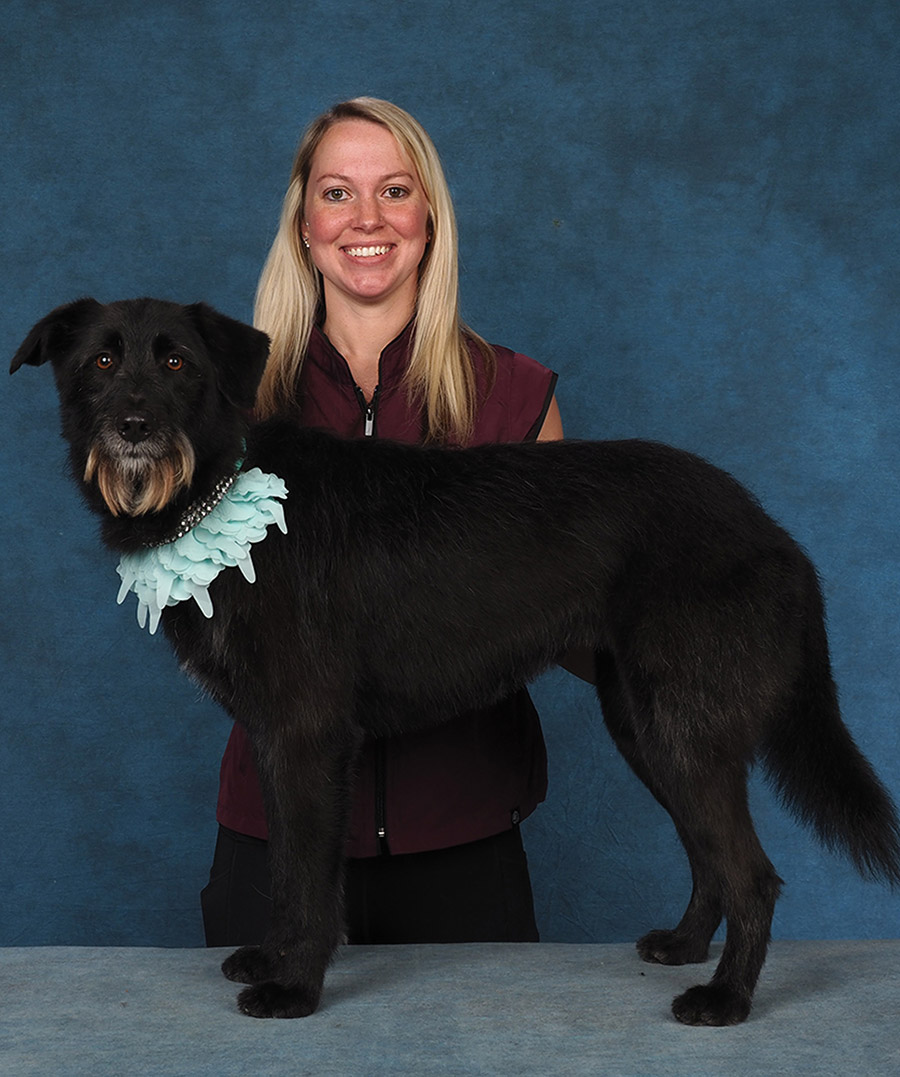
This puppy came in with the request of two inches all over, but the client was informed that today’s appointment would simply be to introduce the dog to everything so we can achieve that trim next time, if the behavior did not permit. Expectations are very important to control at this point in a puppy’s life. This one left clean, happy and freshly trimmed, and also set up for even more grooming success next time.

by Adriane Pope
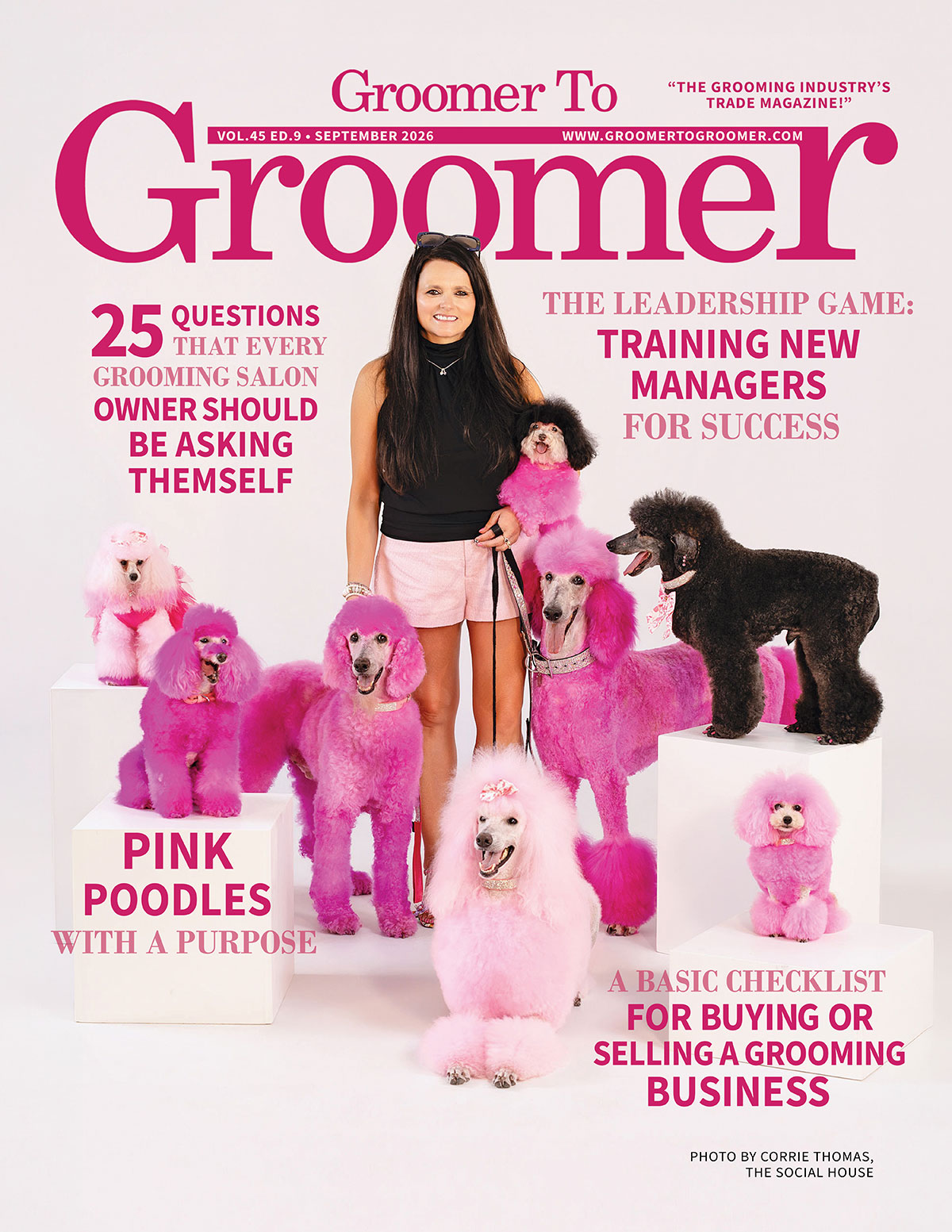
Photo by Corrie Thomas, The Social House
 his is 55 for me, and these eight poodles are part of my story.
It all started when I was 14 and working at a kennel. At 20, I graduated from grooming school, and that is when I fell in love with the industry. I saw Creative dogs and said to myself, “I will do this one day.”
In the 90s, I started competing with all breeds but gravitated toward poodles. I had many private lessons with top competitors, including Liz Paul. At that time, I could only compete a couple times a year but loved every minute of it.
I also stepped into the ring with my Creative design, and after competing for many years, I was ready to step it up. So, I went to learn from the best of the best in Creative, Angela Kumpe and Lori Craig. I pushed myself year after year to get better, which eventually lead to competing in Abstract Runway.
I was so fortunate to travel with my dogs all over the U.S. through competing, and was even featured on the CBS morning show. I also got picked to be in a documentary on Creative grooming, Well Groomed, which ended up at South by Southwest film festival and on HBO. My heart dog, Gucci, and I went to so many festivals that year and I loved every minute of it.
Then, when 2020 hit, things took a turn for the worst and I almost lost my life to COVID. But little did I know that 30 groomers from all over the U.S. showed up one weekend and groomed all of my clients for me. I still cry about it to this day, and I’m not sure if everybody will ever know how grateful and humbled I was that they did that for me.
When I tell you my pink poodles have a purpose, it’s true, because they are my story, and every poodle in this photo has a story. I truly love this industry and thank God every day for allowing me to do what I love, because life is short and you never know when it’s your time. So live life to its fullest and enjoy each day, take a trip, eat the cake, and buy a poodle.


Classified
Rates: 25 words or less, $50.00.
Each additional word, $2.00 each.
Classified ads must be prepaid.
Call for issue deadlines.
Agency discounts do not apply.